
Visual interpretation skills Worksheets for Ages 3-8
3 filtered results
Difficulty Level
Grade
Age
-
From - To
Subject
Activity
Standards
Nurture your child's cognitive development with our Visual Interpretation Skills Worksheets designed for ages 3-8. Our engaging activities help young learners improve their ability to analyze, interpret, and comprehend visual information. Tailored to enhance early learning, these worksheets feature a mix of colorful images, patterns, and puzzles that stimulate critical thinking and problem-solving abilities. Perfect for homeschooling or classroom use, each worksheet aligns with educational standards to ensure your child gains essential visual literacy skills while having fun. Spark curiosity and promote creativity with our diverse range of visual interpretation exercises.
Favorites
With answer key
Interactive
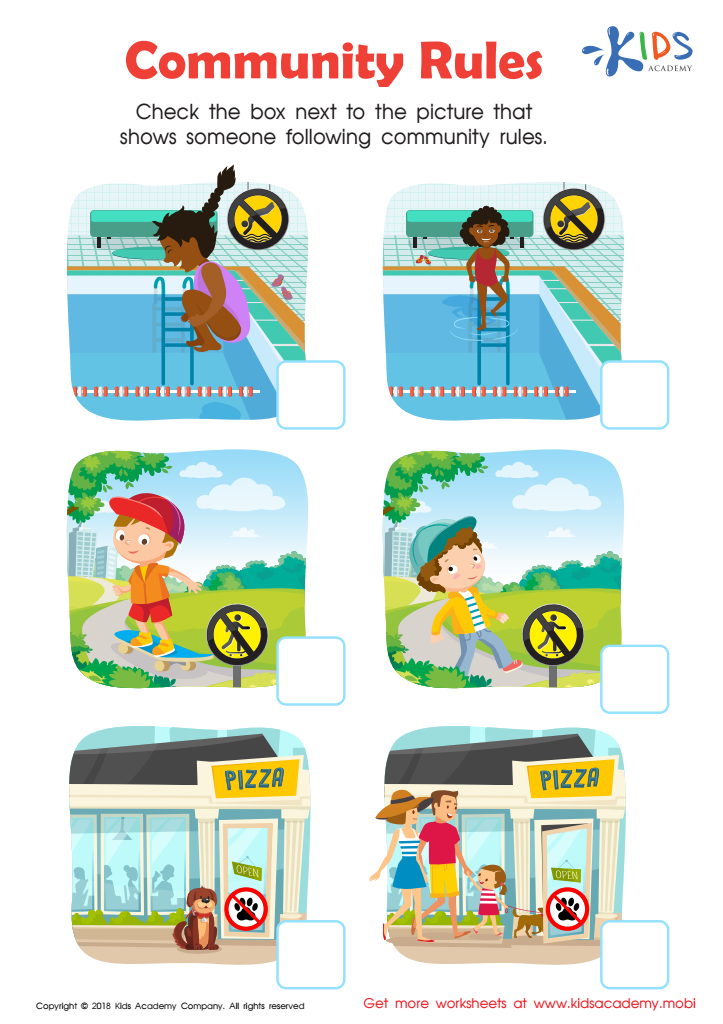
Community Rules Worksheet
Communities are where different people live, work and worship. They're made up of homes, schools, places of worship, businesses and other buildings. To create a healthy, functioning community, it's important for members to follow the rules and guidelines. Use this printout to teach kids about community rules. Ask them to check the box next to the picture that shows someone following them.
 Assign to My Students
Community Rules Worksheet
Worksheet
Join Kids Academy for Free
Who is primarily going to use this learning content?








Visual interpretation skills are vital for children aged 3-8 as they are foundational tools for learning and development. At this crucial stage, kids are naturally curious and continuously exploring the world. Visual interpretation allows them to make sense of what they see, enhancing their understanding of their surroundings.
Strong visual interpretation skills help children recognize and process visual information, which is essential for learning to read and write. These skills aid in identifying shapes, letters, and eventually, words and sentences, thereby building essential literacy skills. When reading, children don't just see letters but understand them as meaningful symbols, which is the crux of literacy.
Additionally, visual interpretation is linked to better comprehension in subjects like math. Recognizing patterns, shapes, and spatial relationships forms the basis of many mathematical concepts essential for early math skills. Outside academic skills, these abilities also enhance problem-solving, critical thinking, and creativity.
Apart from academics, strong visual interpretation skills help in remembering and following instructions. For instance, interpreting signs, symbols, and body language becomes more precise, fostering better communication and interaction with peers and adults. Ultimately, fostering these skills from an early age lays down a robust groundwork for a child's future learning and everyday life skills, making it a crucial focal point for parents and teachers.








