
Comprehension skills Addition & Subtraction Worksheets for Ages 3-8
3 filtered results
Difficulty Level
Grade
Age
-
From - To
Subject
Activity
Standards
Enhance your child's math journey with our Comprehension Skills Addition & Subtraction Worksheets specifically designed for ages 3-8. Our engaging, carefully crafted materials focus on developing young learners' understanding of fundamental math concepts through fun, interactive activities. These worksheets not only promote numerical proficiency, but also boost critical thinking and comprehension skills. Perfect for home or classroom use, they support a strong educational foundation by combining captivating visuals and practical exercises. Equip your child with the tools they need to succeed in their math adventures and beyond with our expert-crafted resources. Start your child’s math mastery today!
Favorites
With answer key
Interactive
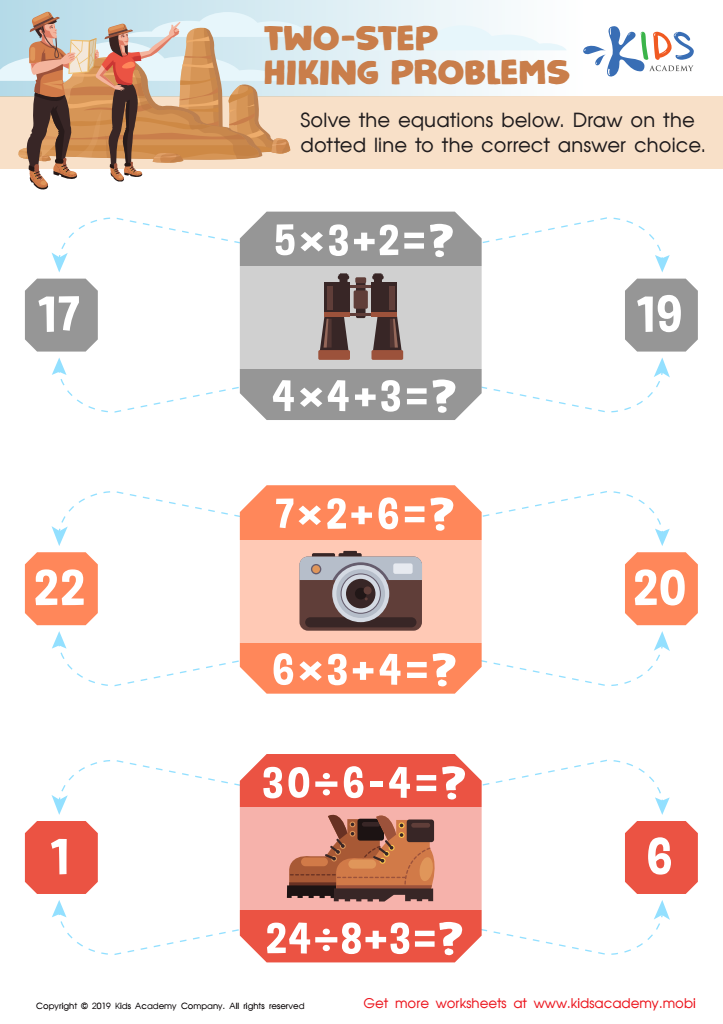
Two-Step Hiking Problems Worksheet
Help your kids ease into math with this worksheet. Solve the three basic equations, then draw on the dotted line to the correct answer. You can help your kids make their journey smoother by guiding them through it.
 Assign to My Students
Two-Step Hiking Problems Worksheet
Worksheet
Join Kids Academy for Free
Who is primarily going to use this learning content?








Comprehension skills in addition and subtraction for ages 3-8 are crucial as they lay the groundwork for mathematical understanding and critical thinking. At this early age, children are developing cognitive skills and basic number sense, which are essential for more complex math concepts later on. By ensuring that children grasp why and how addition and subtraction work, parents and teachers foster a deeper understanding rather than rote memorization of facts.
Understanding these fundamental operations aids in problem-solving, a skill necessary for both academic success and everyday life. For example, being able to comprehend and apply subtraction in real-life situations like figuring out change when buying something helps children make sense of the world around them. This boosts their confidence and independence.
Moreover, introducing these concepts early nurtures a positive attitude towards math. Engaging and supportive experiences with addition and subtraction can demystify math, making it less intimidating as children progress through school. Parents and teachers who prioritize comprehension ensure that children build a solid mathematical foundation, preparing them for future learning and fostering qualities like perseverance and curiosity.
In summary, focusing on comprehension skills in addition and subtraction for young children is integral to their broader educational development and daily life problem-solving abilities.








