Solve word problems Addition & Subtraction Worksheets for Ages 3-8
3 filtered results
-
From - To
Enhance your child's math skills with our "Solve Word Problems Addition & Subtraction Worksheets" designed for ages 3-8! These engaging worksheets encourage young learners to tackle real-life scenarios using addition and subtraction, promoting critical thinking and problem-solving abilities. From fun stories to relatable questions, each worksheet offers diverse challenges that make learning math enjoyable. Our resources are aligned with educational standards, ensuring children build a strong foundation in math while developing comprehension skills. Perfect for classroom use or at-home practice, these worksheets provide an interactive way for kids to connect math concepts with everyday life. Start your child's math journey today!
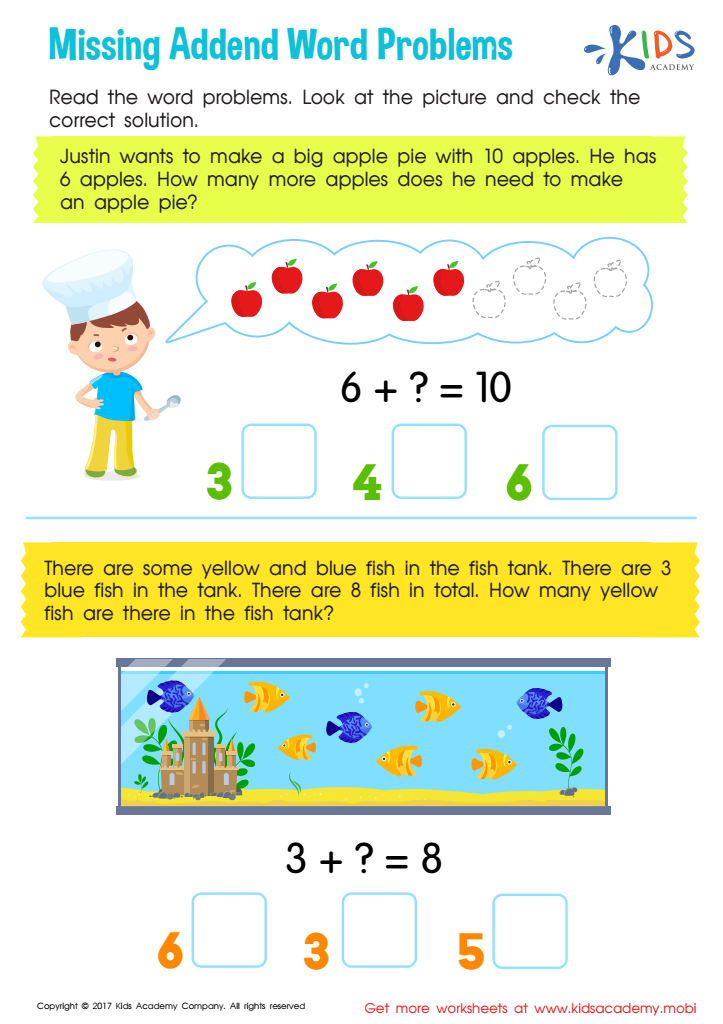
Missing Addend Word Problems Worksheet
 Assign to My Students








Parents and teachers should prioritize solving addition and subtraction word problems with children aged 3 to 8 because these skills are foundational for math literacy and critical thinking. Word problems foster problem-solving abilities by encouraging children to analyze situations, identify relevant information, and apply mathematical operations. This early exposure builds a strong mathematical understanding, enabling students to transition smoothly to more complex concepts in later grades.
Engaging in word problems also enhances language skills. As children learn to interpret questions and communicate their reasoning, they improve their vocabulary and comprehension. This dual focus on math and language equips them with essential skills for both school and everyday life.
Moreover, word problems often reflect real-world scenarios, making math relatable and engaging. Children see the relevance of math in daily activities, from sharing snacks to solving dilemmas at playtime. This connection cultivates a positive attitude towards math, reducing anxiety and fostering a growth mindset.
By working together on word problems, parents and teachers play a vital role in nurturing a child’s confidence in math while reinforcing collaborative learning strategies. Active participation in this aspect of learning also strengthens the parent-child or teacher-student bond, promoting a supportive educational environment.








