Understanding base ten Numbers Worksheets for Ages 3-8
3 filtered results
-
From - To
Discover our engaging Understanding Base Ten Numbers Worksheets, designed for children ages 3-8! These worksheets provide a fun and interactive way for young learners to grasp the concept of place value and the base ten system. Through a variety of age-appropriate activities, kids can practice counting, identifying quantities, and mastering addition and subtraction using base ten blocks. Our resources support early math skills development, ensuring kids build a solid foundation for future mathematical understanding. With vibrant illustrations and user-friendly designs, these worksheets make learning exciting and effective. Start your child's journey into the world of numbers today and enhance their math confidence!
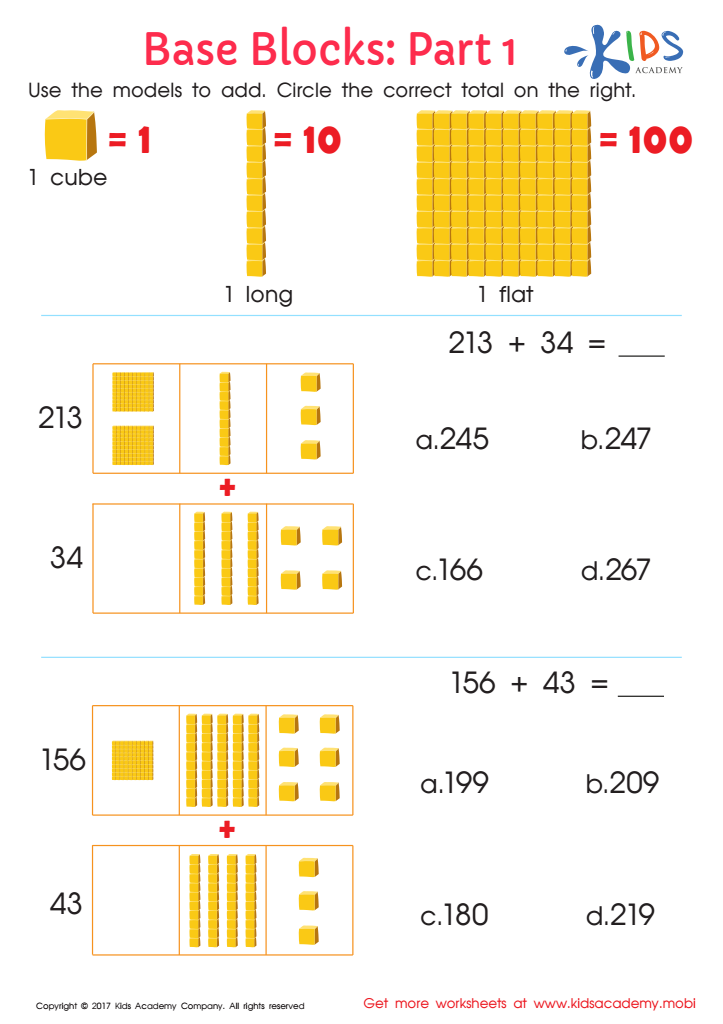
Base Ten Blocks Worksheet: Part 1
 Assign to My Students
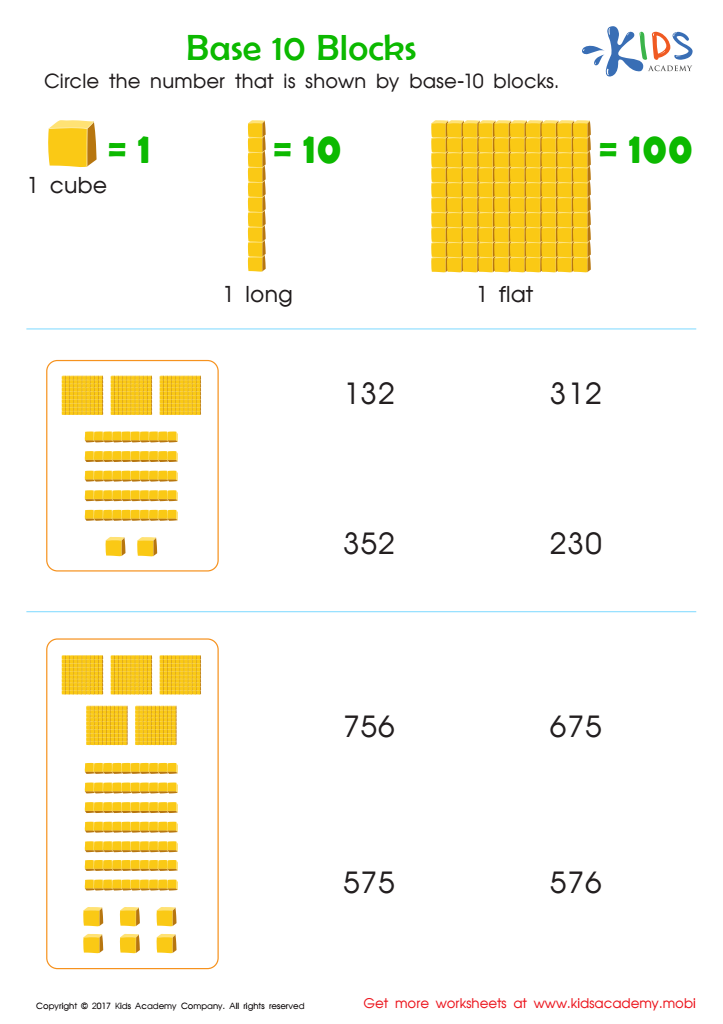
Base Ten Blocks Worksheet
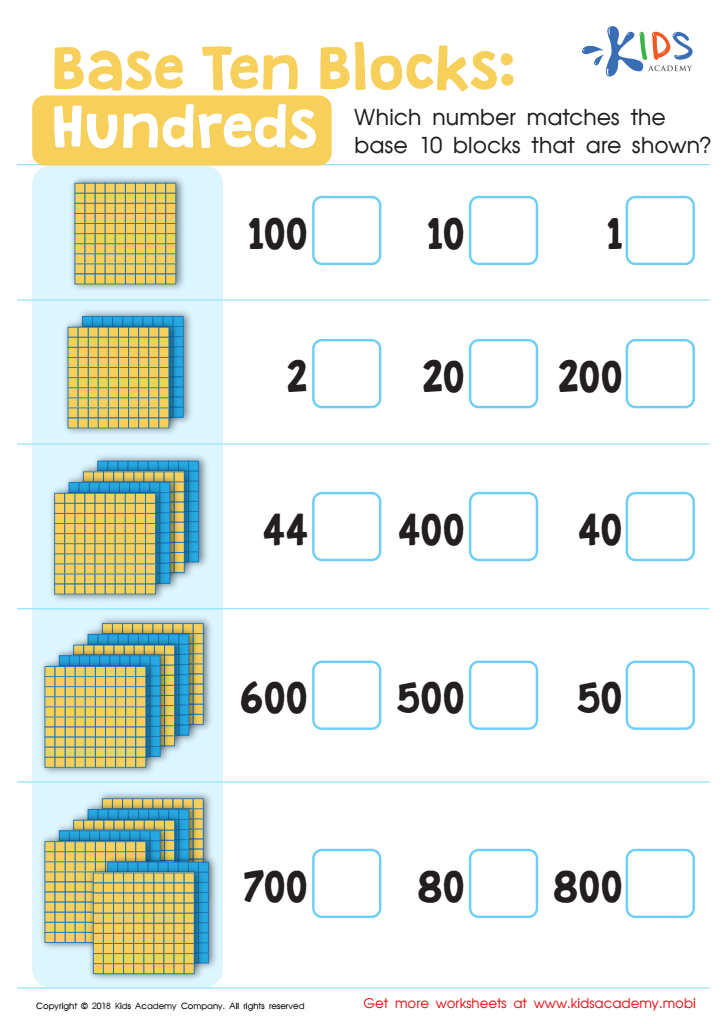
Base Ten Blocks: Hundreds Worksheet







Understanding base ten numbers is crucial for children aged 3 to 8 because it lays the foundation for their mathematical proficiency. At this critical developmental stage, children's cognitive skills are rapidly evolving, and grasping the concept of place value helps them comprehend how our number system operates. This understanding is essential as it allows children to distinguish between different quantities and perform operations like addition and subtraction.
When children understand base ten, they learn to group numbers into tens and ones, an insight that simplifies calculations and improves number recognition. For parents and teachers, fostering this understanding equips children with the skills necessary to tackle more complex mathematical concepts in later grades, such as multiplication and division, and ultimately enhances their problem-solving abilities.
Moreover, a solid grasp of base ten numbers boosts children's confidence in mathematics. It encourages a positive attitude towards learning and promotes perseverance in tackling challenging tasks. Supporting children in this foundational skill can mitigate math anxiety, paving the way for a lifetime of mathematical success. Therefore, parents and teachers should prioritize teaching base ten concepts to cultivate a strong mathematical foundation in young learners, fostering both academic competence and confidence.








