
Basic arithmetic understanding Math Worksheets for Ages 3-8
7 filtered results
Difficulty Level
Grade
Age
-
From - To
Subject
Activity
Standards
Welcome to our "Basic Arithmetic Understanding Math Worksheets" page, designed for children ages 3-8! Our engaging and colorful worksheets provide a fun and interactive way for young learners to master essential arithmetic skills. From counting and simple addition to basic subtraction, these worksheets will help children build a strong mathematical foundation. Each activity is created to align with early learning standards, promoting both skill development and confidence in math. Parents and educators can easily download and print these resources, making both homeschooling and classroom learning enjoyable and effective. Explore our collection today and watch your child's math skills flourish!
Favorites
With answer key
Interactive
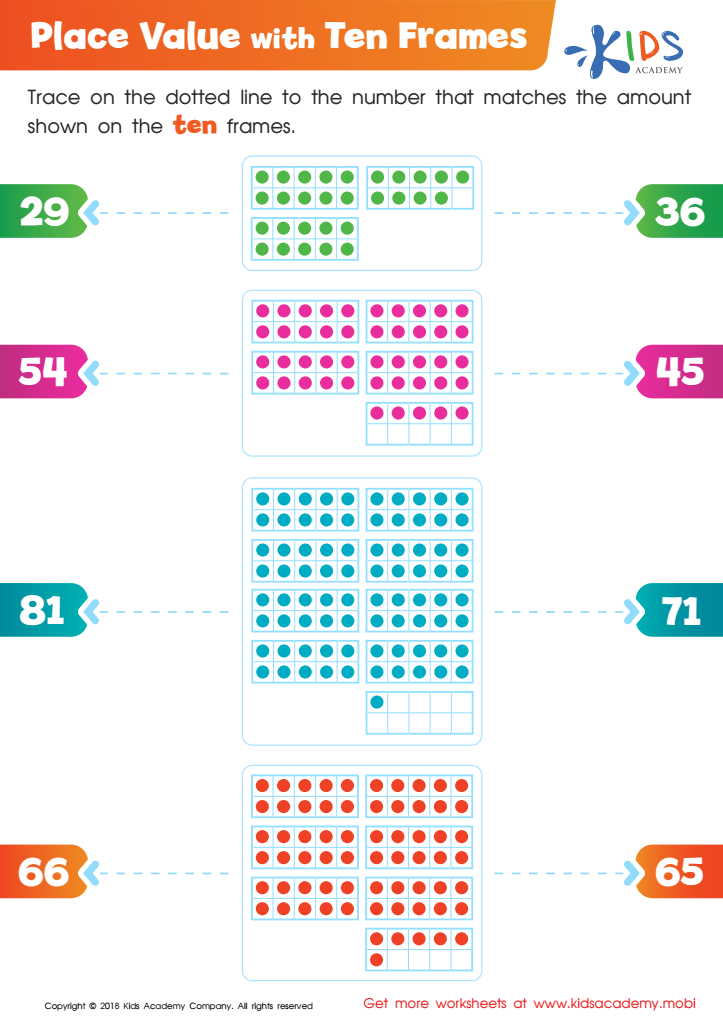
Place Values with Ten Frames Worksheet
Assist your child in counting the dots in each of the framed numbers. Then, guide them as they trace the dotted lines to the number that matches the amount shown. This worksheet will help them learn more about mathematics, as well as how to count numbers.
 Assign to My Students
Place Values with Ten Frames Worksheet
Worksheet
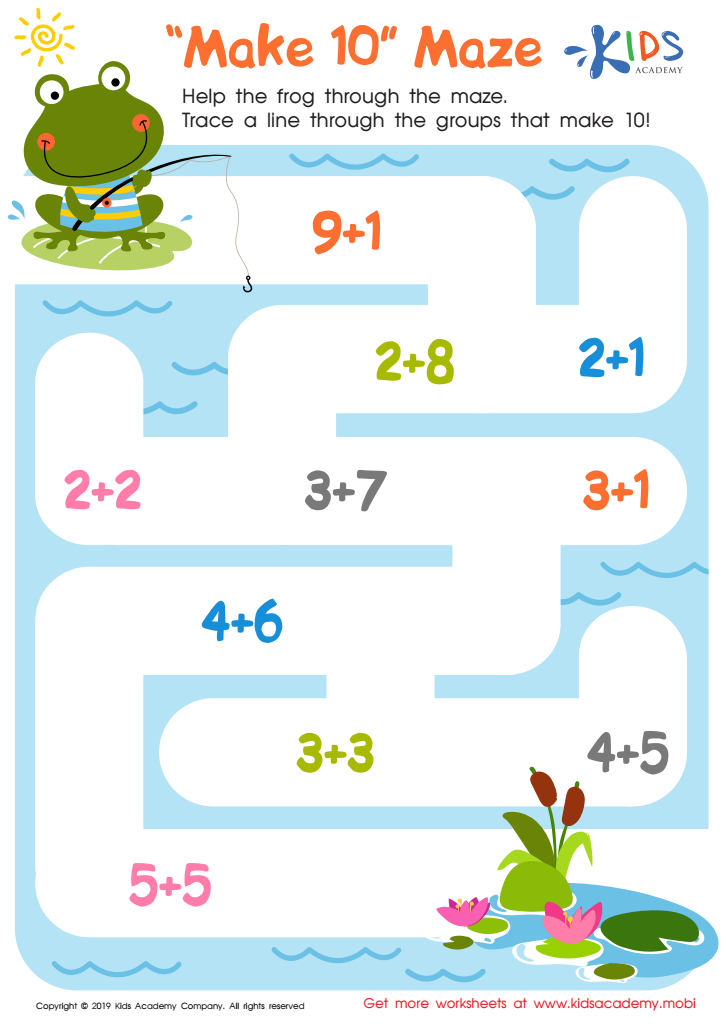
Make 10 Maze Worksheet
Help your child's frog friend make its way out of the maze! Mazes are an enjoyable way to get your kids to learn and can be a challenge. Have your kids take a look at this tracing sheet and help the frog make its way through the maze by tracing a line through the groups of equations that make 10. It’ll be a fun time for everyone!
Make 10 Maze Worksheet
Worksheet
Join Kids Academy for Free
Who is primarily going to use this learning content?



.jpg)



Understanding basic arithmetic is crucial for children aged 3-8 as it lays the foundation for their future mathematics learning and overall cognitive development. During these formative years, children develop essential skills that enhance their problem-solving abilities and critical thinking. Basic arithmetic, including addition and subtraction, helps children make sense of the world around them. By learning these concepts, they are able to quantify their experiences—such as counting toys, sharing snacks, or understanding time.
Moreover, arithmetic fosters logical reasoning and boosts confidence in young learners. It introduces patterns and relationships, providing a framework for their mathematical growth. Early engagement with math concepts cultivates a positive attitude towards learning, which is vital for academic success. Teachers and parents can support this by integrating arithmetic into everyday activities, creating a playful learning environment that reinforces these concepts in context.
Strong arithmetic skills also correlate with better performance in later, more complex mathematics, leading to academic success across subjects. By investing time and resources into enhancing children’s arithmetic understanding, adults play an essential role in shaping their cognitive, emotional, and social development, ensuring they are well-prepared for the challenges of higher education and beyond.








