
Understanding number bonds Math Worksheets for Ages 3-8
3 filtered results
Difficulty Level
Grade
Age
-
From - To
Subject
Activity
Standards
Discover our engaging "Understanding Number Bonds" math worksheets, specially designed for children ages 3-8. These worksheets offer fun and interactive activities that help young learners grasp the concept of number bonds, enhancing their early math skills. Through playful exercises, kids will explore addition and subtraction relationships, fostering a solid foundation for future mathematical understanding. Our resources include colorful visuals and real-world examples, making learning enjoyable and effective. Ideal for classroom use or at-home practice, these worksheets encourage critical thinking and problem-solving abilities. Start your child's mathematical journey today and watch them thrive with confidence in their math skills!
Favorites
With answer key
Interactive
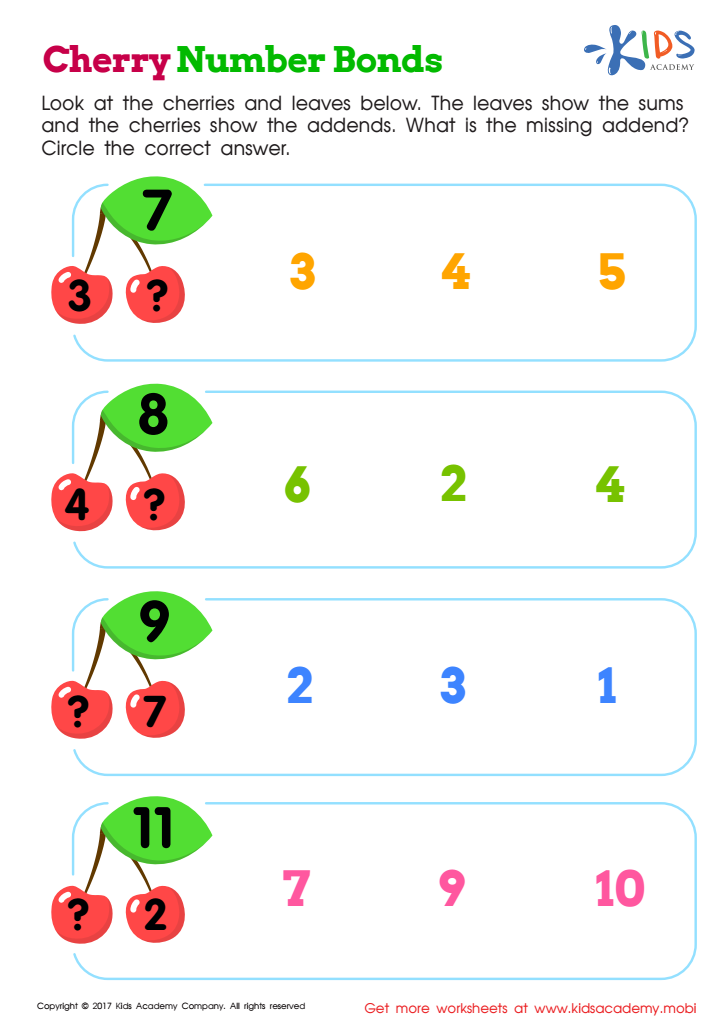
Cherry Number Bonds Worksheet
Help your child figure out which number on the right side is missing from the equation. Look at the worksheet together and you'll see that the numbers on the leaves are the sum of the numbers on the cherries.
 Assign to My Students
Cherry Number Bonds Worksheet
Worksheet
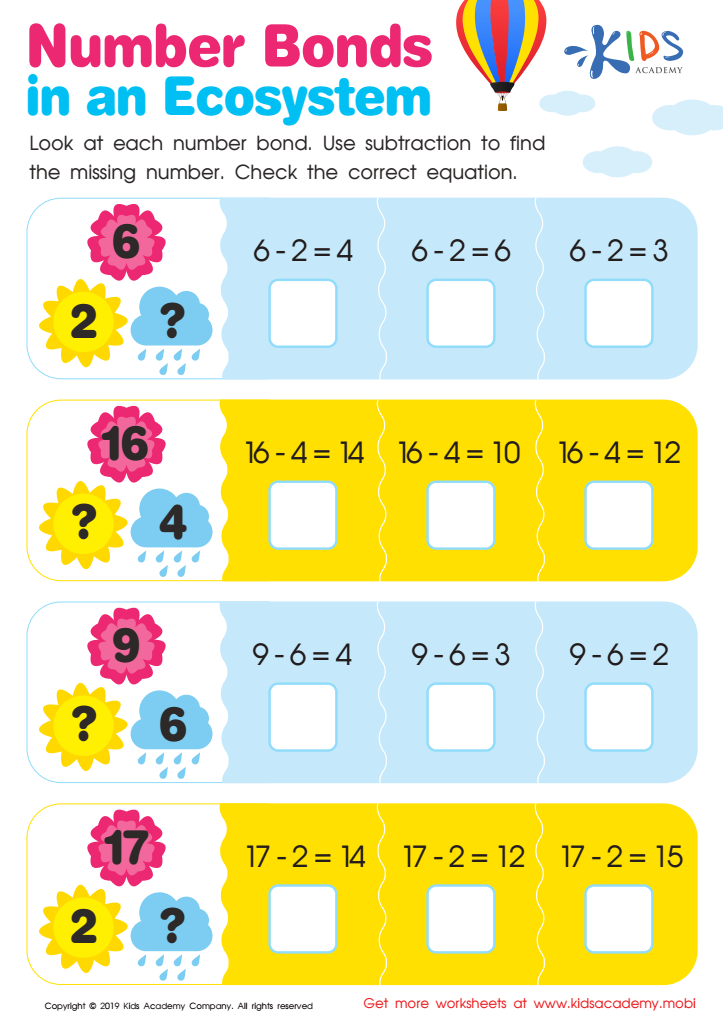
Number Bonds in an Ecosystem Worksheet
This worksheet is a great tool to help your kids sharpen their maths skills. Use the colourful images to teach them how to subtract the missing numbers and check the equation. Show them the four different images and let them try solving each number bond. With your guidance, they'll be able to hone their maths skills in no time!
Number Bonds in an Ecosystem Worksheet
Worksheet
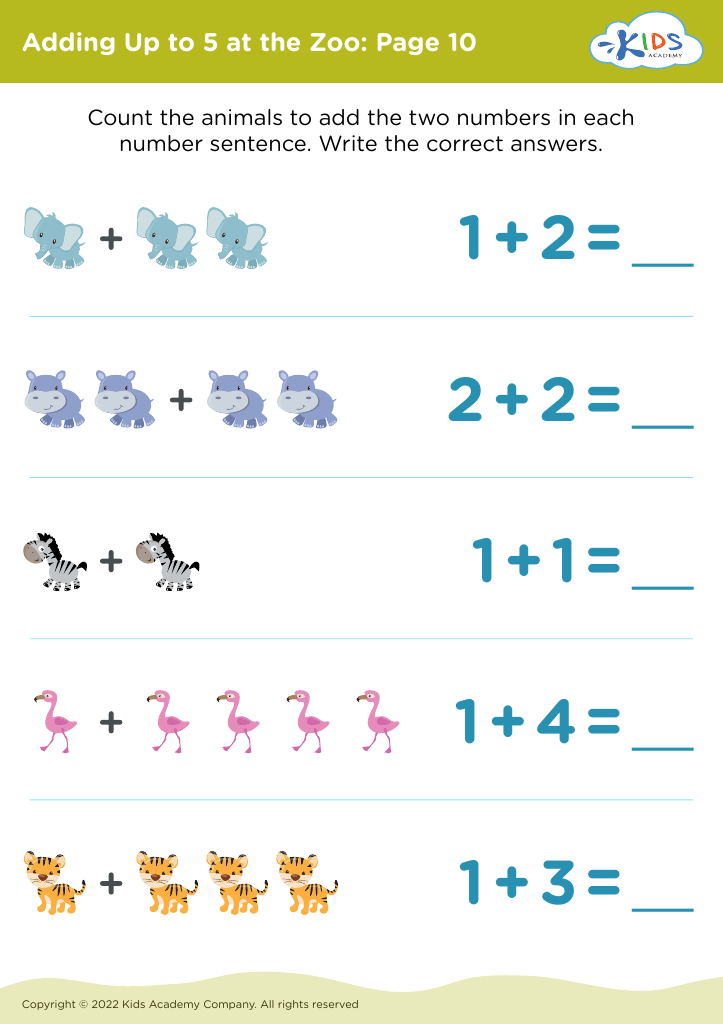
Join Kids Academy for Free
Who is primarily going to use this learning content?



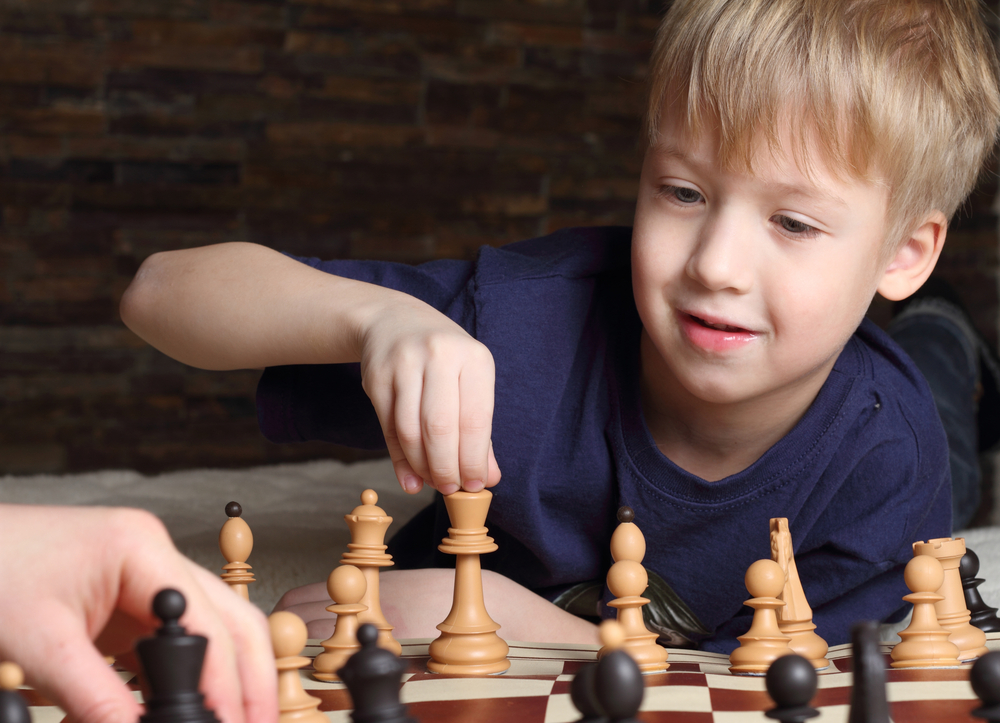

Understanding number bonds is crucial for young children aged 3-8, as it lays the foundational skills for future math learning. Number bonds refer to the relationships between numbers, specifically how they combine and separate to create sums. For example, the number bond of 5 comprises 2 and 3, showcasing how different pairs can come together to form a total.
Parents and teachers should prioritize this understanding because it fosters number sense, enhances children's problem-solving abilities, and encourages mental math. When children grasp number bonds, they develop a deeper comprehension of addition and subtraction, which is critical for more advanced arithmetic skills later on.
Moreover, number bonds can make math more engaging and relatable. By using practical examples, like grouping objects or playing with toys, educators can create a fun learning environment where young learners explore numerical relationships.
This early mathematical knowledge is essential not only for academic success but also for building confidence in children as they navigate more complex math concepts in later grades. An emphasis on number bonds can ultimately cultivate a positive attitude toward math, promoting lifelong learning and curiosity.








