
Understanding ordinal numbers Math Worksheets for Ages 3-8
3 filtered results
Difficulty Level
Grade
Age
-
From - To
Subject
Activity
Standards
Unlock the world of numbers with our "Understanding Ordinal Numbers" math worksheets, designed specifically for children ages 3-8. These engaging, printable worksheets explore the concept of order and ranking, helping young learners grasp the significance of ordinal numbers—from first to tenth and beyond. Ideal for preschool to grade 2, our fun activities and vibrant illustrations make mastering early math skills an exciting adventure. Support your child’s education journey by fostering numerical fluency and boosting confidence through hands-on practice. Start today with Kids Academy to enhance your child's understanding of ordinal numbers in an enjoyable and effective way!
Favorites
With answer key
Interactive
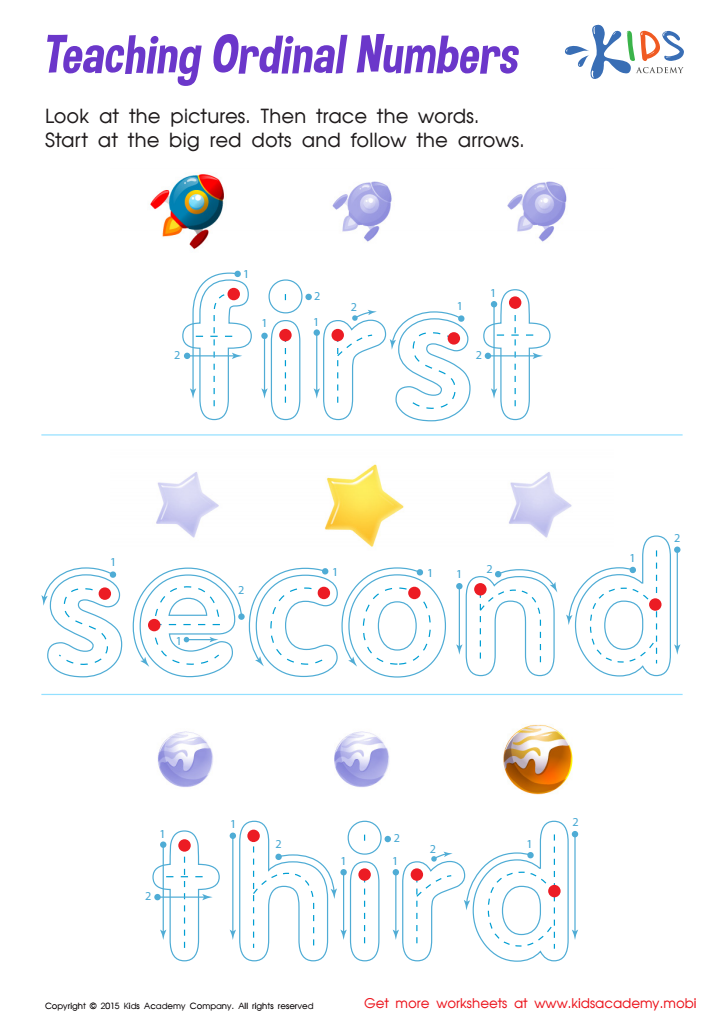
Ordinal Numbers: Teaching Ordinal Numbers Printable
Practice makes perfect!
Kids need to understand ordinal numbers - placement, recognition and spelling. Our worksheet helps kids make connections between the placement and spelling of ordinal numbers. Practice will help your little one perfect this vital number concept.
 Assign to My Students
Ordinal Numbers: Teaching Ordinal Numbers Printable
Worksheet
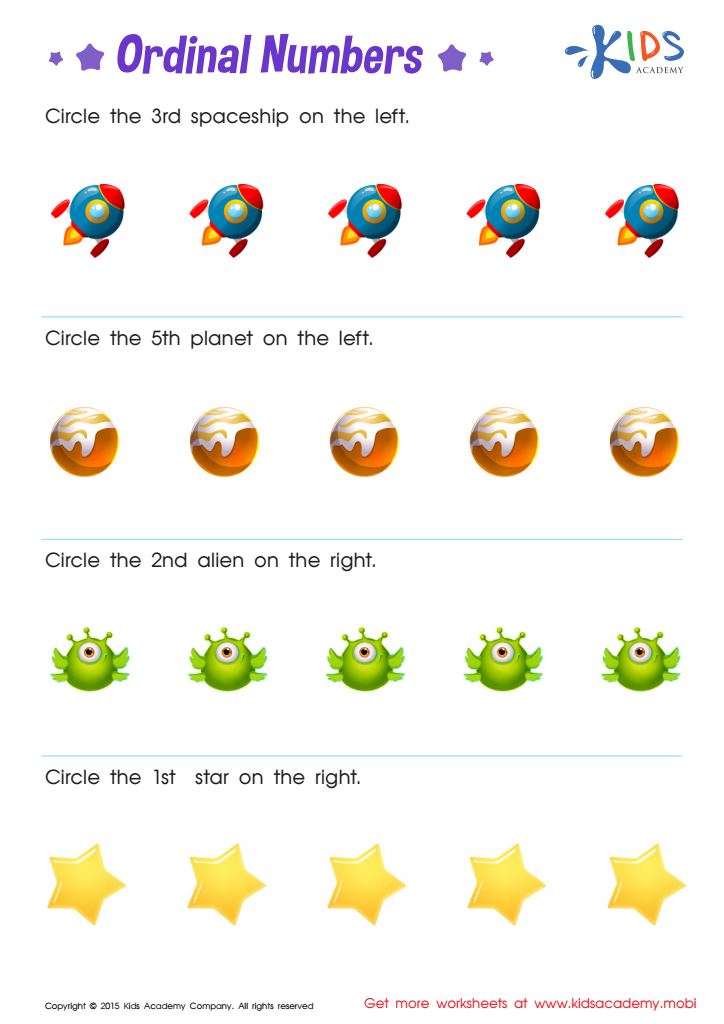
Ordinal Numbers: Space Ordinals Worksheet
Practicing with ordinal numbers worksheet PDFs helps kids master crucial concepts for higher-level math. Plus, when kids have fun learning, the knowledge sticks! So, have your child “blast off” with this space-themed worksheet to read directions, practice relative directions, and learn ordinal numbers.
Ordinal Numbers: Space Ordinals Worksheet
Worksheet
Join Kids Academy for Free
Who is primarily going to use this learning content?








Understanding ordinal numbers, such as first, second, and third, is crucial for young children's cognitive and academic development. For ages 3-8, integrating ordinal numbers into learning enhances their grasp of sequence and order, which are foundational concepts in mathematics and everyday life. This comprehension fosters skills such as ranking, organization, and logical reasoning.
Parents and teachers have a significant role in nurturing these skills early on. When children understand ordinal numbers, they begin to make sense of patterns and structures in their environment. For instance, navigating daily routines, following steps in a process, and understanding their position in a line are all real-life applications of ordinal numbers.
In a classroom setting, recognizing sequences according to ordinal numbers is foundational for more advanced math topics, such as number lines, charts, and data interpretation. For instance, understanding which contestant came first in a race, interpreting story sequences, or organizing objects based on specified criteria, all intertwine ordinal knowledge.
Furthermore, mastering ordinal numbers can boost a child's confidence in their ability to learn more complex concepts. Parents and teachers who prioritize this development help children build a strong mathematical foundation, which directly influences later success in school and in problem-solving scenarios encountered in everyday life. This early grasp of ordinal concepts is not just about numbers; it’s about creating a structured framework that supports holistic cognitive development.








