Visual fraction representation Math Worksheets for Ages 3-8
3 filtered results
-
From - To
Discover engaging Visual Fraction Representation Math Worksheets tailored for kids aged 3-8 at Kids Academy! Foster early math skills through colorful and captivating exercises designed to make learning fractions fun and intuitive. Our worksheets focus on helping young learners visualize fractions by shading parts of shapes, comparing sizes, and solving simple fraction problems. Perfect for classroom use or at-home practice, these resources support foundational math concepts and promote critical thinking. Give your child a head start in math with our expertly crafted and age-appropriate fraction worksheets. Visit Kids Academy for special learning tools that inspire confidence and curiosity in young mathematicians.
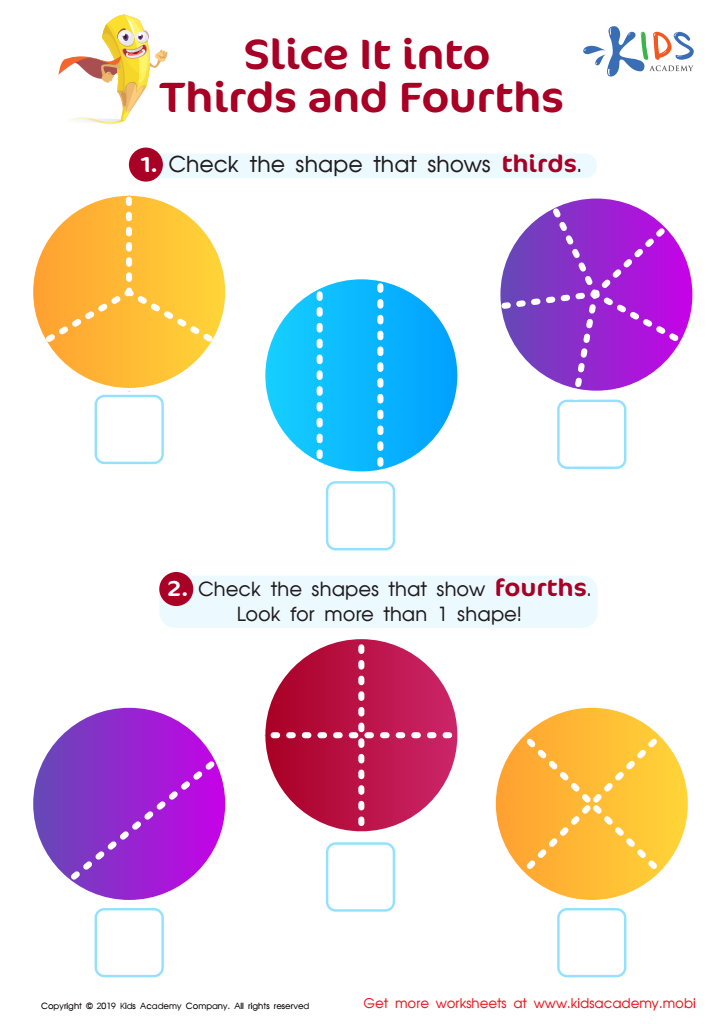
Slice in Thirds Fourths Worksheet
 Assign to My Students
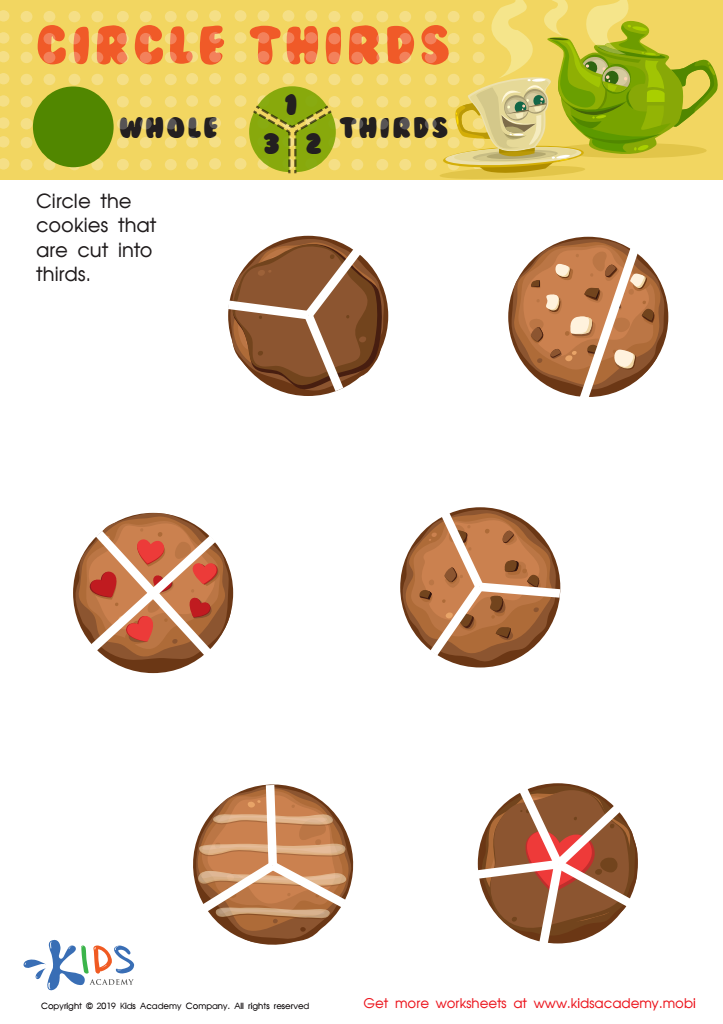
Circle Thirds Worksheet








Visual fraction representation in math is crucial for young learners, especially those aged 3-8. At this early developmental stage, children are naturally inclined toward visual learning. By leveraging visual fraction representations, such as pie charts or fraction bars, parents and teachers can make abstract mathematical concepts more tangible and understandable.
Young children often struggle with the idea of fractions because it involves splitting a whole into parts, which is less intuitive than simple counting or addition. Visual aids can bridge this gap by concretely showing how fractions work. When kids see that 1/2 of a pie and 2/4 of the same pie are equivalent, the concept becomes clearer and more graspable. This visual approach not only enhances understanding but also makes learning more engaging and enjoyable.
Moreover, early exposure to fraction representations can foster a growth mindset toward math. Positive early experiences with challenging concepts can build a child’s confidence and interest in the subject, laying a solid foundation for future learning. As fractions are fundamental to advanced mathematics and various real-life scenarios, mastering them early on can contribute to long-term academic success.
In essence, caring about visual fraction representation for young children is an investment in their mathematical literacy, cognitive development, and overall confidence, setting the stage for a lifetime of successful learning.








