
Developing arithmetic skills Worksheets for Ages 3-9
3 filtered results
Difficulty Level
Grade
Age
-
From - To
Subject
Activity
Standards
Unlock your child's mathematical potential with our Developing Arithmetic Skills Worksheets for Ages 3-9! Tailored for young learners, these worksheets introduce essential concepts such as addition, subtraction, and number recognition in a fun and engaging manner. Our comprehensive resources feature vibrant visuals and age-appropriate activities that make learning math enjoyable. Whether at home or in the classroom, these printable activities support skill mastery while promoting critical thinking and problem-solving. Perfect for reinforcing topics taught in school or supplementing homeschooling, watch as your child's confidence and arithmetic abilities flourish. Start your mathematical journey today with our exciting and effective worksheets!
Favorites
With answer key
Interactive
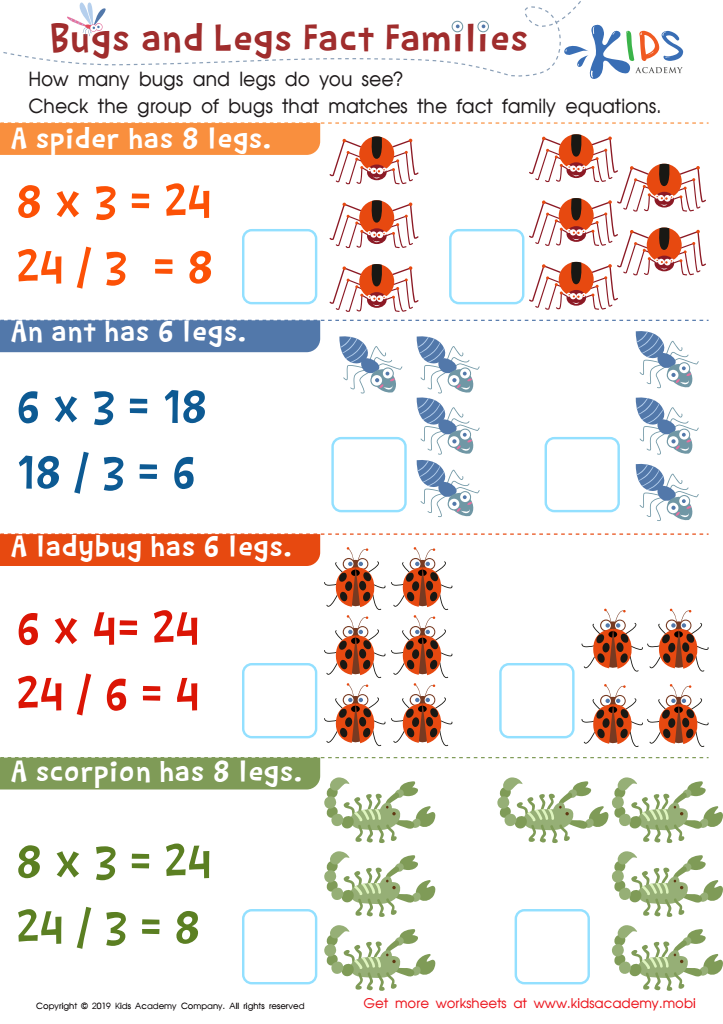
Bugs and Legs Fact Families Worksheet
This free worksheet uses bugs and insects to help young math students learn about fact families and recognize patterns in multiplication and division. It's a fun and colorful way to gain automaticity and efficiency in computation skills, without even realizing it's math!
 Assign to My Students
Bugs and Legs Fact Families Worksheet
Worksheet
Join Kids Academy for Free
Who is primarily going to use this learning content?



.jpg)

.jpg)


Developing arithmetic skills in children aged 3-9 is crucial for their overall cognitive and social development. Early math skills form the foundation for later learning experiences in mathematics, which is essential for academic success and everyday problem-solving. Arithmetic skills enable children to understand quantities, patterns, and relationships, fostering critical thinking and analytical abilities that are vital in various real-life situations.
At this young age, children's brains are highly malleable, making it an optimal time for them to absorb new concepts. Engaging activities, such as counting objects, simple addition or subtraction games, and using patterns in play, can create a strong mathematical foundation. These experiences not only cultivate arithmetic skills but also enhance language development and enhance fine motor skills through interactive play.
Furthermore, early mastery of basic arithmetic can boost children's confidence in their abilities, encouraging a positive attitude toward math as they progress in school. When parents and educators prioritize these skills, they equip children with the necessary tools to navigate future mathematical challenges and larger educational choices. Ultimately, investing time in developing arithmetic skills early can lead to better academic outcomes and a lifelong appreciation for mathematics.








