Understand number relationships Worksheets for Ages 3-9
5 filtered results
-
From - To
Explore our "Understand Number Relationships Worksheets" designed for children aged 3-9! These engaging resources help young learners grasp the essential concepts of number relationships, enhancing their math skills through fun activities. Our worksheets efficiently cover topics like counting, comparison, and addition/subtraction, making foundational math enjoyable and interactive. Each worksheet is crafted to cater to various learning styles, ensuring every child can excel. Parents and educators can track progress and promote critical thinking while building a strong number sense. Empower your child's mathematical journey with our user-friendly, printable worksheets, and watch their confidence soar as they master number relationships!
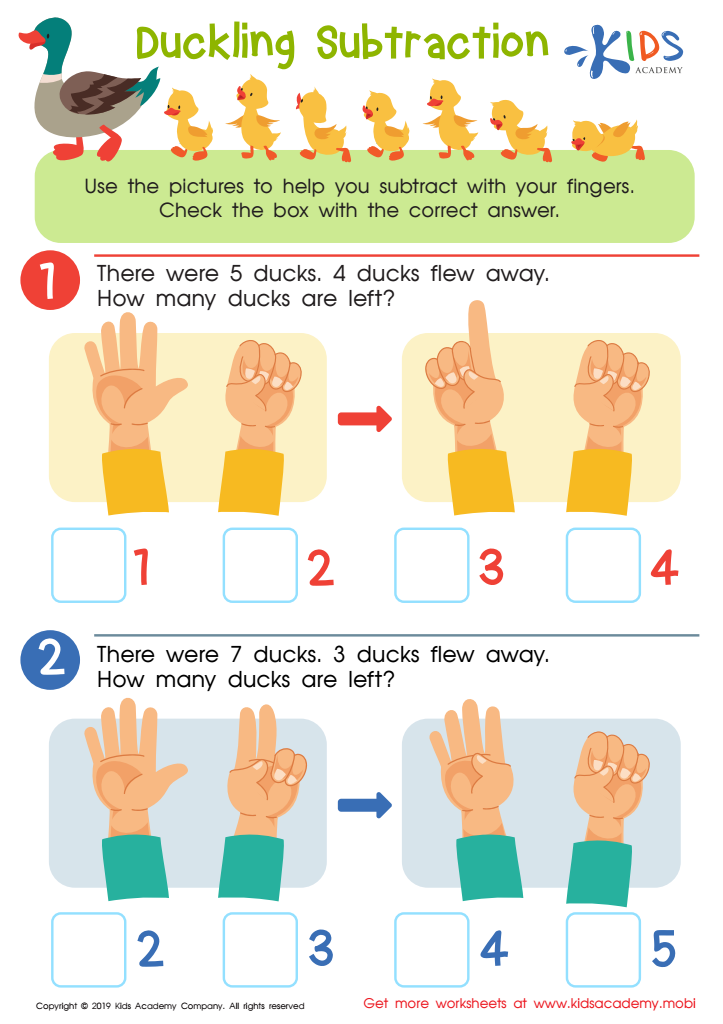
Duckling Subtraction Worksheet
 Assign to My Students







Understanding number relationships is crucial for children aged 3-9 as it forms the foundation for their future mathematical learning and overall cognitive development. This concept encompasses various skills, including recognizing quantities, understanding the concept of greater vs. lesser, and making connections between numbers and their applied meanings.
When children grasp number relationships, they develop strong problem-solving skills and the ability to think logically. This helps them not only in math but also in everyday situations, supporting critical thinking as they assess and compare quantities in their surroundings. For example, recognizing that three apples are more than two encourages them to think critically about comparisons and decision-making.
Moreover, early exposure to these concepts fosters a positive attitude towards math, reducing anxiety and building confidence as they advance through their education. Parents and teachers play a vital role in nurturing these skills through playful interactions, games, and supportive discussions, making learning enjoyable and relevant. Additionally, strong foundational skills in number relationships can improve academic performance, helping children succeed in higher-level math courses later on. Overall, emphasizing understanding number relationships in young children is a vital investment in their educational journey and lifelong learning.








