Understanding measurements Addition & Subtraction Worksheets for Ages 3-9
4 filtered results
-
From - To
Understanding Measurements Addition & Subtraction Worksheets for Ages 3-9
Enhance your child’s math skills with our engaging "Understanding Measurements Addition & Subtraction Worksheets." Tailored for children aged 3-9, these worksheets help young learners grasp basic math concepts through playful activities involving measurement. Our fun and educational exercises stimulate your child’s interest while teaching the fundamentals of adding and subtracting measurements in real-world contexts. Perfect for both classroom and home learning, these printable worksheets support developmental milestones, laying a solid foundation for future mathematical success. Boost your child’s confidence and competence in math today with Kids Academy's expertly designed worksheets.
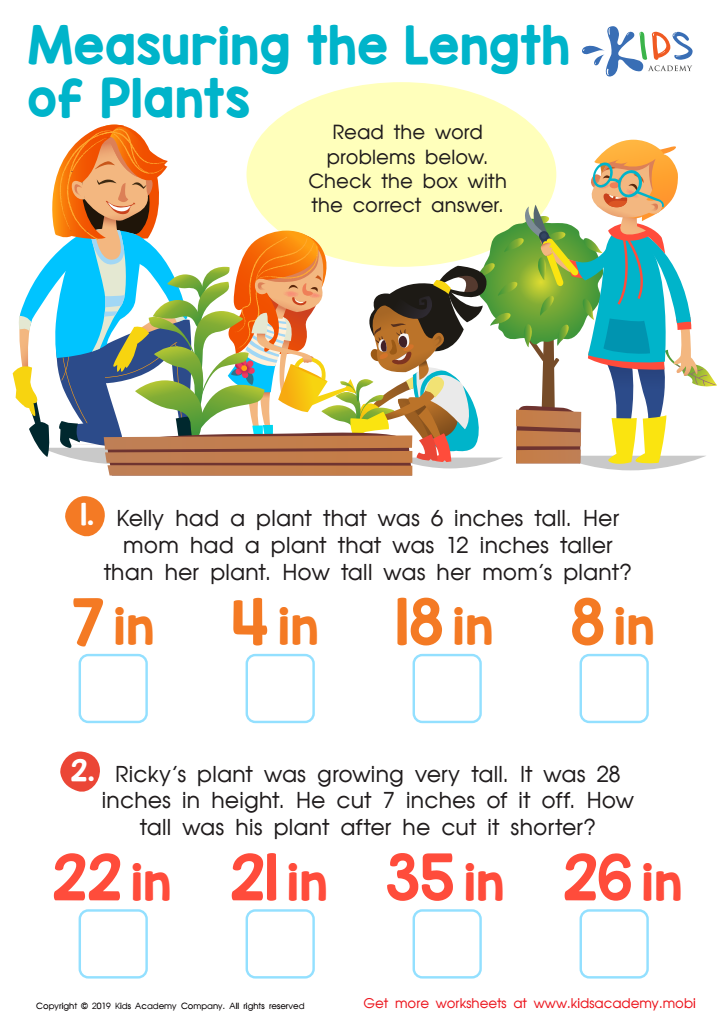
Measuring the Length of Plants Worksheet
 Assign to My Students
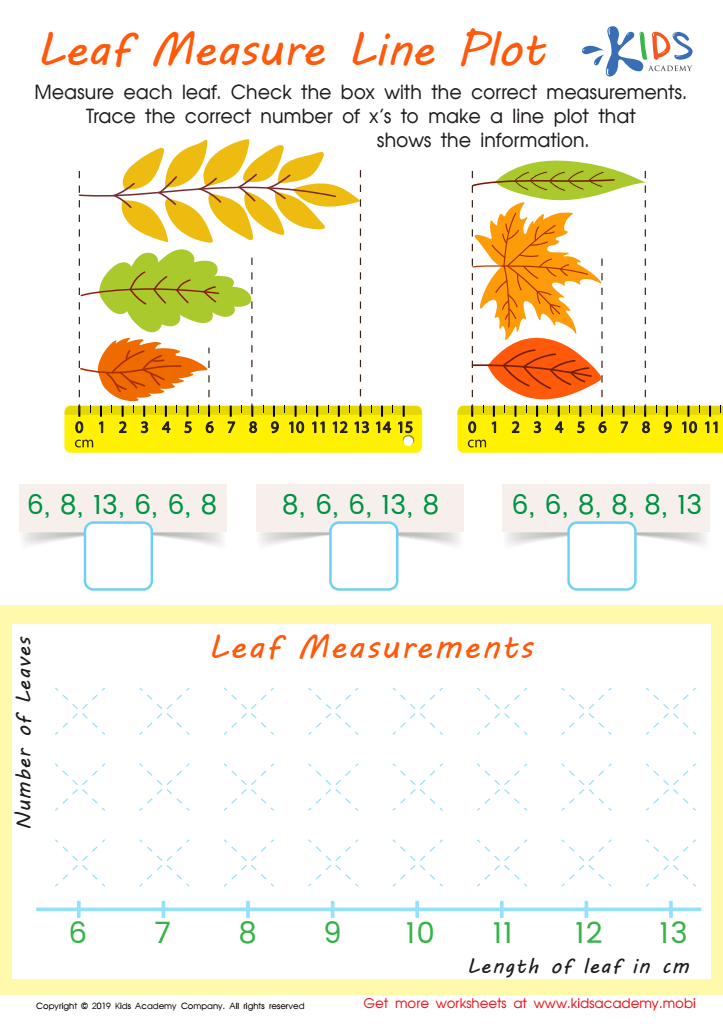
Leaf Measure Line Plot Worksheet








Understanding measurements, addition, and subtraction is crucial for children ages 3-9 because these foundational math skills form the bedrock for future learning and everyday problem-solving. Firstly, measurements are integral to understanding the world. They help children grasp concepts of size, length, weight, and volume, which are woven into daily life—from cooking in the kitchen to buying groceries.
Addition and subtraction are the core building blocks of arithmetic. Proficiency in these operations enhances logical thinking and the ability to process more complex math problems down the line. This age is pivotal for cognitive development; thus, mastering these skills early can boost confidence and foster a positive attitude towards math.
Moreover, engaging with these concepts improves critical reasoning and analytical skills. They help children recognize patterns, make predictions, and comprehend sequences. Addition and subtraction are also essential for time management, counting money, and other practical tasks they'll encounter whisking them toward independence.
From a social perspective, children who grasp these concepts can more comfortably engage in classroom activities and collaborative projects, enhancing their social and academic experiences. Therefore, parents and teachers should prioritize these mathematical skills to equip children with essential tools for academic success and everyday life.








