Basic addition practice Math Worksheets for Ages 3-9 - Page 2
25 filtered results
-
From - To
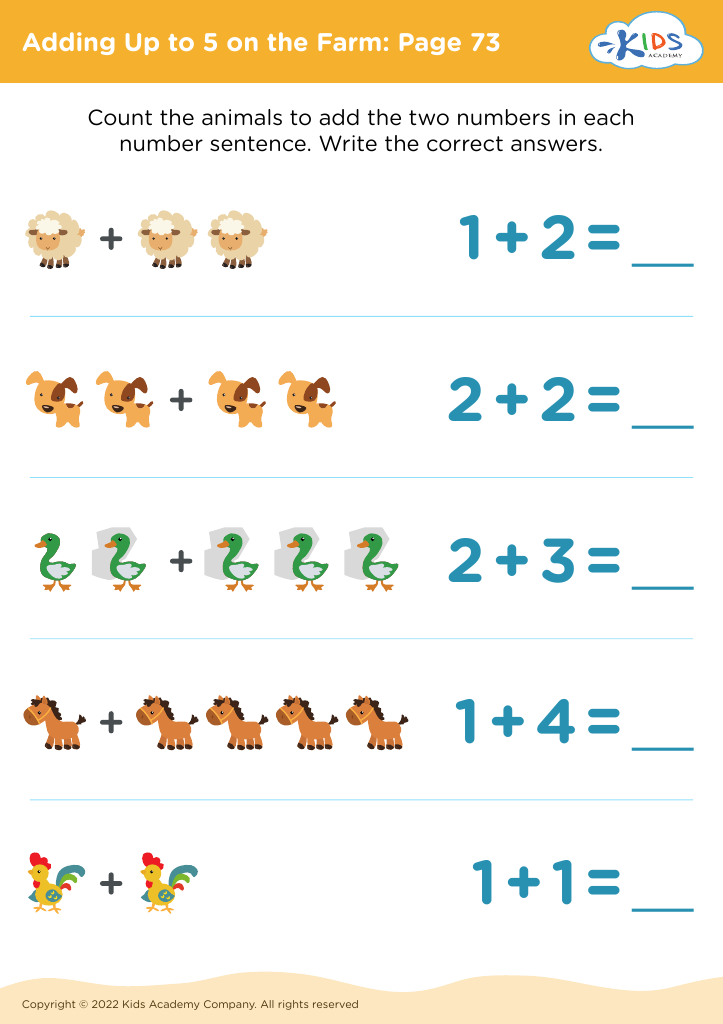








Parents and teachers should care about basic addition practice for ages 3-9 because it lays the fundamental groundwork for all future math learning. At this young age, children's brains are highly receptive to new information, making it an ideal time to introduce foundational mathematical concepts. Mastery in basic addition not only boosts numerical fluency but also enhances problem-solving skills and logical thinking.
Basic addition is often the first arithmetic operation that children encounter, and proficiency in this area builds confidence. When children can quickly and accurately perform basic addition, they are more likely to feel proficient and comfortable with more complex mathematical tasks in later grades, such as multiplication, division, and fractions.
Moreover, early math skills are closely linked to academic success across subjects. Studies show that children who excel in early math skills tend to perform better in literacy and science subjects. Therefore, fostering a strong numerical foundation through basic addition can lead to overall academic improvements.
Incorporating fun and engaging activities like games, visual aids, and interactive practices can make learning addition enjoyable and less daunting. Support from parents and teachers in this foundational stage can instill a lifelong appreciation for math and critical thinking, setting children up for long-term educational success.








