Counting skills enhancement Math Worksheets for Ages 3-9
3 filtered results
-
From - To
Boost your child's counting skills with our specially designed Math Worksheets for Ages 3-9. Perfect for young learners, these engaging and interactive worksheets help kids grasp fundamental counting concepts while having fun. From number recognition and basic counting to advanced sequencing and skip counting, each worksheet targets essential math skills crucial for early academic success. With colorful illustrations and fun activities, children stay motivated and eager to learn. Ideal for homeschoolers, parents, and teachers, our Counting Skills Enhancement Math Worksheets provide the perfect foundation for confident and proficient little mathematicians. Try them today and watch your child excel!
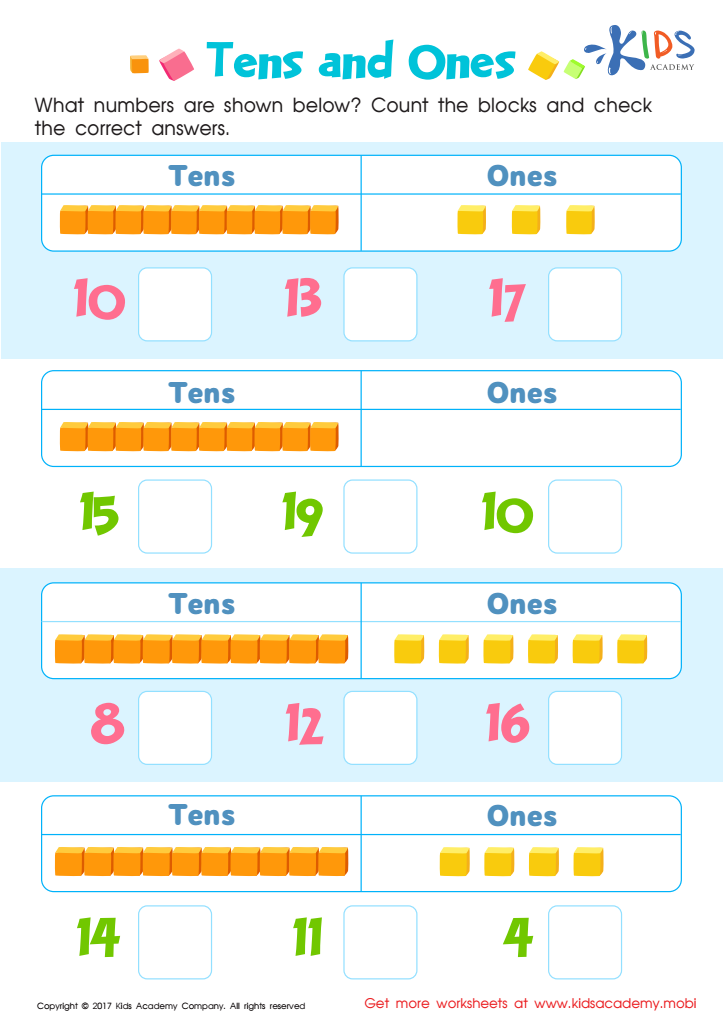
Tens and Ones Worksheet
 Assign to My Students
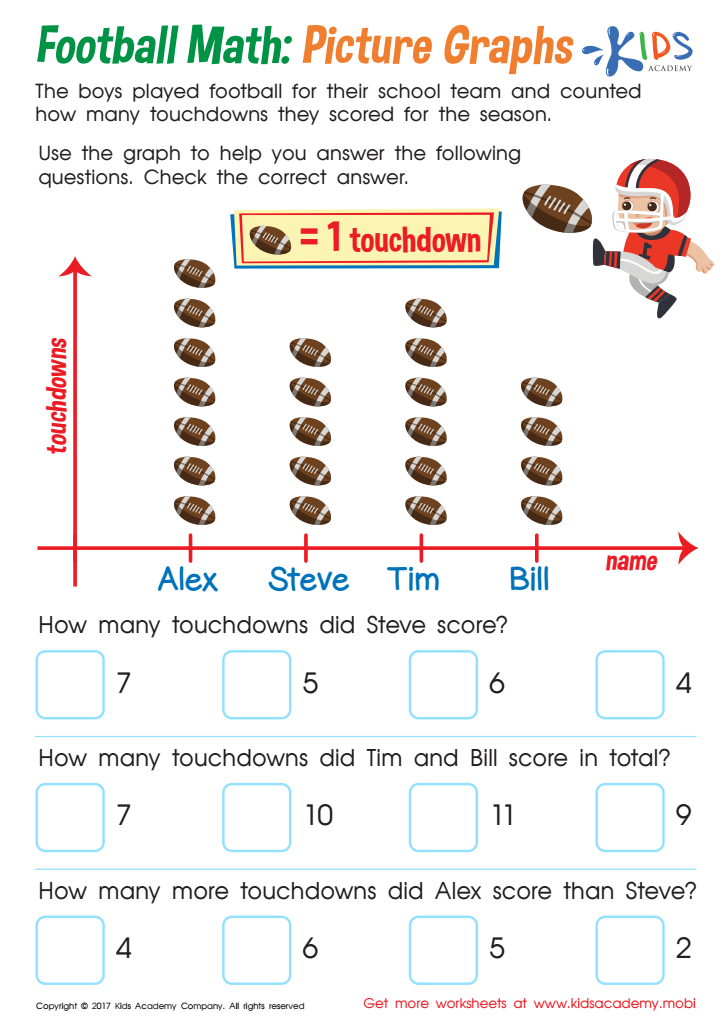
Football Math Worksheet








Counting skills are foundational to early mathematical understanding, making it essential for parents and teachers to prioritize enhancing these abilities in children aged 3 to 9. These formative years are crucial as they lay the groundwork for future learning and cognitive development.
First, counting enhances numerical literacy, enabling children to comprehend numbers, understand their properties, and recognize patterns. This is pivotal for grasping more complex mathematical concepts later, such as addition, subtraction, multiplication, and division. Equipping children with strong counting skills also promotes problem-solving abilities and logical thinking, which are vital across all areas of learning and everyday life.
Moreover, when children count objects, they develop one-to-one correspondence, which means they learn that each object in a set corresponds to one number. This practice is essential for accurate measurement, comparison, and estimation—skills that are necessary beyond the classroom, such as in practical situations like cooking, shopping, and time management.
Fostering counting skills also boosts confidence and curiosity in mathematics. When young learners find counting engaging and accessible, they are more likely to enjoy math and persist when faced with challenging tasks.
By supporting counting skill enhancement, parents and teachers help shape a child's positive mathematical mindset, laying a robust foundation for their educational journey and promoting lifelong learning engagement.








