
Knowledge reinforcement Math Worksheets for Ages 3-9
3 filtered results
Difficulty Level
Grade
Age
-
From - To
Subject
Activity
Standards
Discover our engaging "Knowledge Reinforcement Math Worksheets" designed specifically for children aged 3-9. These interactive worksheets offer a fun way to strengthen essential math skills, including counting, addition, subtraction, and early problem-solving. Each worksheet is crafted to promote self-paced learning, ensuring that young learners can practice at their own level and build confidence in their abilities. With colorful illustrations and playful themes, these resources enhance engagement and retention while making math enjoyable. Perfect for parents and teachers alike, our worksheets provide a comprehensive, effective tool to support children's development in foundational mathematics. Elevate your child’s learning experience today!
Favorites
With answer key
Interactive
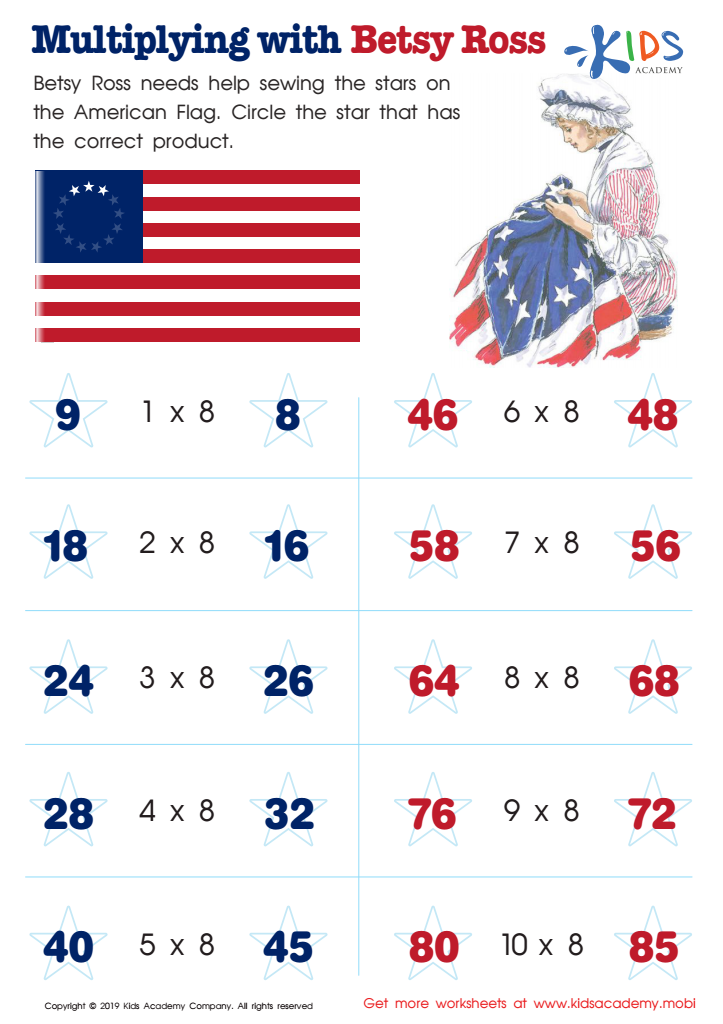
Multiplying with Betsy Ross Worksheet
Before getting into the worksheet, have your students take a quick history lesson on Betsy Ross. Ask them if they know her role in American history. On the printout, ask your kids to identify what Betsy Ross is doing - sewing the stars on the American Flag. Have them circle the star that has the correct pattern.
 Assign to My Students
Multiplying with Betsy Ross Worksheet
Worksheet
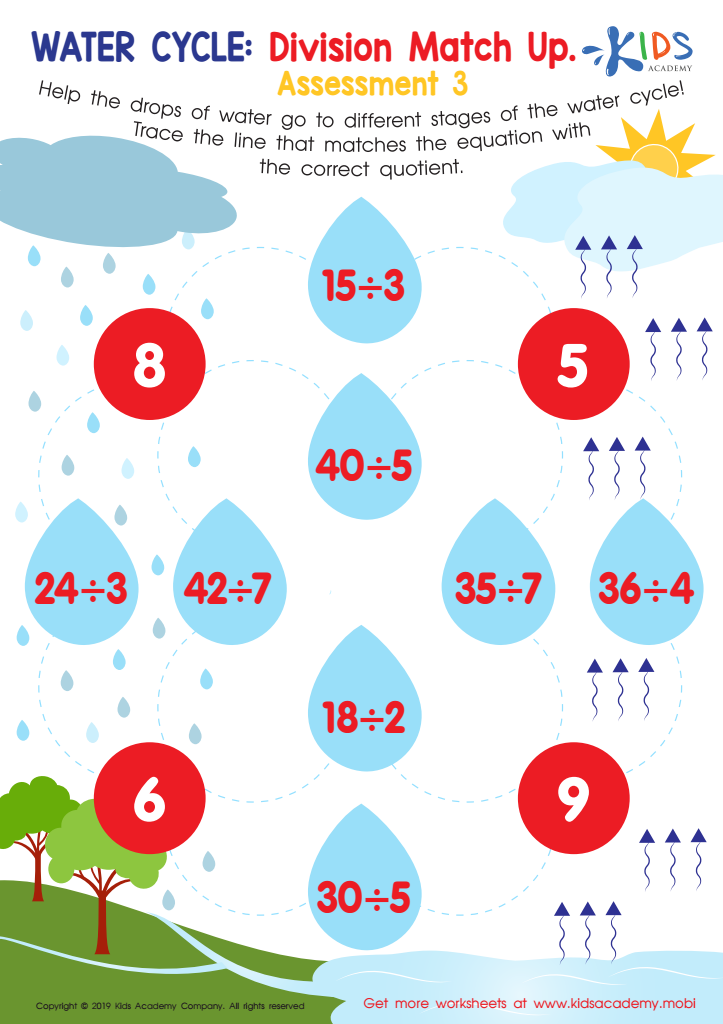
Water Cycle Division Match Up Assessment 3 Worksheet
Division is more fun than schoolwork with this assessment! Traceable lines let kids match equations to quotients, helping them build automaticity and giving you an easy way to see their progress.
Water Cycle Division Match Up Assessment 3 Worksheet
Worksheet
Join Kids Academy for Free
Who is primarily going to use this learning content?








Knowledge reinforcement in mathematics for children aged 3-9 is crucial as it lays the foundation for their future academic success and critical thinking skills. During these formative years, children develop essential cognitive abilities and mathematical concepts, such as counting, number recognition, and basic operations. Regular exposure and reinforcement help solidify these concepts, making them second nature as they progress in their education.
Engaging in regular math activities, whether through games, storytelling, or real-world problem-solving, promotes not only mathematical understanding but also enhances language and social skills. This cross-disciplinary approach makes learning more meaningful and enjoyable and caters to different learning styles.
Furthermore, early math proficiency is often linked to broader educational outcomes. Children who demonstrate strong math skills in elementary school are more likely to experience academic success in later stages. Parents and teachers play a critical role in creating a nurturing learning environment, as their encouragement and support can significantly boost a child's confidence and interest in math.
Additionally, early math skills are linked to better problem-solving abilities, which are invaluable in everyday life. By prioritizing knowledge reinforcement in math, parents and teachers can help cultivate a generation of confident, capable learners ready to tackle the challenges of the future.








