
Reading analog clocks Math Worksheets for Ages 3-9
8 filtered results
Difficulty Level
Grade
Age
-
From - To
Subject
Activity
Standards
Discover a variety of engaging Reading Analog Clocks Math Worksheets tailored for kids ages 3-9 on Kids Academy. Our printable activities are designed to develop essential time-telling skills through fun, interactive exercises. Young learners can practice recognizing clock faces, understanding hour and minute hands, and telling time accurately. Our worksheets gradually increase in complexity to suit different age groups and learning paces, ensuring that children stay challenged and motivated. Ideal for both classroom use and at-home learning, these resources make mastering analog clocks an enjoyable adventure for every child. Empower your little ones with time-telling confidence today!
Favorites
With answer key
Interactive
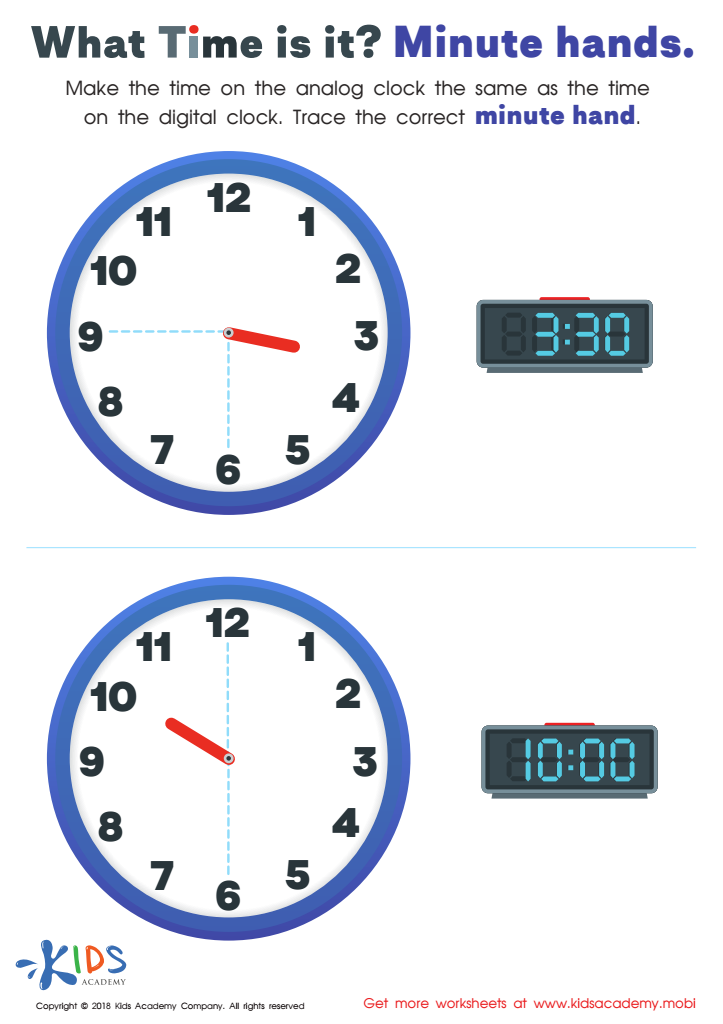
What Time Is it? Minute Hands Worksheet
Help your kids telling time with the minute hand correctly with this tracing sheet. Trace the correct minute hand to make the time on the analog clock the same as the time on the digital clock. Give them a pictured demonstration of how to do it and you'll be all set!
 Assign to My Students
What Time Is it? Minute Hands Worksheet
Worksheet
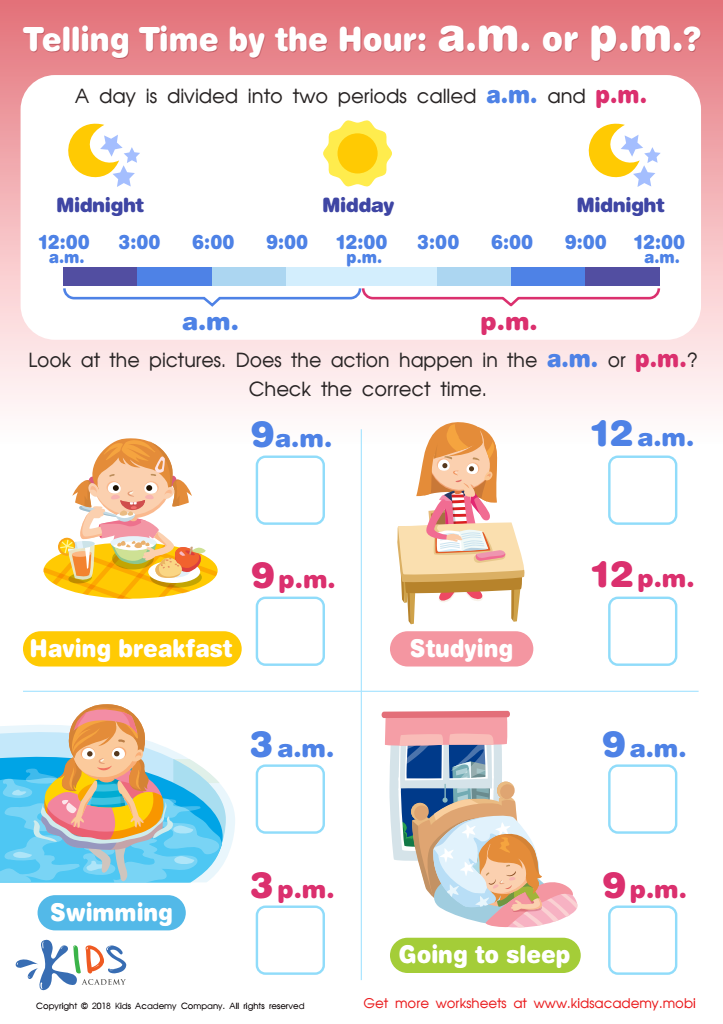
Tilling Time by the Hour: a.m. or p.m.? Worksheet
Can your child tell the time? This worksheet will help them learn. Explain a.m and p.m. and look at the pictures together. Ask your child if the activities happen in the a.m or p.m and help them check the correct time.
Tilling Time by the Hour: a.m. or p.m.? Worksheet
Worksheet
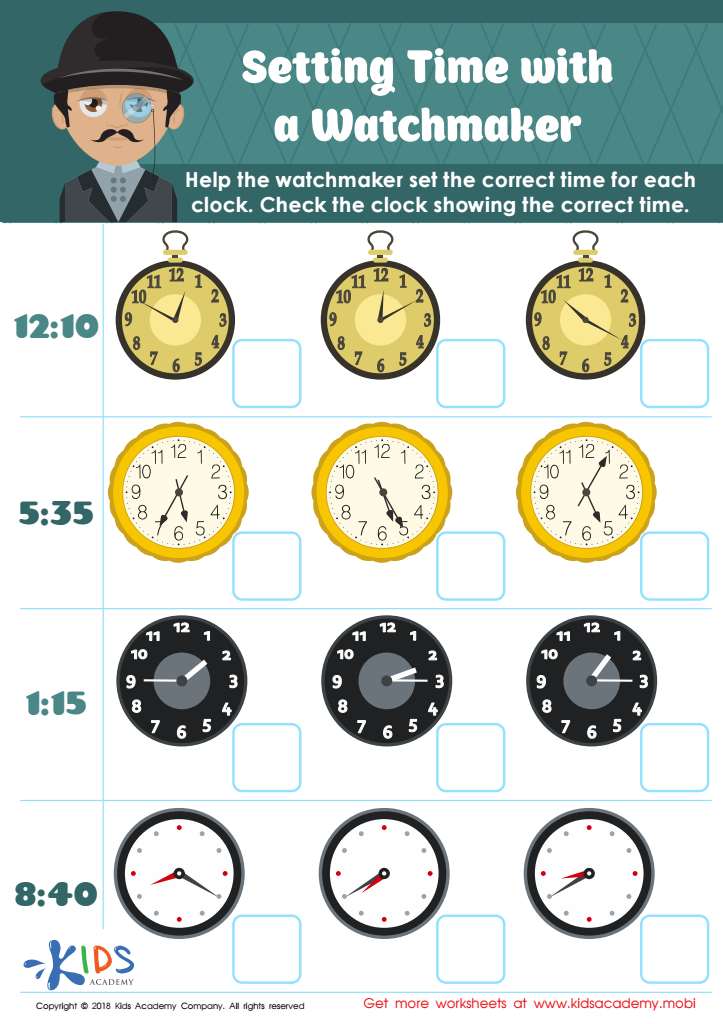
Setting Time with Watchmaker Worksheet
Can your kids tell the time? If so, this worksheet should be easy. Help them set the time for each clock: look at the time written on the left side and find the clock on the right side that matches.
Setting Time with Watchmaker Worksheet
Worksheet
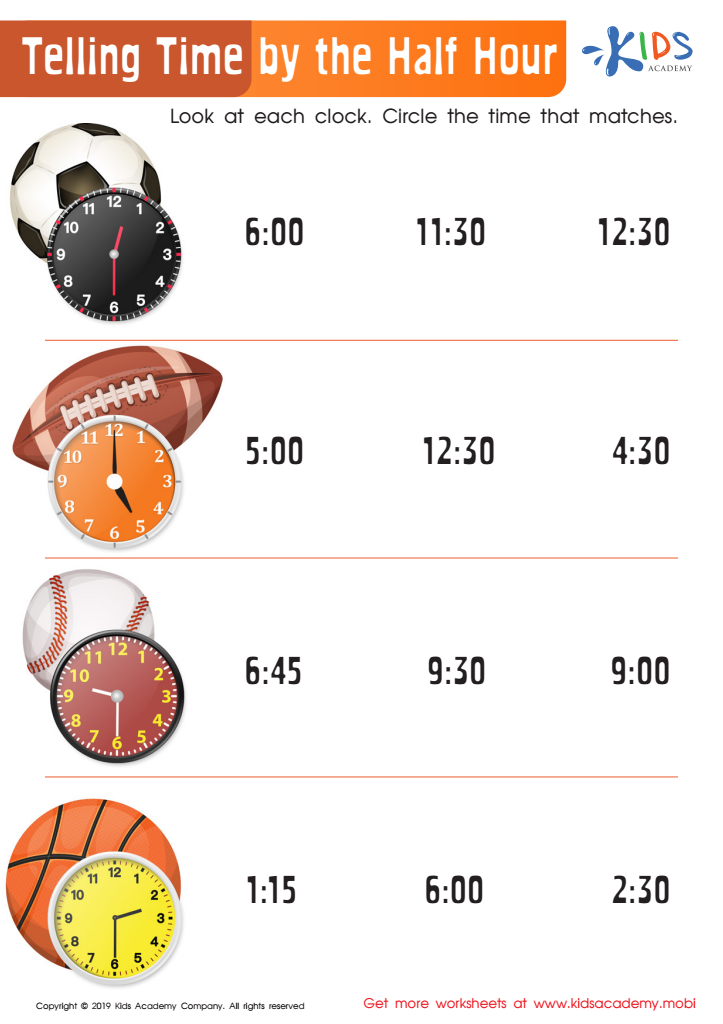
Telling Time by the Half Hour Worksheet
Teach kids to tell time with this worksheet! Four clocks are labeled with different times; help your child circle the right one. It's a great way to teach them to read analog and digital clocks, watches, and written times. Easy and fun learning!
Telling Time by the Half Hour Worksheet
Worksheet
Join Kids Academy for Free
Who is primarily going to use this learning content?





Reading analog clocks is a crucial skill for young children because it integrates several foundational learning domains vital for their holistic development. Firstly, it reinforces number recognition and sequencing, enabling children to become acquainted with numerals and their order. This skill underpins future mathematics success, as a solid grasp of numbers and counting are essential preconditions for more advanced math concepts.
Analog clocks also enhance children's understanding of fractions. By learning terms like “quarter past” and “half past,” children start to comprehend division and the concept of parts of a whole even before formally encountering fractions in their curriculum.
Moreover, reading analog clocks develops critical thinking and problem-solving skills. Figuring out the time involves interpreting the positions of the hour and minute hands relative to the numbers on the clock face. This hands-on, contextual problem-solving nurtures their cognitive growth.
Additionally, the skill teaches time management by instilling a sense of daily rhythms and routines, helping children grasp practical life skills. It promotes punctuality, an essential value for academic and social settings.
For parents and teachers, prioritizing this skill ensures children are well-prepared to manage their time efficiently, fostering independence and confidence in their early academic life, which are essential attributes for lifelong learning.








