Understanding measurements Math Worksheets for Ages 3-9 - Page 2
26 filtered results
-
From - To
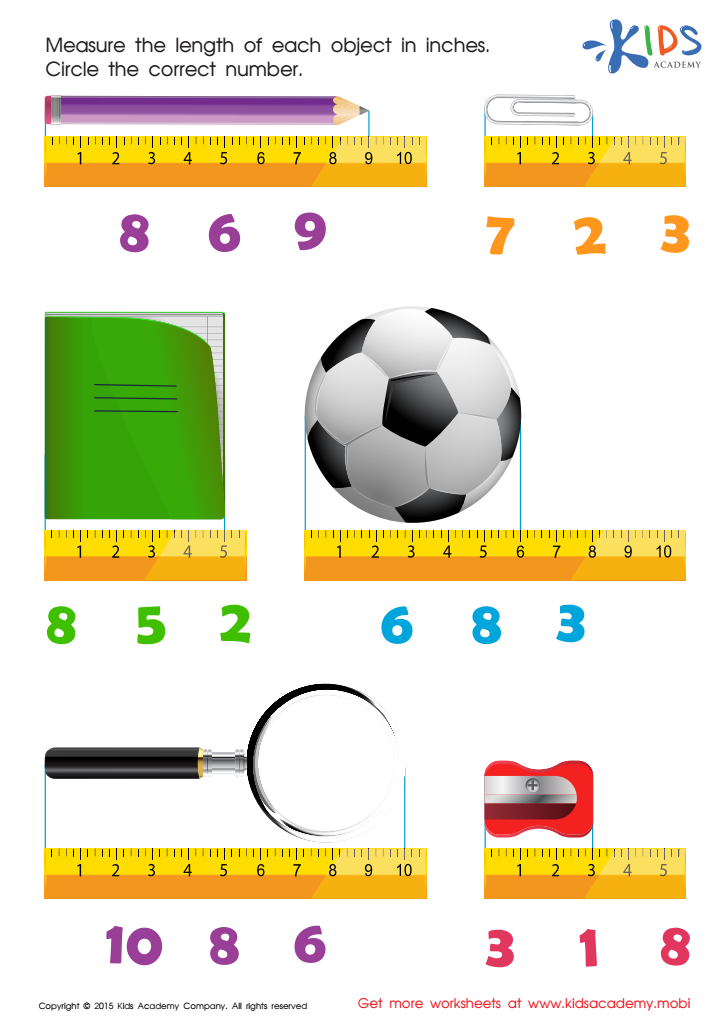
Learning measuring objects in inches Worksheet
 Assign to My Students
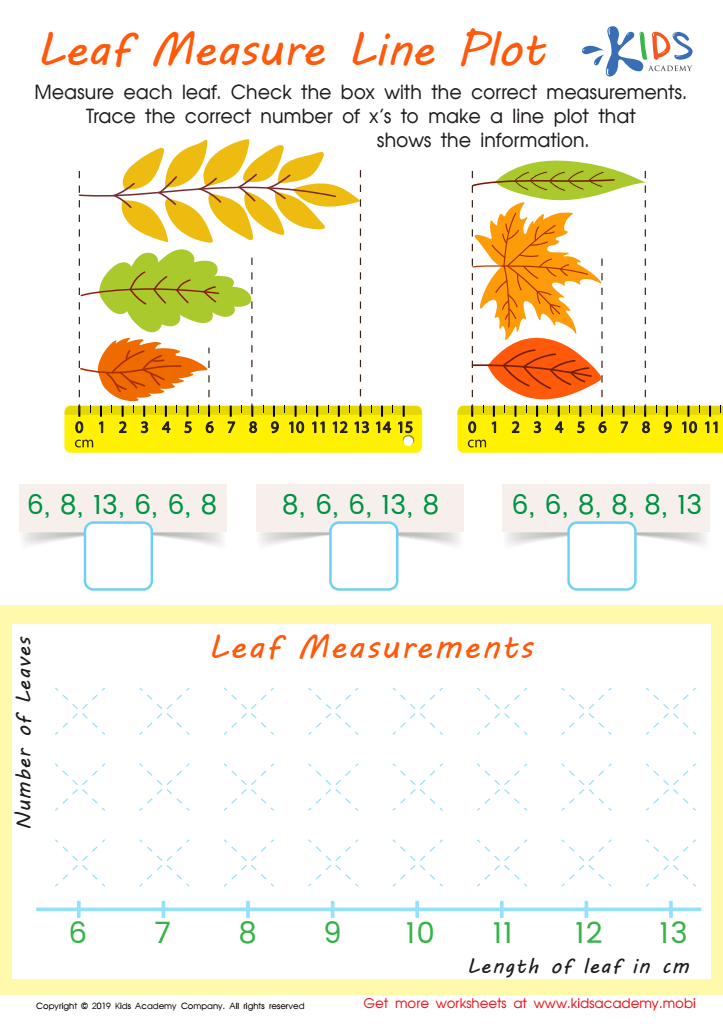
Leaf Measure Line Plot Worksheet








Understanding measurements is crucial for children aged 3-9 as it lays the foundation for critical thinking, problem-solving, and real-life applications. During these formative years, children begin to grasp the concepts of size, weight, length, and volume, which are essential for their everyday experiences. For parents and teachers, fostering this understanding enhances a child's ability to compare, estimate, and quantify information, crucial skills for their academic journey.
When children learn about measurements, they also develop their mathematical language, enabling them to articulate their thoughts and reasoning. Furthermore, engaging in measurement activities promotes hands-on learning and exploration, often leading to increased motivation and interest in math. This understanding is not just academic; it's relevant in various life skills, such as cooking, shopping, and understanding spatial relationships.
Moreover, measurement concepts are interconnected with other areas of math, like addition and subtraction, laying the groundwork for more complex mathematical reasoning. By emphasizing the importance of measurements, parents and teachers can help children develop confidence and a positive attitude toward math, which will benefit them in school and beyond. Ultimately, supporting young learners in this area nurtures their overall cognitive and academic growth.








