
Rounding numbers Rounding Worksheets for Ages 3-9
6 filtered results
Difficulty Level
Grade
Age
-
From - To
Subject
Activity
Standards
Explore our engaging Rounding Numbers Worksheets designed for children aged 3-9! These expertly crafted resources help young learners master the concept of rounding, making math fun and accessible. With a variety of colorful, interactive activities, kids will practice rounding numbers to the nearest ten and hundred, building foundational skills that support their mathematical journey. Ideal for both classroom and at-home learning, our worksheets cater to different learning styles, ensuring every child can grasp this essential math technique. Boost your child's confidence and proficiency in rounding with our comprehensive worksheets, available for instant download and easy printing. Start rounding numbers today!
Favorites
With answer key
Interactive
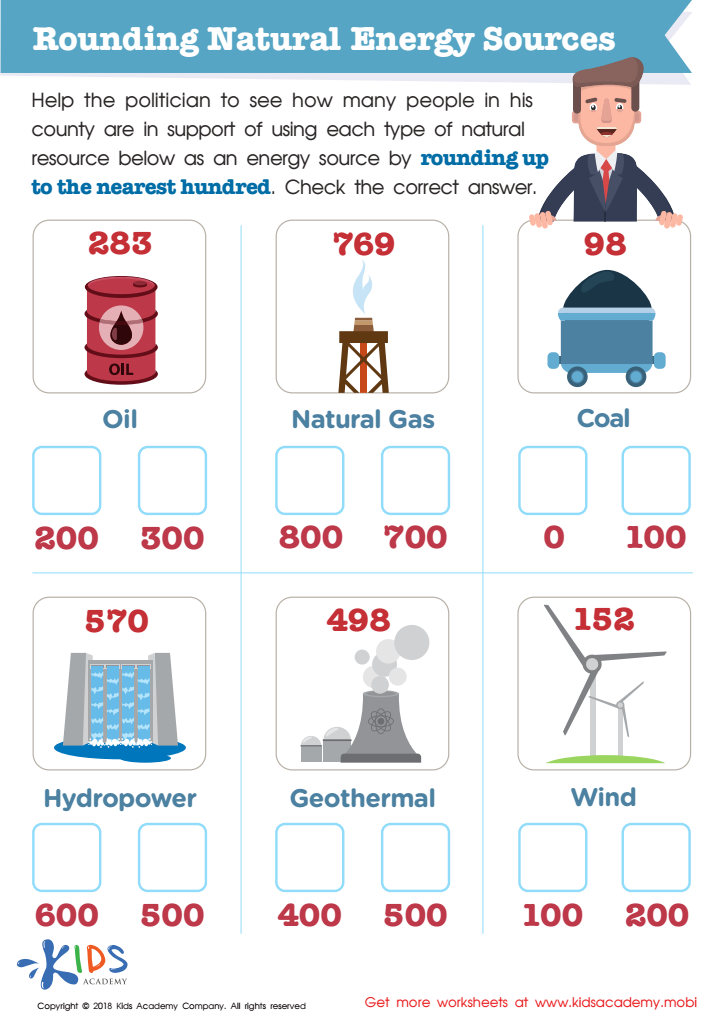
Rounding Natural Energy Sources Worksheet
Ask your kids what policies they would love to see if a politician is voted into power. Then, have them help the politician in this worksheet, downloading the PDF and rounding up the number of people to the nearest hundred in support of using different natural resources as an energy source. Guide them to the correct answer.
 Assign to My Students
Rounding Natural Energy Sources Worksheet
Worksheet
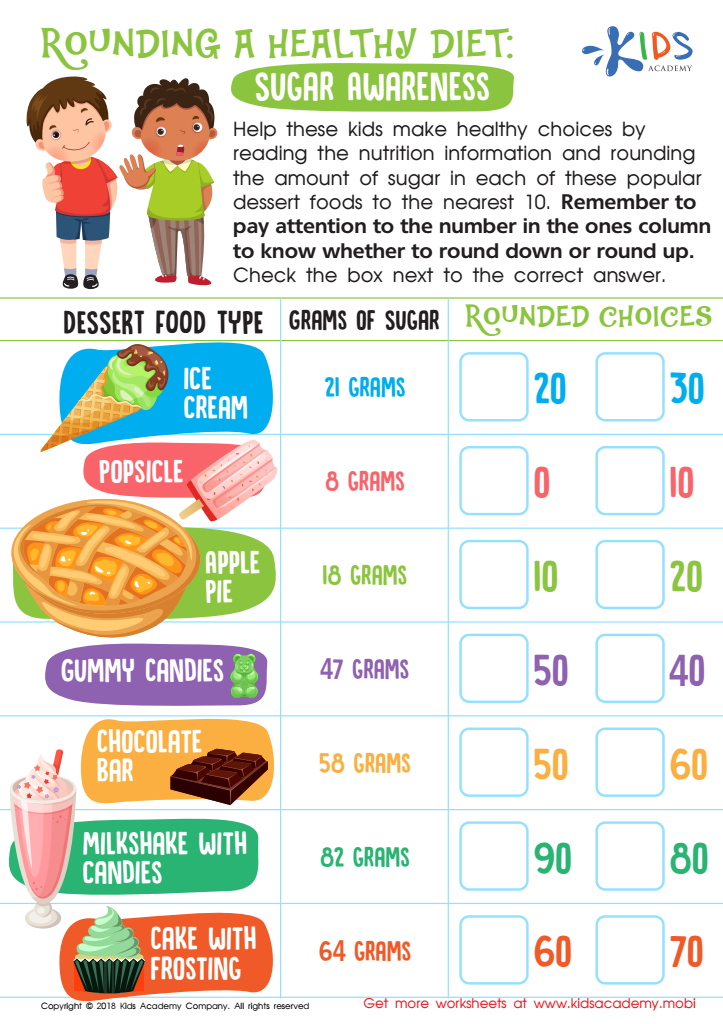
Rounding Healthy Diet Worksheet
Kids Academy understands the value of making math relevant. Check out this energizing rounding worksheet which merges math concepts with health class! Kids get to be aware of sugary treats and work out how many grams of sugar they contain. To complete, they view each item and round the number to the nearest 10. Remind them to focus on the ones column to decide if the number rounds up or down.
Rounding Healthy Diet Worksheet
Worksheet
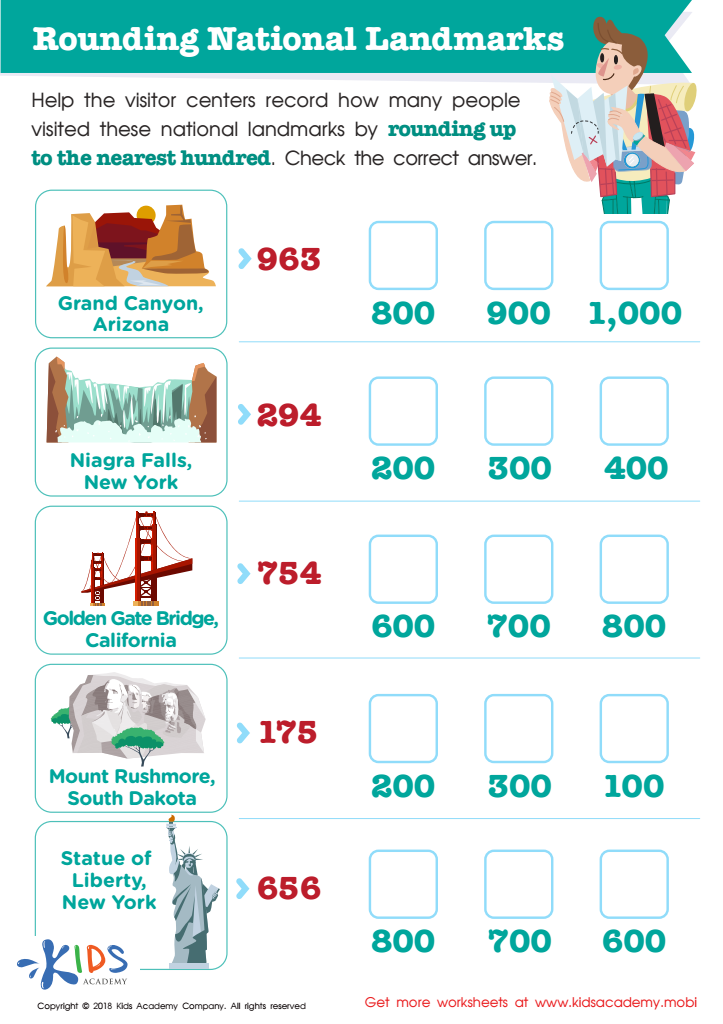
Rounding National Landmarks Worksheet
Does your city have tourist attractions? Help your kids count visitors to these national landmarks by rounding up to the nearest hundred. Then check the correct answer from the provided options. Or explore tourist centres in another state with your family.
Rounding National Landmarks Worksheet
Worksheet
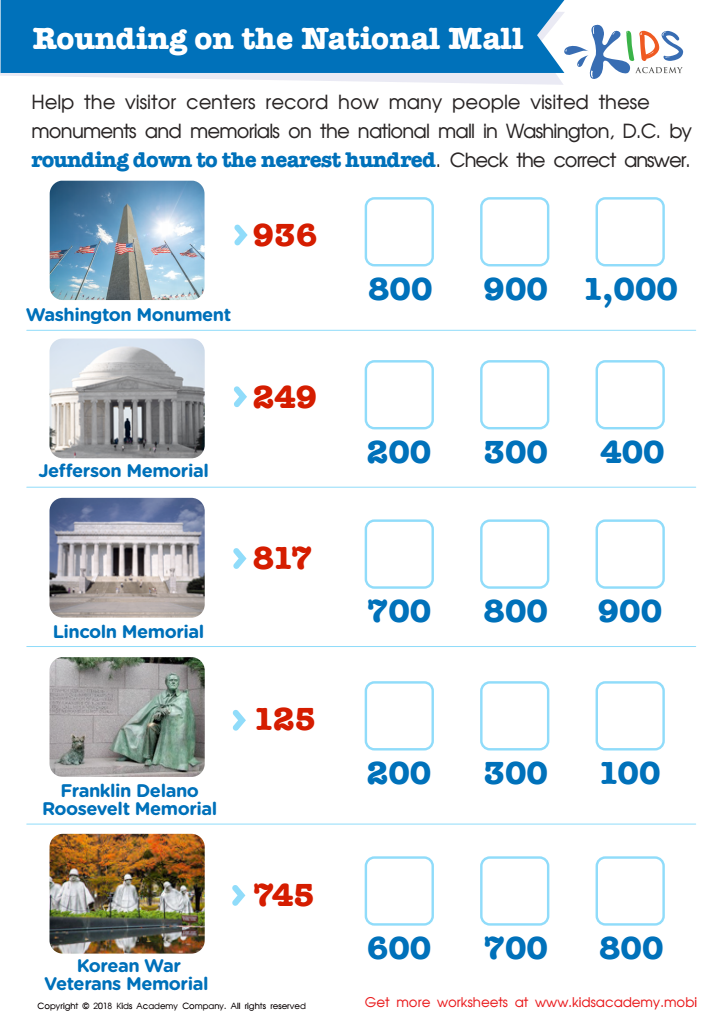
Rounding on the National Mall Worksheet
Math and social studies come together in this worksheet. Learners must round numbers to record attendance at Washington D.C. monuments and memorials. Remind them to round down to the nearest hundred. Extend the lesson by talking about each monument - a great way to teach or refresh your child's knowledge of these national landmarks!
Rounding on the National Mall Worksheet
Worksheet
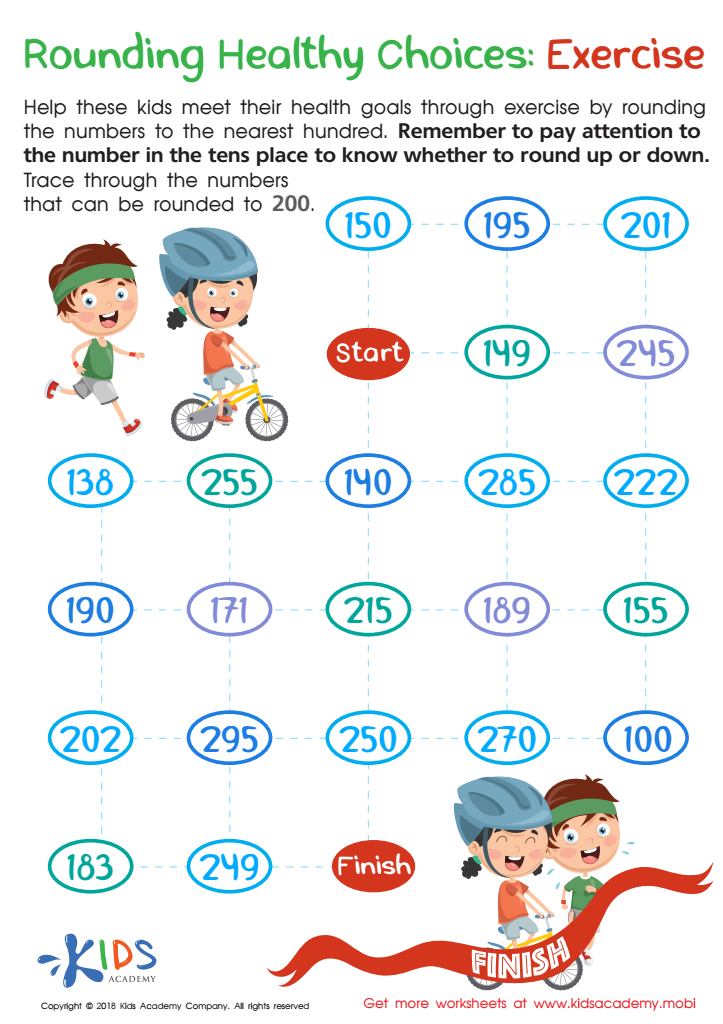
Rounding Healthy Choices Exercise Worksheet
Tired of boring math worksheets? Check out this fun rounding maze printout! Help the kids reach their goals by going from start to finish. To move through the maze, they must find numbers to round to 200. Teach them to pay close attention to the tens place to know whether to round up or down. Have fun and reach the finish line to complete the maze!
Rounding Healthy Choices Exercise Worksheet
Worksheet
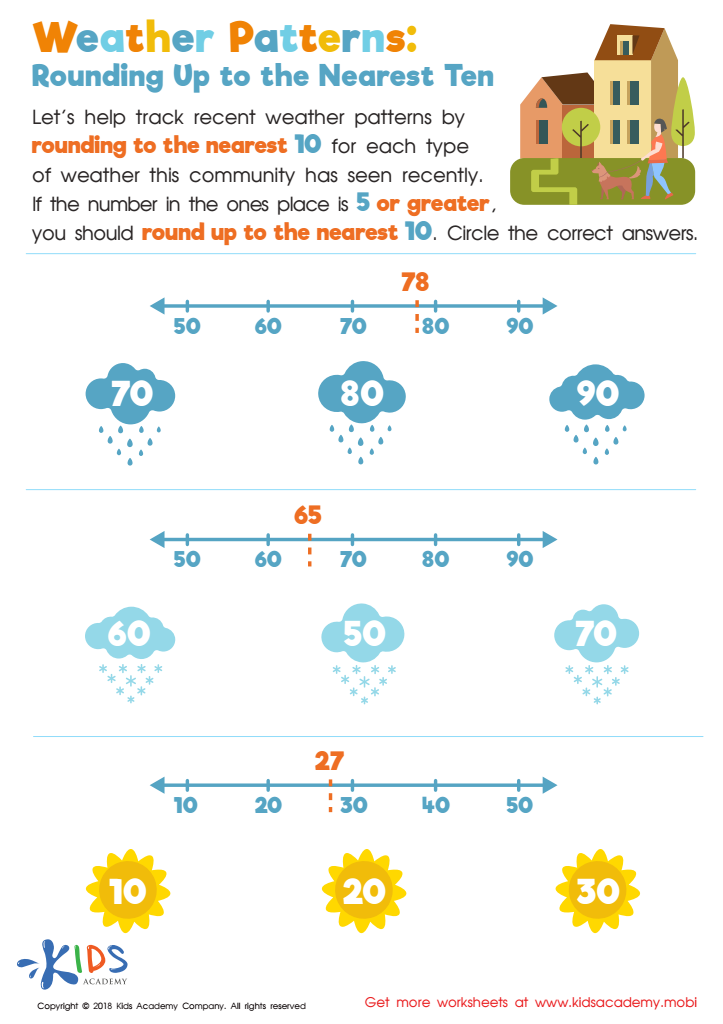
Weather Patterns Worksheet
Use this Weather Patterns worksheet to help your kids develop their mathematical skills. Get them to round the recent weather patterns to the nearest 10 and round up if the number in the ones place is 5 or higher. Work with them to figure out which answers are correct and get them to circle them.
Weather Patterns Worksheet
Worksheet
Join Kids Academy for Free
Who is primarily going to use this learning content?





Rounding numbers is a fundamental skill that helps young learners grasp essential mathematical concepts and develop their problem-solving abilities. For children aged 3-9, understanding rounding fosters number sense, which is crucial as they encounter increasingly complex math tasks in their education.
Rounding helps simplify numbers, making them easier to work with, especially when estimating sums or differences. This skill enables children to quickly assess quantities, which is useful in everyday situations, such as shopping, making quick calculations, and understanding measurements in cooking or construction tasks.
In addition to practicality, rounding reinforces critical cognitive skills like critical thinking and estimation. It encourages students to think about the magnitude of numbers, leading to a deeper understanding of place value and the relationships between different numbers. Engaging students in rounding activities can also boost confidence, as they discover that mathematics can be approachable and less intimidating.
Furthermore, by fostering rounding skills at an early age, parents and teachers lay a solid foundation for future mathematical learning, preparing children for more complex topics in later grades. Overall, rounding numbers is an integral part of mathematical literacy and should be actively encouraged in young learners.








