Problem-solving practice Addition & Subtraction Worksheets for 3-Year-Olds
3 filtered results
-
From - To
Welcome to our engaging "Problem-Solving Practice: Addition & Subtraction Worksheets for 3-Year-Olds"! Designed to enhance young learners' mathematical skills, these worksheets provide a playful approach to fundamental arithmetic concepts. With vibrant visuals and age-appropriate challenges, children will develop their problem-solving abilities while practicing simple addition and subtraction. Our resources encourage independent thinking and boost confidence in early math skills. Ideal for at-home learning or in preschool settings, these worksheets foster a love for numbers and math problem-solving. Explore our collection today and watch your little one thrive as they tackle fun and interactive math adventures!
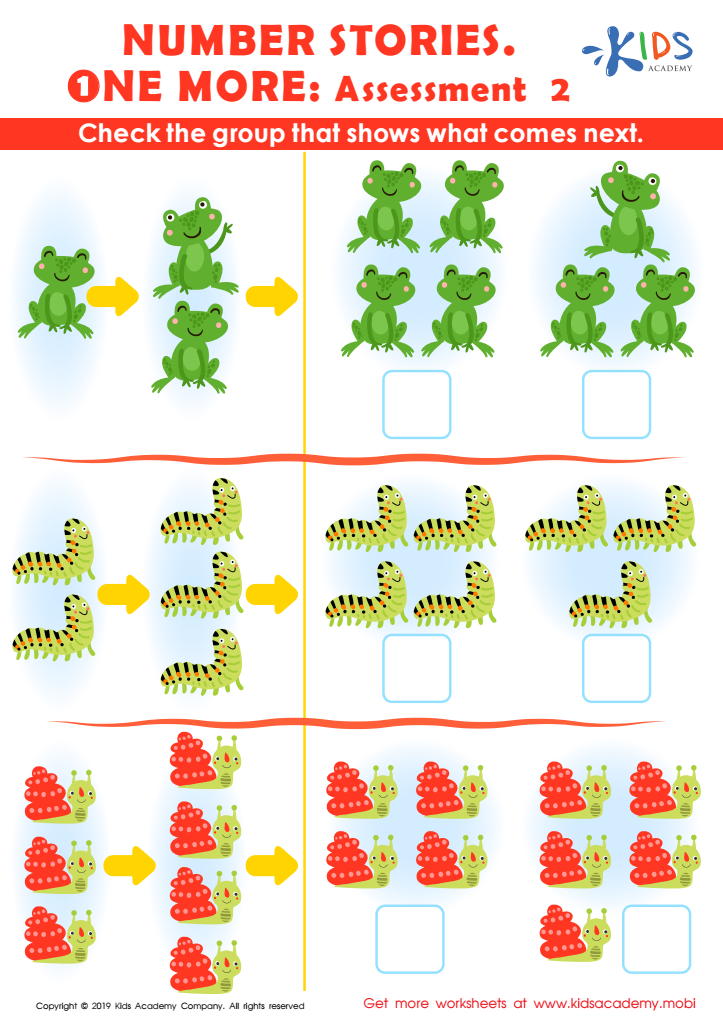
Number Stories One More – Assessment 2 Worksheet
 Assign to My Students








Problem-solving practice in addition and subtraction for 3-year-olds is vital for several reasons. First, early exposure to mathematical concepts supports cognitive development. As children engage in these activities, they learn to recognize patterns, make comparisons, and think logically, laying a foundation for more complex mathematical skills later on.
Moreover, practicing problem-solving encourages critical thinking and promotes resilience. When children face challenges in adding or subtracting, they learn to experiment, make mistakes, and find solutions—which builds their confidence. This skill is transferable beyond math, influencing their overall approach to learning and everyday situations.
Socially, working on problems together fosters cooperation and communication with peers or adults. Kids develop language skills as they articulate their thought processes and reasoning, enhancing their vocabulary and comprehension.
Finally, instilling a love for math early promotes a positive attitude toward learning. Math is often perceived as difficult in later years, but early experiences that engage curiosity can shift that mindset. For parents and teachers, facilitating addition and subtraction practice is not just about numbers; it’s about equipping young learners with essential life skills that will benefit them academically and socially throughout their education.








