
Comparing sizes Math Worksheets for 3-Year-Olds
3 filtered results
Difficulty Level
Grade
Age
-
From - To
Subject
Activity
Standards
Introduce your little learner to the delightful world of comparing sizes with our engaging Math Worksheets for 3-Year-Olds! Tailored for tiny hands and curious minds, these worksheets make learning fun and interactive. With colorful images and simple activities, children will visually grasp the concepts of big, small, tall, and short. Perfect for enhancing early math skills, these resources support cognitive development and foster problem-solving abilities. Ideal for both classroom use and at-home practice, our comparing sizes worksheets help your toddler build a strong mathematical foundation while enjoying the magic of learning through play. Explore today to nurture your child's growth!
Favorites
With answer key
Interactive
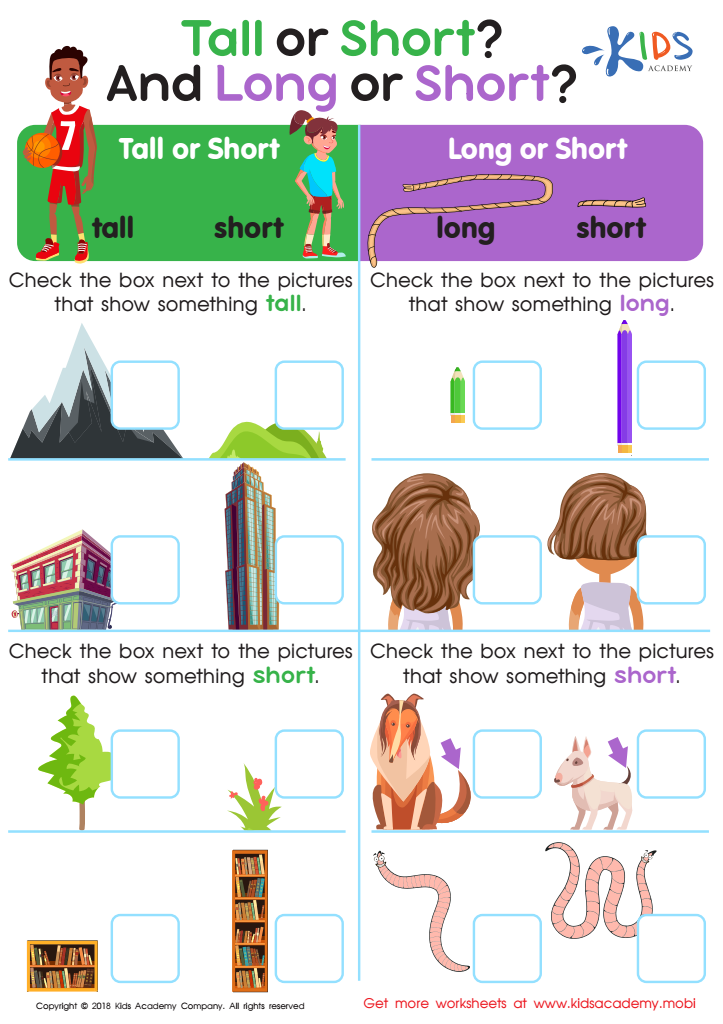
Tall or Short and Long or Short? Worksheet
This worksheet is fun and helpful for kids to understand the difference between height and length. With pictures of familiar objects, they can compare and choose the box with the right answer. This helps them gain skills and a better foundation for future measuring.
 Assign to My Students
Tall or Short and Long or Short? Worksheet
Worksheet
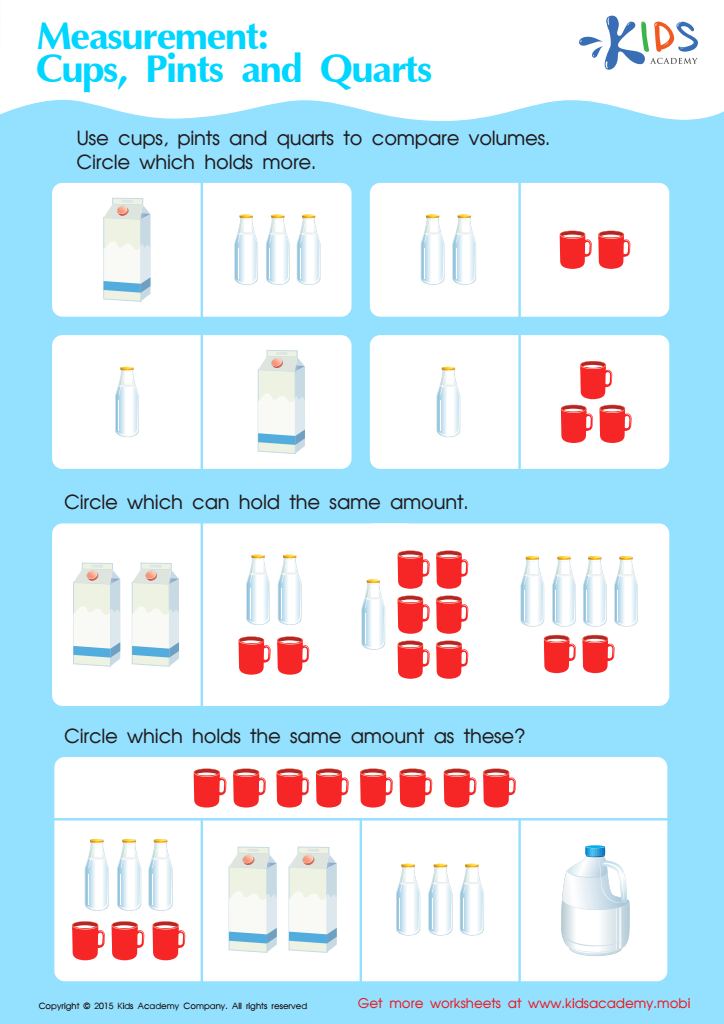
Measurement: Compare Volumes Worksheet
Compare volumes with Kids Academy and have fun! (80 words)
Practice measuring with Kids Academy and have fun! Compare volumes in pictures and circle which holds more. Keep learning with free math worksheets available on our website. Enjoy the process and have fun!
Measurement: Compare Volumes Worksheet
Worksheet
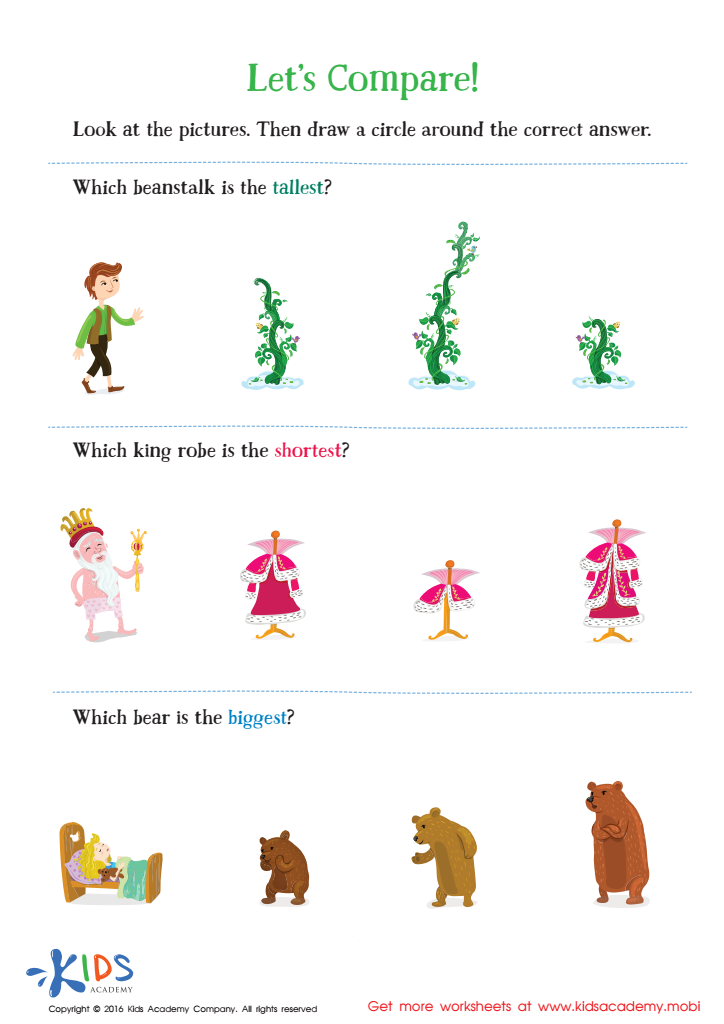
Fairy Tale Worksheet: Let's Compare
Preschoolers need to recognize different sizes of objects. This worksheet combines fun fairy tales with size practice, helping them read, problem solve, and sort through pictures. Your child will love the images and be eager to complete it. Enhance their learning by talking about the tales to build comprehension.
Fairy Tale Worksheet: Let's Compare
Worksheet
Join Kids Academy for Free
Who is primarily going to use this learning content?




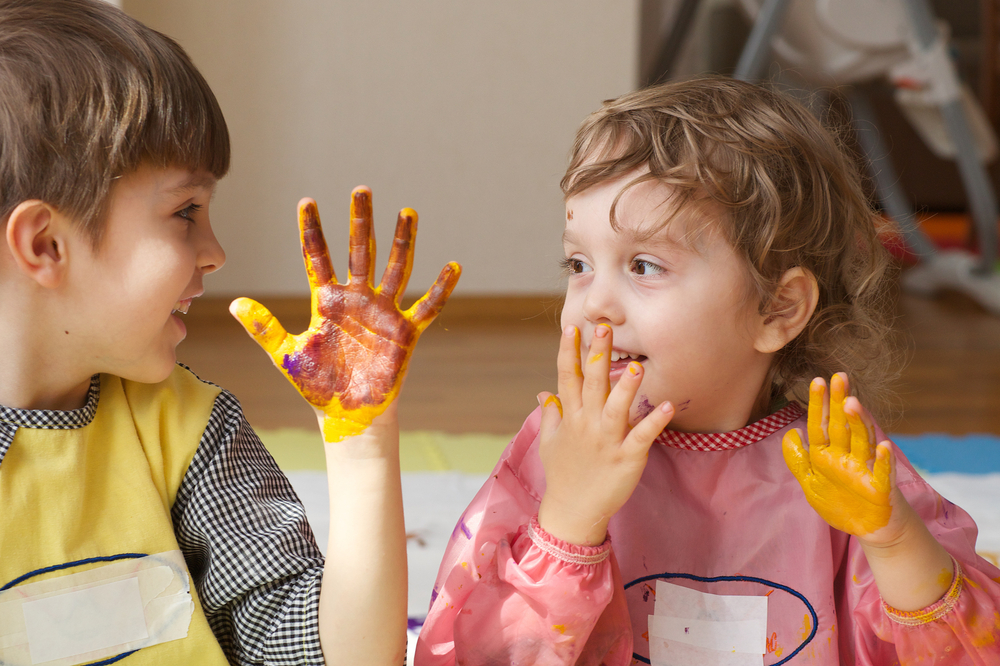


Introducing the concept of comparing sizes to 3-year-olds is a pivotal foundational math skill that fosters cognitive development. At this age, children's brains are rapidly growing, and they are naturally curious about the world around them. By involving them in activities that focus on comparing sizes, parents and teachers help enhance their observational skills, critical thinking, and vocabulary.
When children compare objects based on size, they learn to notice differences and similarities, a fundamental aspect of logical thinking. This skill supports their problem-solving abilities, allowing them to make sense of their environment and the relationships between objects. For instance, understanding that one toy is bigger than another or that a book is smaller than a drawer is crucial for spatial awareness.
Moreover, comparing sizes integrates essential language development. Words like "big," "small," "tall," and "short" become part of their everyday vocabulary, enhancing their ability to communicate effectively. These activities also promote social interactions, as children often find enjoyment in collaborative sorting or ordering games.
Finally, engaging in comparing sizes lays a foundation for more complex mathematical concepts such as measurement, estimation, and even geometry. Early mastery of these basic concepts sets the stage for future academic success by building confidence and competence in their mathematical abilities. This, combined with the joy and curiosity sparked by engaging, hands-on learning, underscores why parents and teachers should prioritize size comparison activities in early childhood education.








