
Fine motor development Addition & Subtraction Worksheets for Ages 4-5
3 filtered results
Difficulty Level
Grade
Age
-
From - To
Subject
Activity
Standards
Our "Fine Motor Development Addition & Subtraction Worksheets for Ages 4-5" are expertly crafted to blend foundational math skills with essential fine motor exercises. Tailored for young learners, these engaging worksheets not only introduce basic addition and subtraction concepts but also enhance hand-eye coordination, pencil control, and precise movements. Activities include tracing numbers, drawing lines, and coloring, which make learning both fun and educational. These worksheets provide a well-rounded approach to early math education, ensuring your child builds strong mathematical understanding while also developing crucial fine motor skills that prepare them for future academic success.
Favorites
With answer key
Interactive
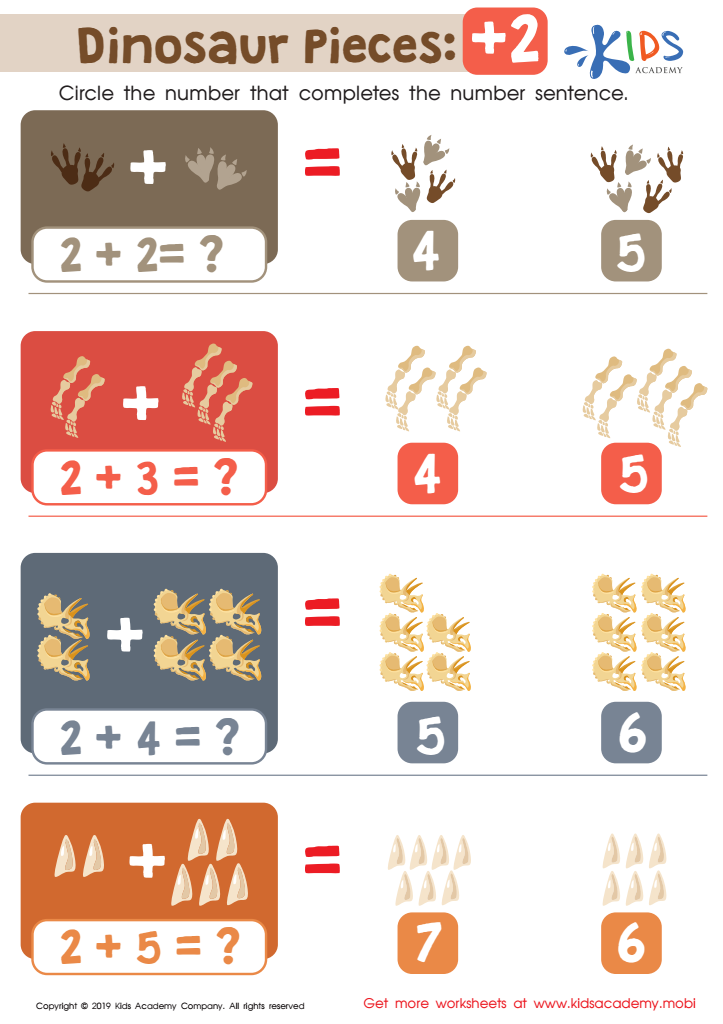
Dinosaur Pieces: +2 Worksheet
Kids love dinosaurs! See if your kids can solve these three equations featuring the mysterious creatures. Download the PDF and have them circle the number that completes each equation. Dinosaurs are extinct, not seen for thousands of years, but they can still help kids work on their math skills!
 Assign to My Students
Dinosaur Pieces: +2 Worksheet
Worksheet
Join Kids Academy for Free
Who is primarily going to use this learning content?








Fine motor development is crucial for 4-5-year-old children, as it directly impacts their ability to perform everyday tasks and succeed in academic environments. Fine motor skills involve the coordination of small muscles in the hands and fingers, which are essential for tasks like writing, buttoning clothing, and using utensils. By focusing on the development of these skills, parents and teachers can help children build the physical foundation necessary for efficient and legible handwriting, artistic expression, and independent self-care.
In parallel, building a strong understanding of addition and subtraction in young children sets the stage for future mathematical success. During ages 4-5, children's cognitive abilities rapidly develop, making it an ideal time to introduce fundamental math concepts. Early proficiency in addition and subtraction not only enhances number sense and problem-solving skills but also fosters a positive attitude towards mathematics. These skills encourage logical thinking and help children grasp more complex mathematical concepts in later schooling.
Combination of fine motor development with early math proficiency supports a well-rounded educational foundation. Engaging children in activities that merge these areas – such as counting blocks and writing numbers – promotes an integrated approach to learning. This holistic development approach ensures children build confidence, independence, and a robust academic foundation, essential for lifelong learning and daily activities.








