Understanding number relationships Addition & Subtraction Worksheets for Ages 4-5
4 filtered results
-
From - To
Our "Understanding Number Relationships: Addition & Subtraction Worksheets for Ages 4-5" are expertly designed to help early learners grasp essential math concepts. These engaging worksheets enhance your child's ability to identify and understand number relationships, fostering critical thinking and number sense. By using visually appealing activities and simple exercises, kids practice addition and subtraction in a way that feels both fun and achievable. Perfect for at-home learning or supplementing classroom instruction, these worksheets build a strong foundation for future math success. Encourage your child’s mathematical journey with these thoughtfully crafted learning tools!
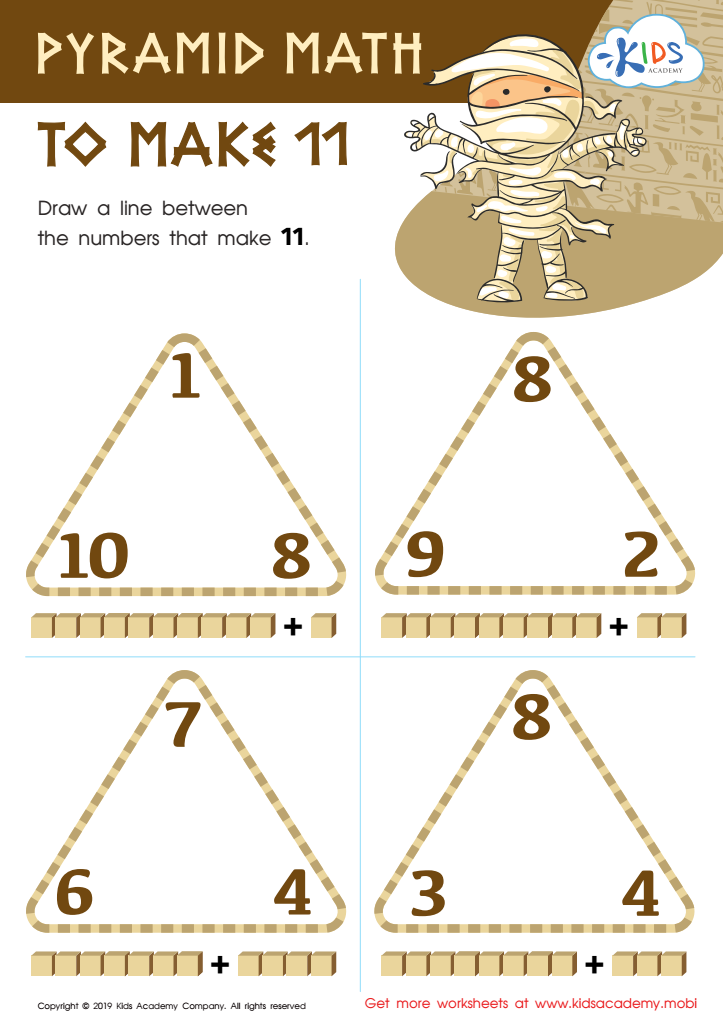
Pyramid Math to Make 11 Worksheet
 Assign to My Students








Understanding number relationships, addition, and subtraction at ages 4-5 is essential as it lays the foundational groundwork for future mathematical skills. At this tender age, children are naturally curious and highly absorbent, making it the perfect time to introduce these fundamental concepts in a playful and engaging manner.
Number relationships help children comprehend how numbers interconnect, forming the base for understanding more complex mathematical ideas. For instance, recognizing that 3 is less than 5 or understanding that 2 and 3 together make 5, builds their ability to visualize numbers and understand numerical order and quantities. These conceptions are the stepping stones for mental math and problem-solving skills.
Addition introduces them to the idea of combining quantities, enhancing their cognitive skills by teaching them the concept of 'more.' Subtraction, on the other hand, deals with 'taking away' and helps them to understand discrepancies and the notion of decrease. Proficiency in these areas can boost a child's confidence and promote a positive attitude toward math as they transition to higher grades.
Additionally, early aptitude in math contributes to the development of critical thinking and logical reasoning. Caring about these skills ensures children aren’t just prepared for academic success but also equipped with essential life skills for their future.








