
Enhance counting skills Math Worksheets for Ages 4-6
4 filtered results
Difficulty Level
Grade
Age
-
From - To
Subject
Activity
Standards
Discover our "Enhance Counting Skills" math worksheets designed for children aged 4 to 6. These engaging resources provide a fun and interactive way for young learners to develop essential counting skills. Each worksheet features colorful illustrations and playful themes that captivate children's attention, making math enjoyable. Activities include counting objects, number matching, and sequencing, which help improve numerical understanding and fine motor skills. Ideal for both classroom and at-home learning, our worksheets support early mathematical development and build a strong foundation for future math success. Download now and watch your child gain confidence in counting while having fun!
Favorites
With answer key
Interactive
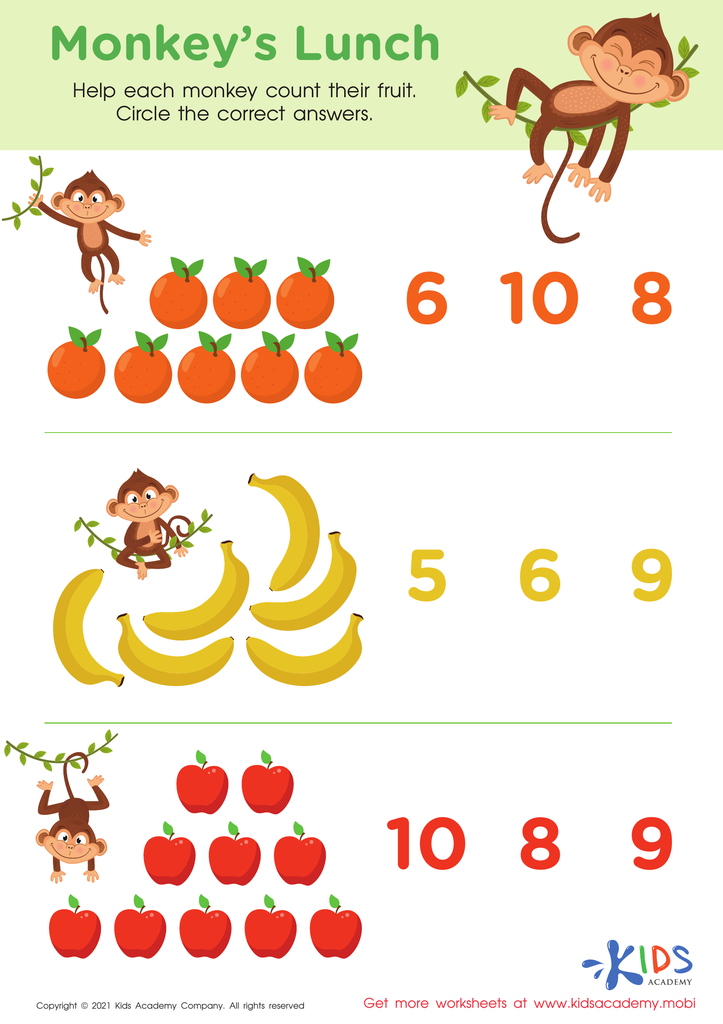
Monkey’s Lunch Worksheet
Download this free worksheet to help your kindergartner perfect their counting skills! Have your child circle the correct answers and count the fruits for the monkeys. It'll seem like fun, but your child is really learning how to count, group objects, and identify numbers.
Monkey’s Lunch Worksheet
Worksheet
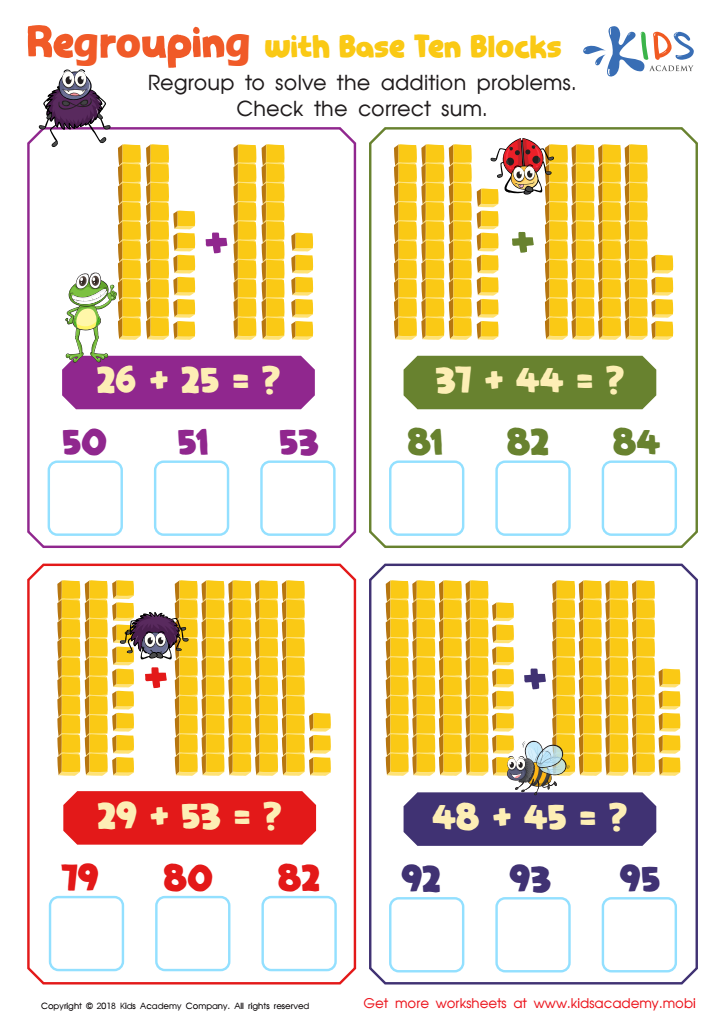
Regrouping With Base Ten Blocks Worksheet
Challenge your child to regroup the base ten blocks and solve the four equations in this worksheet. This exercise requires counting and adding up in base ten. When they are done, help them check the correct sum.
 Assign to My Students
Regrouping With Base Ten Blocks Worksheet
Worksheet
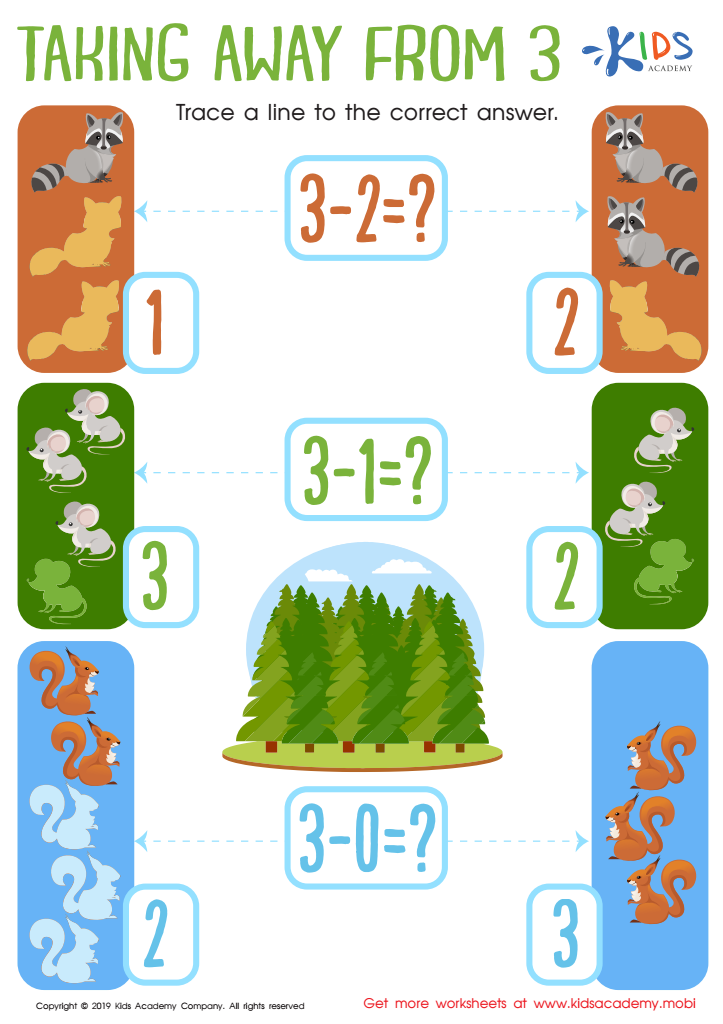
Taking Away From 3 Worksheet
Help your students learn equations and math easily by using this tracing worksheet. It has three different equations that they can count and solve, then trace a line to the correct answer. This will make the learning process fun and exciting.
Taking Away From 3 Worksheet
Worksheet
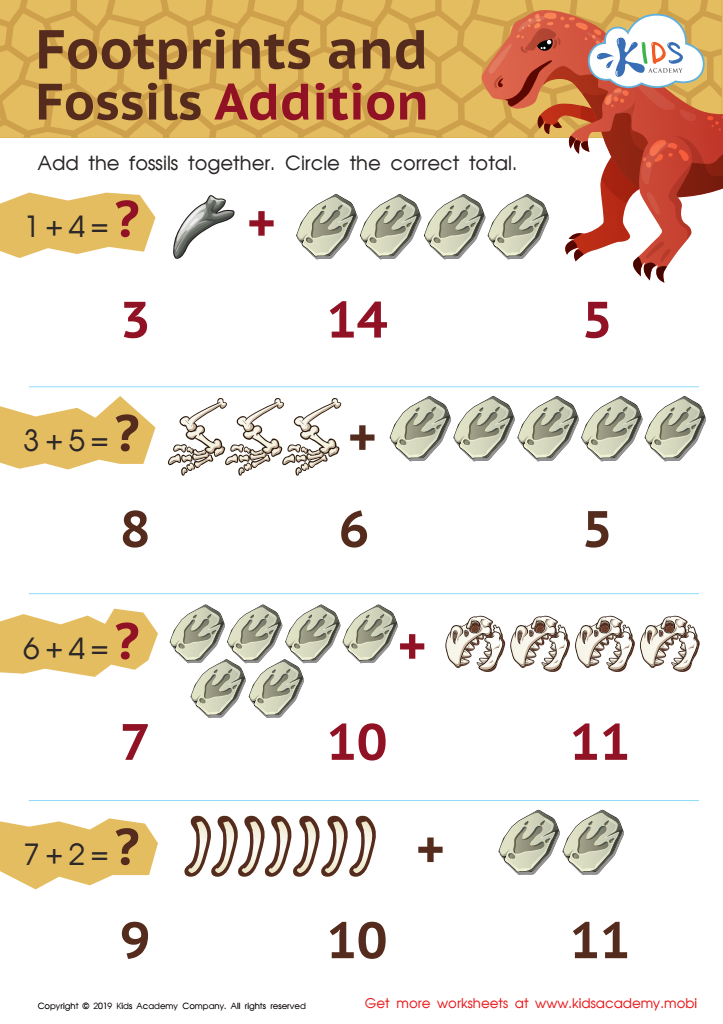
Footprints and Fossils Addition Worksheet
Show your students that addition and subtraction is easy with the right guidance and exercises. Use this worksheet to help them practice by adding fossils and circling the correct total of each equation. Your students will soon see that addition and subtraction is not so intimidating after all.
Footprints and Fossils Addition Worksheet
Worksheet
Join Kids Academy for Free
Who is primarily going to use this learning content?


.jpg)




Enhancing counting skills in children aged 4-6 is crucial for several reasons. At this developmental stage, children are laying the foundation for their mathematical understanding. Counting is not just a skill; it promotes cognitive development, helping children understand quantities and relationships between numbers, which is essential for more advanced math concepts later on.
Moreover, strong counting skills boost confidence and foster a positive attitude toward learning. When children can accurately count and recognize numerals, they become more engaged learners, showing a willingness to explore mathematical concepts through play and interaction.
Additionally, counting activities support fine motor skills and language development. Using counters, toys, or everyday objects during counting promotes hand-eye coordination. Describing their counting process enhances vocabulary and communication skills.
Developing counting skills also aids in problem-solving abilities, critical for navigating various life situations. These early experiences in math are directly linked to future academic success, as children with strong counting abilities often excel in school.
Ultimately, parents and teachers play a vital role in nurturing these skills, encouraging a rich mathematical environment that empowers children to embrace learning and think critically. In doing so, they are setting the stage for lifelong learning and a robust understanding of mathematics.








