
Shape Recognition Physical Science Worksheets for Ages 4-6
3 filtered results
Difficulty Level
Grade
Age
-
From - To
Subject
Activity
Standards
Explore our engaging Shape Recognition Physical Science Worksheets designed specifically for children ages 4 to 6! These interactive worksheets aim to enhance early learning through fun activities that promote shape identification and cognitive development. Kids will engage with vibrant visuals, puzzles, and hands-on exercises that make learning about shapes enjoyable. Our worksheets encourage not only shape recognition but also critical thinking and fine motor skills. Ideal for homes and classrooms, these resources support a foundational understanding of physical science concepts in a playful way. Start your child’s journey in scientific discovery and creativity today with our tailored worksheets!
Favorites
With answer key
Interactive
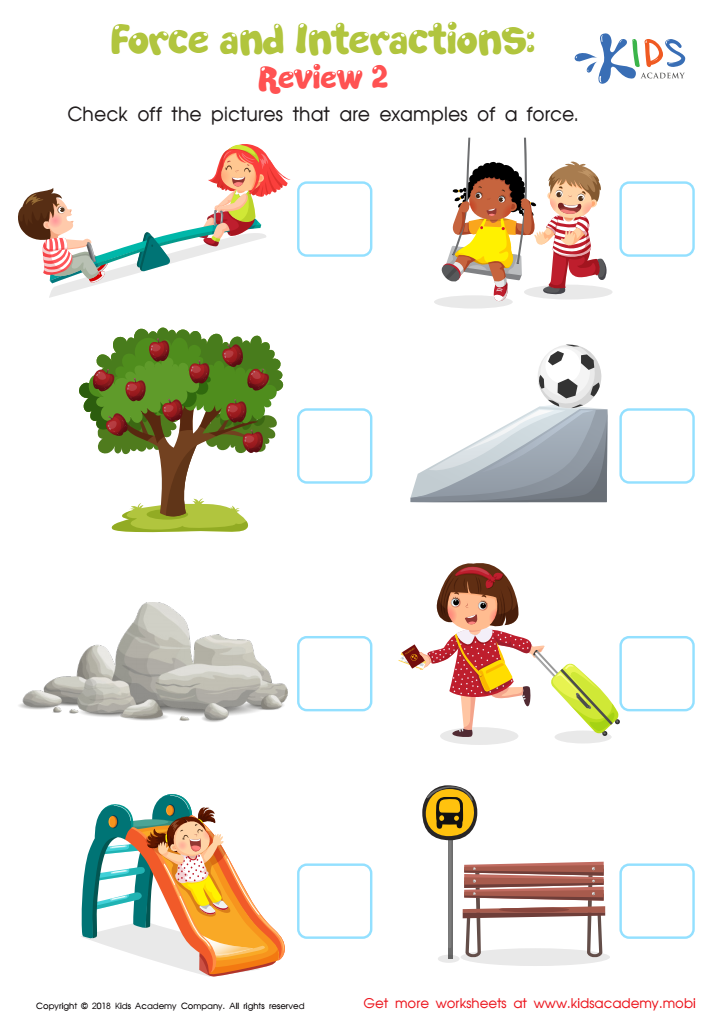
Force and Interactions: Review 2 Worksheet
Your child can identify force examples by checking the pictures. There are 8 images of kids engaging in activities and objects in motion. Get them to name the activities and objects, or if they know, explain force and interaction.
 Assign to My Students
Force and Interactions: Review 2 Worksheet
Worksheet
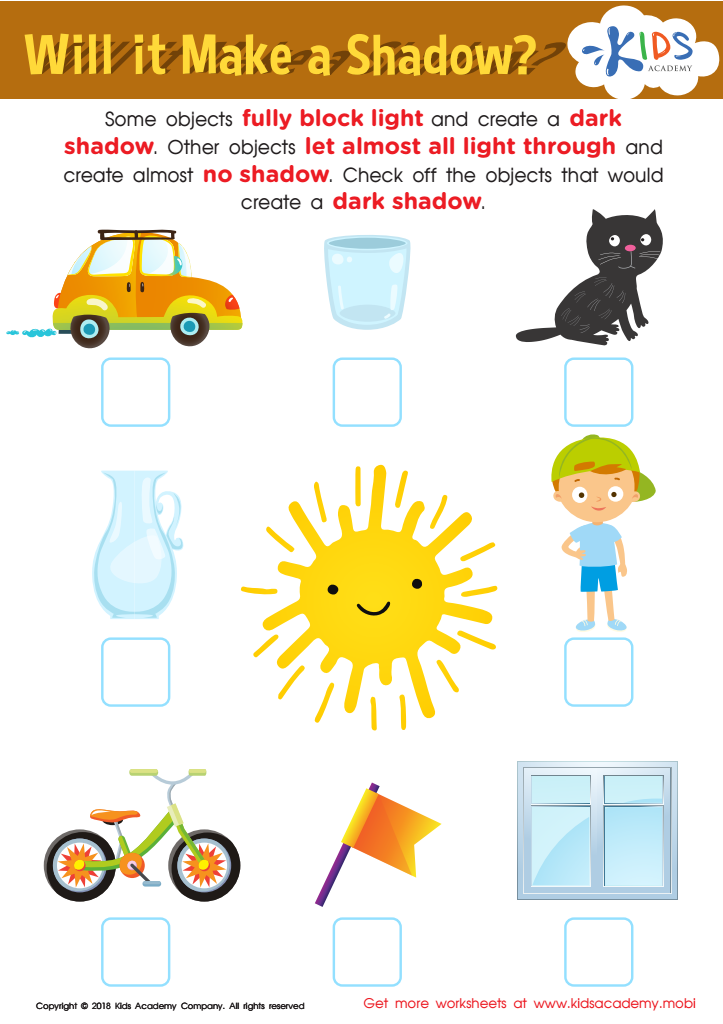
Will It Make a Shadow? Worksheet
Teach your students about shadows with this printout. Ask them to check off the boxes next to the pictures that create a shadow. Explain that some objects block light, forming a shadow, while others don't and thus don't create a shadow. Your students are likely already familiar with their own shadow.
Will It Make a Shadow? Worksheet
Worksheet
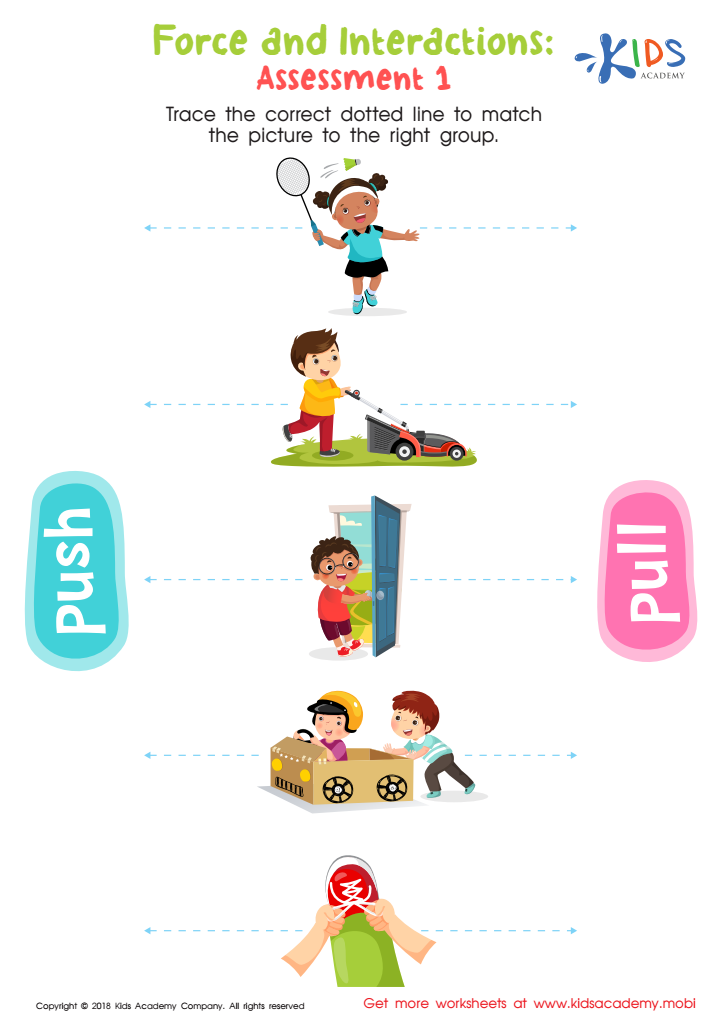
Force and Interactions: Assessment 2 Worksheet
Help your child see the difference between push and pull with this fun worksheet. Ask them to match each picture to the right group. The "push" is on the left and the "pull" is on the right. Assist them in tracing the activities and explain what it is the people are doing.
Force and Interactions: Assessment 2 Worksheet
Worksheet
Join Kids Academy for Free
Who is primarily going to use this learning content?








Shape recognition is a foundational skill in early childhood education that lays the groundwork for children’s cognitive development. For children aged 4-6, recognizing shapes not only enhances their visual perception but also improves their spatial awareness, which is crucial for mathematical understanding and later problem-solving skills.
Parents and teachers should care about shape recognition because it supports critical thinking. As children learn to identify and categorize shapes, they develop the ability to group objects based on characteristics, fostering early logical reasoning. Furthermore, shape recognition plays a critical role in their everyday environment, helping them navigate and describe the world around them.
Engaging with shapes can also enhance fine motor skills through activities like cutting, drawing, and building. These activities promote hand-eye coordination and creativity. Additionally, incorporating shape recognition into play encourages interactive learning experiences, which are essential for engagement and motivation.
Ultimately, the exploration of shapes serves as a gateway to more complex concepts in science and mathematics, creating a strong foundation that benefits a child's academic journey. By prioritizing shape recognition, parents and teachers are investing in essential skills that will benefit children academically and socially as they progress.







