
Basic arithmetic understanding Worksheets for Ages 4-7
7 filtered results
Difficulty Level
Grade
Age
-
From - To
Subject
Activity
Standards
Discover our “Basic Arithmetic Understanding Worksheets” designed specifically for children aged 4-7. These engaging worksheets help young learners build a solid foundation in essential math concepts through fun and interactive activities. With a variety of exercises on addition, subtraction, and number recognition, children will develop confidence in their arithmetic skills. Our worksheets feature vibrant visuals and relatable scenarios, making learning enjoyable and effective. Ideal for homeschooling or classroom settings, these resources empower educators and parents to cultivate a positive math experience. Start your child's journey to mathematical success with our thoughtfully crafted worksheets today!
Favorites
With answer key
Interactive
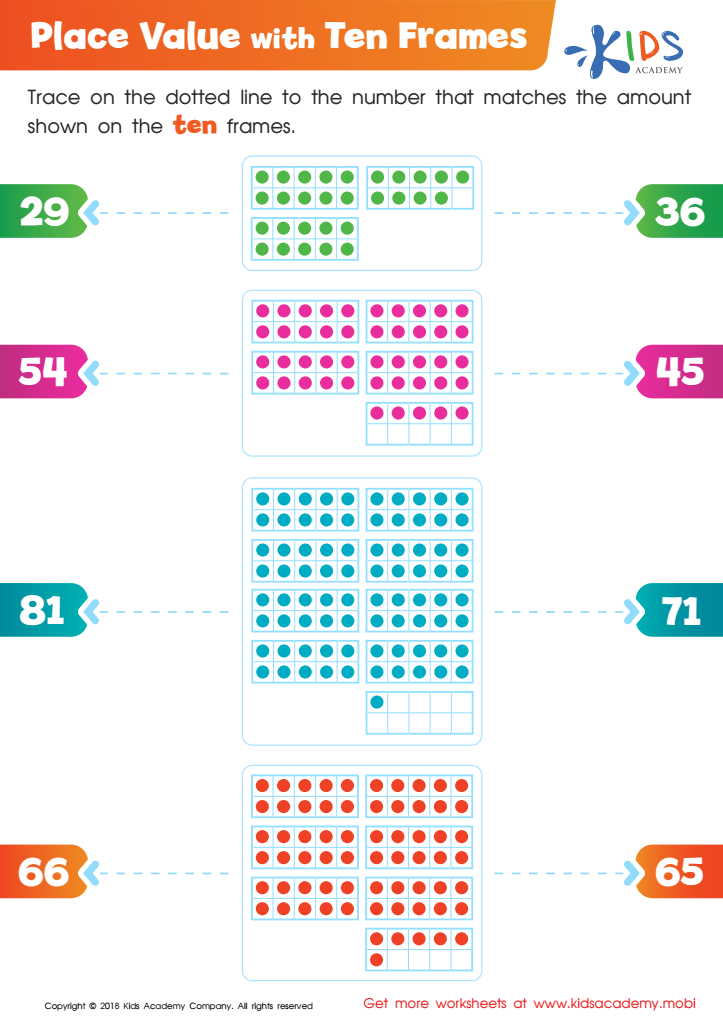
Place Values with Ten Frames Worksheet
Assist your child in counting the dots in each of the framed numbers. Then, guide them as they trace the dotted lines to the number that matches the amount shown. This worksheet will help them learn more about mathematics, as well as how to count numbers.
 Assign to My Students
Place Values with Ten Frames Worksheet
Worksheet
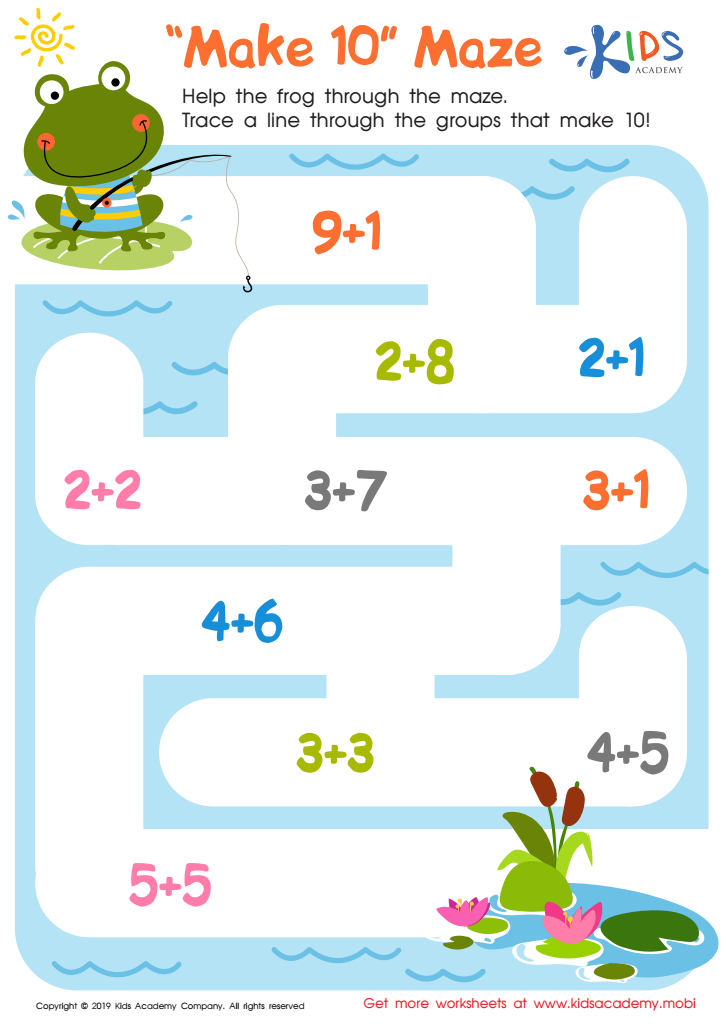
Make 10 Maze Worksheet
Help your child's frog friend make its way out of the maze! Mazes are an enjoyable way to get your kids to learn and can be a challenge. Have your kids take a look at this tracing sheet and help the frog make its way through the maze by tracing a line through the groups of equations that make 10. It’ll be a fun time for everyone!
Make 10 Maze Worksheet
Worksheet
Join Kids Academy for Free
Who is primarily going to use this learning content?







Basic arithmetic understanding is crucial for children aged 4-7 as it serves as the foundation for their overall mathematical development and academic success. At this stage, children begin to grasp fundamental concepts like addition, subtraction, number recognition, and counting, all of which are essential life skills. Understanding these concepts fosters critical thinking and problem-solving abilities, enabling children to approach challenges with confidence.
Moreover, early arithmetic skills correlate strongly with later mathematical proficiency, influencing future learning in subjects such as science and engineering. When parents and teachers prioritize math understanding, they help build a child's enthusiasm for learning, turning potentially daunting subjects into enjoyable activities through games, manipulatives, and real-life applications.
Additionally, early arithmetic promotes cognitive development, allowing children to categorize, compare, and sequence information. It also supports social development; children learn to collaborate on problem-solving tasks, enhancing their communication and teamwork skills.
Finally, strong arithmetic foundations can contribute to a child's emotional well-being, reducing anxiety surrounding mathematics as they progress in school. By nurturing these skills, teachers and parents play a vital role in setting up children for lifelong learning and success.








