Learning number patterns Worksheets for Ages 4-7
4 filtered results
-
From - To
Enhance your child's math skills with our engaging learning number patterns worksheets designed specifically for ages 4-7. These interactive worksheets help young learners grasp essential concepts of number sequencing and pattern recognition in a fun and stimulating way. Through colorful activities and exercises, children will develop their critical thinking and problem-solving abilities as they identify and create various number patterns. Perfect for both classroom use and at-home learning, our worksheets support early math development while keeping kids motivated and excited. Explore our collection today and watch your little ones master number patterns with confidence and joy!
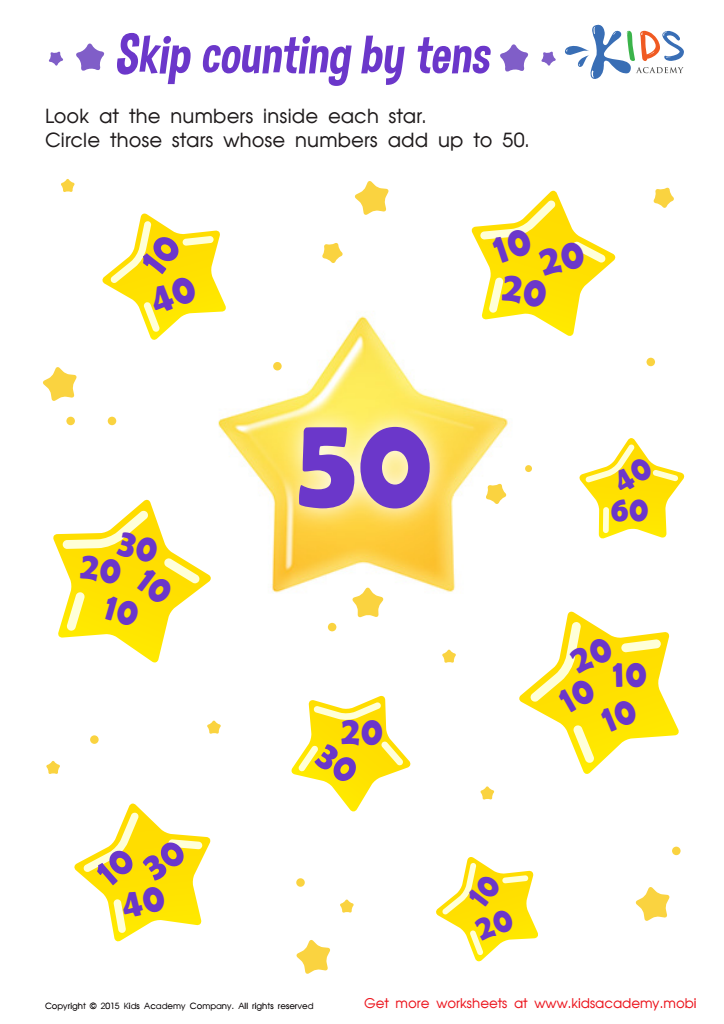
Learn Dozens: Skip Counting by Tens Printable
 Assign to My Students








Learning number patterns is crucial for children aged 4-7 as it lays the foundation for essential mathematical skills. Understanding number patterns helps young learners recognize sequences, which is a fundamental aspect of arithmetic and problem-solving. By identifying how numbers relate to one another, children develop critical thinking and logical reasoning skills that will benefit them in all areas of life.
For teachers and parents, fostering this understanding benefits the entire learning process. It encourages a positive attitude towards math by making it engaging and interactive. When children grasp patterns, they become more confident in their abilities, which reduces anxiety towards more advanced mathematical concepts in the future.
Moreover, number pattern recognition enhances cognitive skills, such as memory and attention span, important for grasping other academic subjects. Integrating pattern recognition into everyday activities, such as counting snacks or recognizing shapes in the environment, creates fun and practical learning opportunities.
In a variety of ways, from games to songs, emphasizing patterns helps in creating a rich learning environment that nurtures curiosity, promotes exploration, and supports a lifelong love of learning. Thus, investing time and resources into teaching number patterns is essential for children’s long-term success in mathematics and beyond.








