Math comprehension Worksheets for Ages 4-7
3 filtered results
-
From - To
Unlock your child's potential with our Math Comprehension Worksheets for ages 4-7! Designed to inspire and challenge young minds, our engaging worksheets focus on foundational math skills such as addition, subtraction, counting, and pattern recognition. Each activity is tailored to be both educational and fun, ensuring that early learners develop a strong mathematical foundation while keeping their curiosity alive. Perfect for home or classroom use, these printable resources are a great way to support early math comprehension and boost your child's confidence. Set your young learner on the path to success with our expertly crafted worksheets!
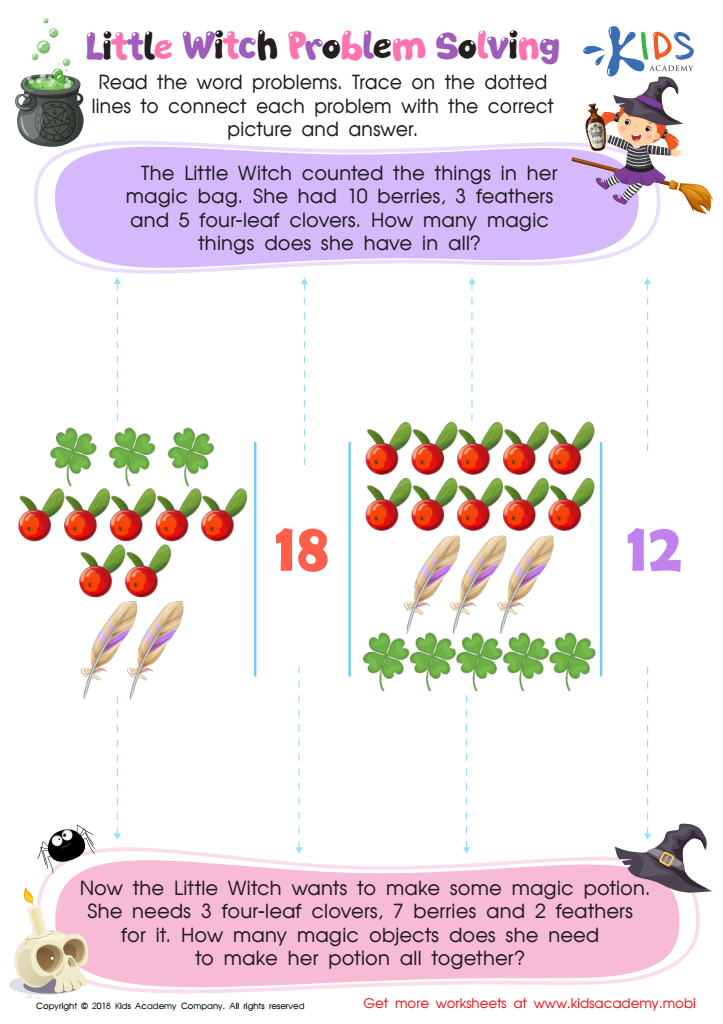
Little Witch Problem Solving Worksheet
 Assign to My Students
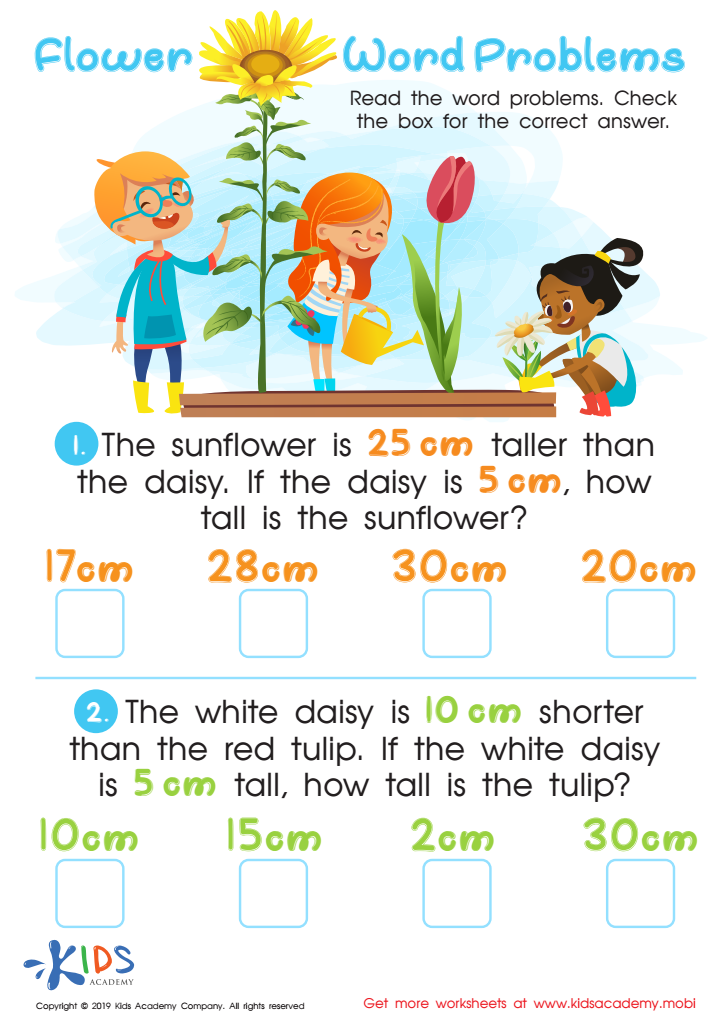
Flower Word Problems Worksheet








Mathematical comprehension during the ages of 4-7 is critical for a child's overall cognitive development and academic success. During these formative years, children are not only learning basic math skills but are also developing foundational problem-solving abilities and critical thinking skills. Math teaches children how to recognize patterns, understand relationships between numbers, and develop logical reasoning pathways.
Early math skills are strongly correlated with later academic achievement, not only in math but also in reading and other subjects. A study from the National Mathematics Advisory Panel in the U.S. found that early math skills are a more significant predictor of later academic success than early reading skills. Hence, fostering a love and understanding of math at a young age can set the stage for future educational benefits.
Moreover, early math experiences can boost a child's confidence both in school and in life. Struggling with math can lead to feelings of anxiety and inadequacy, whereas mastery and comprehension can lead to positive attitudes and self-assurance. In practical terms, math skills are crucial in daily life, from handling money to telling time and understanding measurements, which are all activities they engage in as they grow.
Therefore, parents and teachers should prioritize mathematical comprehension for young children, as it forms the bedrock of their future academic learning and equips them with tools necessary for everyday life and professional settings in their adulthood.








