Math problem-solving skills Worksheets for Ages 4-7
5 filtered results
-
From - To
Enhance your child's mathematical abilities with our engaging Math Problem-Solving Skills Worksheets designed for ages 4-7. Each worksheet focuses on fundamental concepts such as addition, subtraction, shapes, and patterns, tailored to young learners. Our age-appropriate exercises encourage critical thinking, logical reasoning, and independent problem-solving, making math fun and approachable. Perfect for both classroom and at-home learning, these worksheets support early childhood education by laying a strong foundation for future math success. Start building your child's confidence and skills in math with our expertly crafted resources available at Kids Academy. Download now and watch them excel!
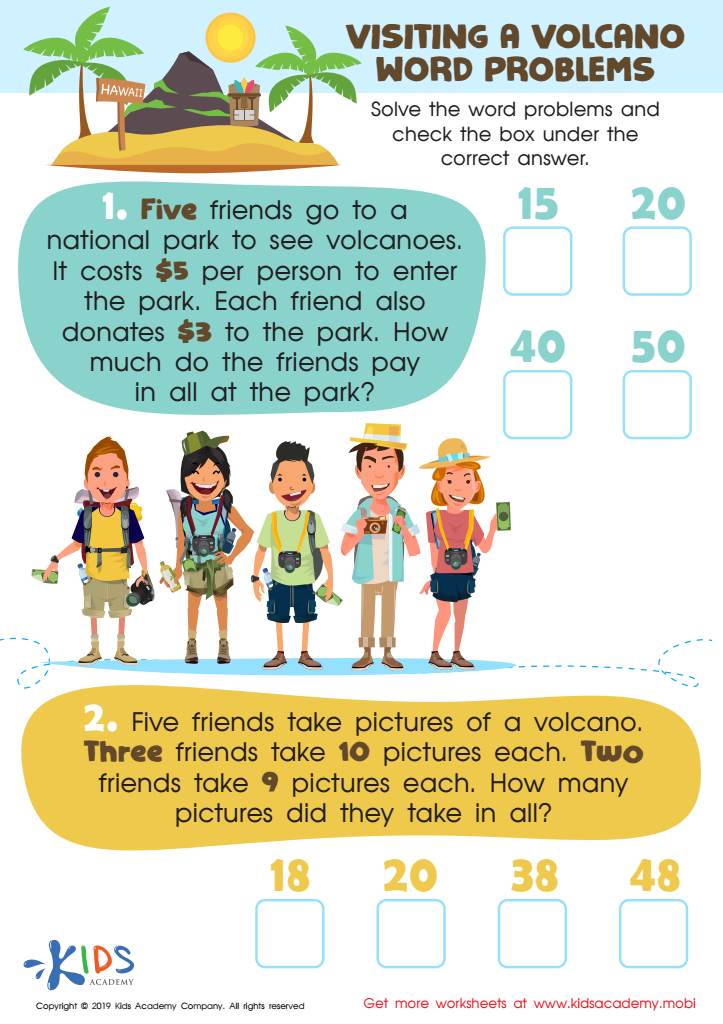
Visiting a Volcano Word Problems Worksheet
 Assign to My Students




.jpg)


Math problem-solving skills are crucial for young children aged 4-7 because they form the foundation for future academic success and daily life skills. At this formative stage, developing a child's ability to solve mathematical problems boosts their critical thinking and logical reasoning, skills that are essential across all areas of learning and decision-making throughout life.
Early math skills go beyond mere numbers; they help children recognize patterns, understand spatial relationships, and develop a structured way of thinking. Problems such as simple addition and subtraction, sorting, measuring, and recognizing shapes can make learning interactive and engaging. This also nurtures creativity, as kids begin to conceptualize and tackle challenges from various angles.
Furthermore, math problem-solving fosters a sense of achievement and builds confidence. When children engage in solving a problem and reach the correct solution, they're likely to develop a "can-do" attitude. This positive self-concept leads to resilience in facing new challenges—not just in math, but in other subjects and life situations.
Lastly, engaging in math problem-solving is a shared activity that encourages communication and cooperative learning among peers and with parents or teachers. This social aspect can enhance a child's ability to express ideas, listen to others, and build relationships, further contributing to their all-around development.








