Practicing mental arithmetic Worksheets for Ages 4-7
3 filtered results
-
From - To
Boost your child's numerical skills with our "Practicing Mental Arithmetic Worksheets for Ages 4-7!" Designed to engage young minds, these printable resources focus on core math concepts, enhancing addition, subtraction, and problem-solving abilities. Each worksheet provides age-appropriate challenges, fostering logical thinking and boosting confidence in math. Perfect for both classroom and home use, our activities make learning fun through interactive exercises that hold children's interest and make practicing mental arithmetic enjoyable. Lay a strong foundation for future math success and build essential skills with our expertly crafted worksheets. Download now and watch your child excel!
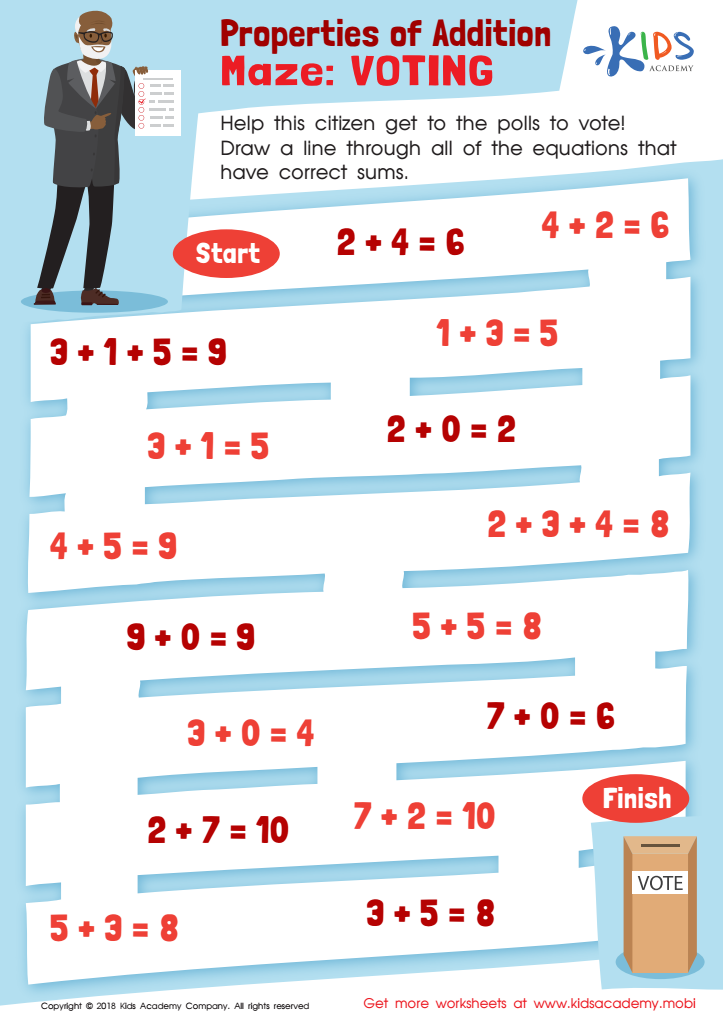
Properties of Addition Maze: Voting Worksheet
 Assign to My Students
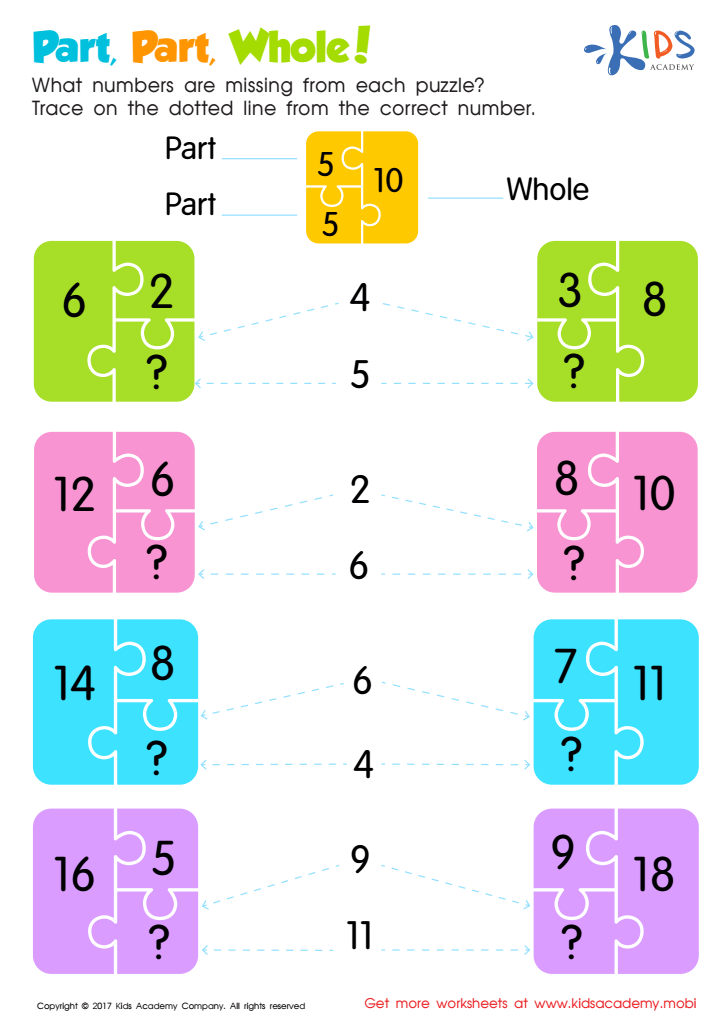
Part, Part, Whole Worksheet






Practicing mental arithmetic for children aged 4-7 is crucial because it lays a foundational framework for their future academic success and cognitive development. At this pivotal age, children's brains are highly pliable and receptive to new information, making it the perfect time to introduce basic mathematical concepts and problem-solving skills through mental arithmetic.
Firstly, mental arithmetic enhances numerical fluency. This early exposure helps children to understand numbers, patterns, and relationships intuitively, fostering a strong number sense which is pivotal as they advance to more complex math. Proficient mental arithmetic skills also promote independence and confidence in young learners, empowering them to tackle everyday problems like counting change or measuring ingredients without hesitation.
Secondly, engaging in mental arithmetic exercises sharpens cognitive abilities, such as memory, concentration, and logical reasoning. These skills are not just essential for math, but are transferrable to other academic areas and daily life situations. Mental calculation encourages kids to think critically and develop effective strategies for problem-solving, strengthening their overall intellectual preparedness.
Moreover, practicing mental arithmetic can be a fun and interactive way to involve parents and teachers in children's learning. Simple activities like number games, quick-fire questions, or counting exercises make learning enjoyable, reinforcing a positive attitude towards mathematics from an early age. Investing effort in mental arithmetic practice creates a robust foundation, paving the way for academic achievement and lifelong critical thinking skills.








