
Understanding moon phases Worksheets for Ages 4-7
3 filtered results
Difficulty Level
Grade
Age
-
From - To
Subject
Activity
Standards
Discover our engaging "Understanding Moon Phases Worksheets" tailored for ages 4-7! These fun and educational worksheets use colorful visuals and simple explanations to help young learners grasp the different phases of the moon. Ideal for home or classroom use, each activity encourages kids to observe, identify, and understand how the moon changes over the month. Activities include picture matching, sequencing, and drawing phases. Perfect for sparking curiosity in astronomy, these worksheets build foundational science and critical thinking skills. Ignite your child’s love for learning about space with our captivating and interactive moon phase activities!
Favorites
With answer key
Interactive
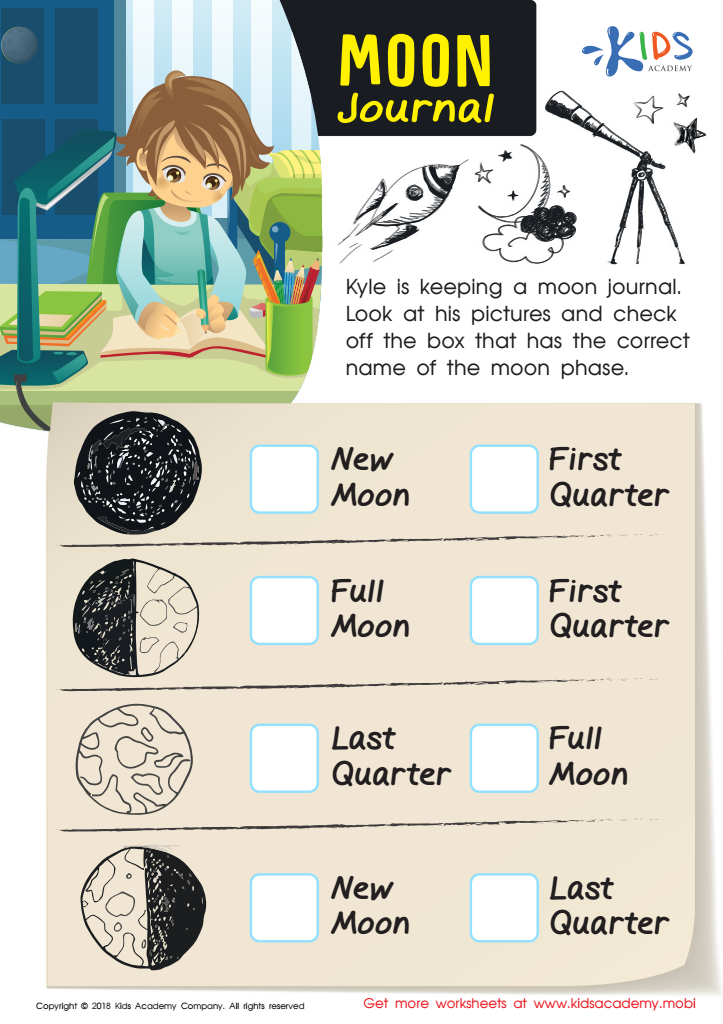
Moon Journal Worksheet
Observe the moon and its 8 phases with your child by downloading this free PDF worksheet from Kids Academy! Review the moon phases with them then help them label Kyle's moon journal. Select the right moon phase for each picture to complete the page!
 Assign to My Students
Moon Journal Worksheet
Worksheet
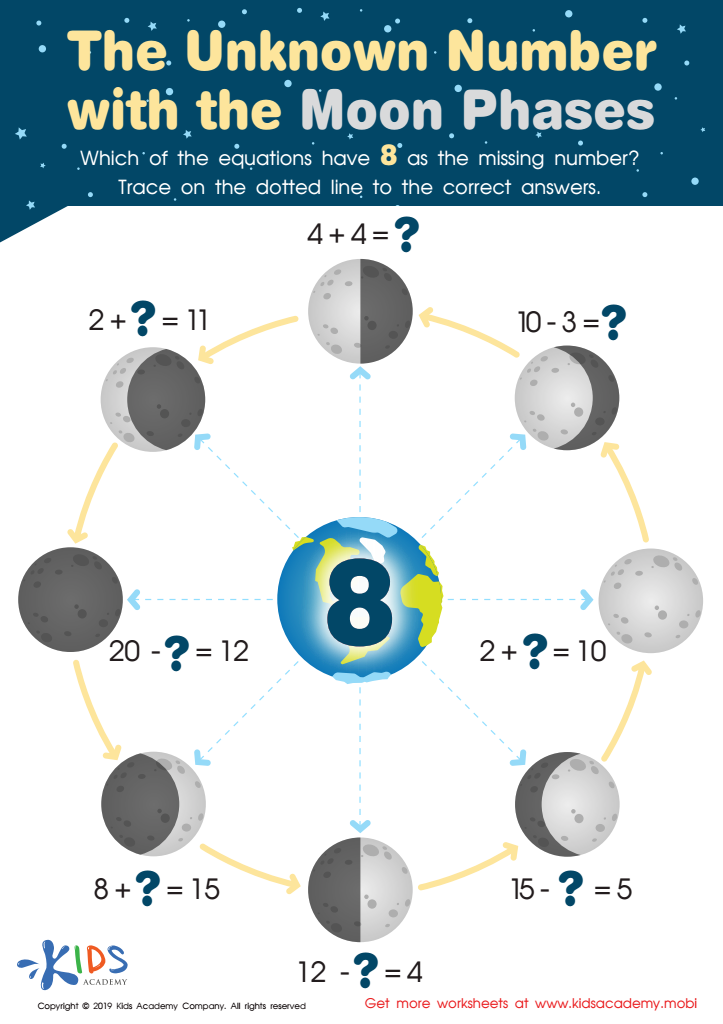
The Unknown Number with the Moon Phases Worksheet
Show your kids the moon one night! Explain why its shape changes during the month with a worksheet. Then, help them to solve math equations and trace the answer, where the missing number is '8'.
The Unknown Number with the Moon Phases Worksheet
Worksheet
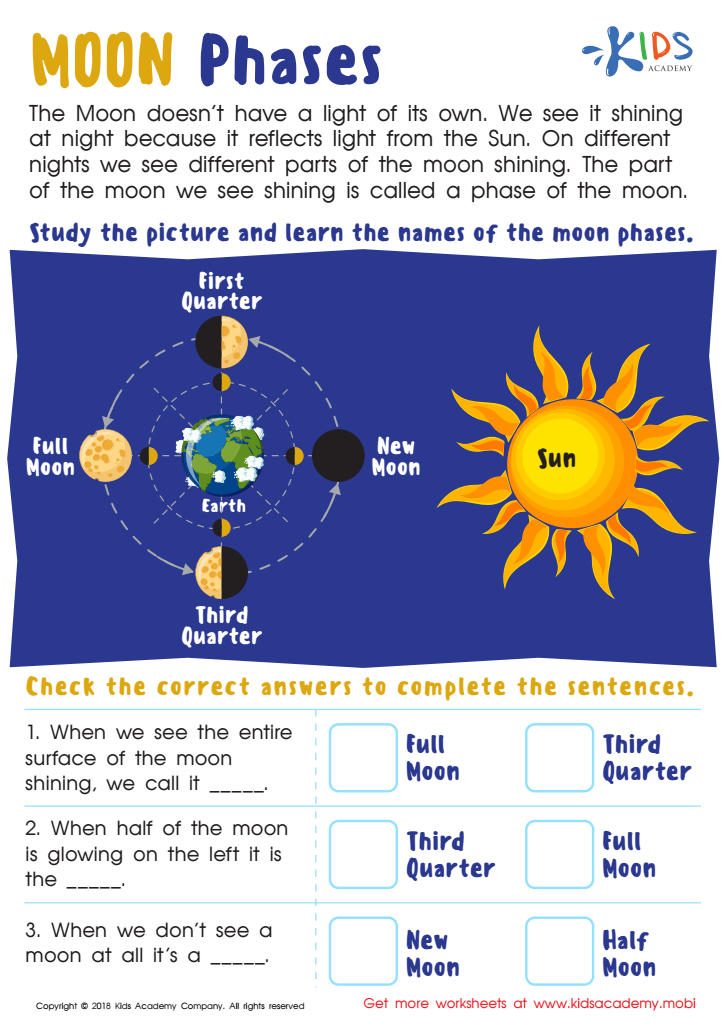
Moon Phases Worksheet
Gaze up at the night sky and the moon's appearance may change from night to night. Encourage your child to learn more about the sun, the moon, and space with this science worksheet. Have them read the text then study the picture. Finally, read the sentences and check the answers to identify the moon's phases.
Moon Phases Worksheet
Worksheet
Join Kids Academy for Free
Who is primarily going to use this learning content?






Understanding moon phases can be a captivating and educational experience for young children aged 4-7 for several reasons. Firstly, it fosters a sense of curiosity about the natural world. Children are naturally inquisitive, and the changing shape of the moon provides a concrete and consistent natural phenomenon to spark their interest and wonder.
Secondly, learning about moon phases can support the development of scientific thinking. By observing the moon, children can practice skills like pattern recognition and critical thinking as they notice how the moon's appearance changes over time. This can lay a foundation for future scientific learning and encourage kids to ask questions and seek answers about the world around them.
Additionally, teaching moon phases can bolster language and literacy skills. As children describe the moon’s shapes and their observations, they expand their vocabulary and communication abilities. Words like "crescent," "gibbous," and "full moon" become part of their linguistic repertoire.
Lastly, integrating moon phases into the curriculum can create cross-disciplinary opportunities for learning. It can be tied to storytelling, art projects (like drawing the moon phases), and even simple math (counting days between phases). Overall, understanding moon phases aligns well with early childhood education's holistic and exploratory approach, making it both beneficial and enriching for young learners.








