
Understanding punctuation Worksheets for Ages 4-7
4 filtered results
Difficulty Level
Grade
Age
-
From - To
Subject
Activity
Standards
Our "Understanding Punctuation Worksheets for Ages 4-7" are designed to help young learners grasp fundamental punctuation rules. With engaging activities and colorful exercises, these worksheets make learning periods, commas, question marks, and exclamation points enjoyable and accessible. Perfect for early grade students, parents and educators can use these resources to build a solid punctuation foundation. Our worksheets encourage practice through fun and interactive formats, ensuring that children develop essential writing skills. Set your child on the path to literacy success today with our expert-designed punctuation worksheets tailored just for young minds!
Favorites
With answer key
Interactive
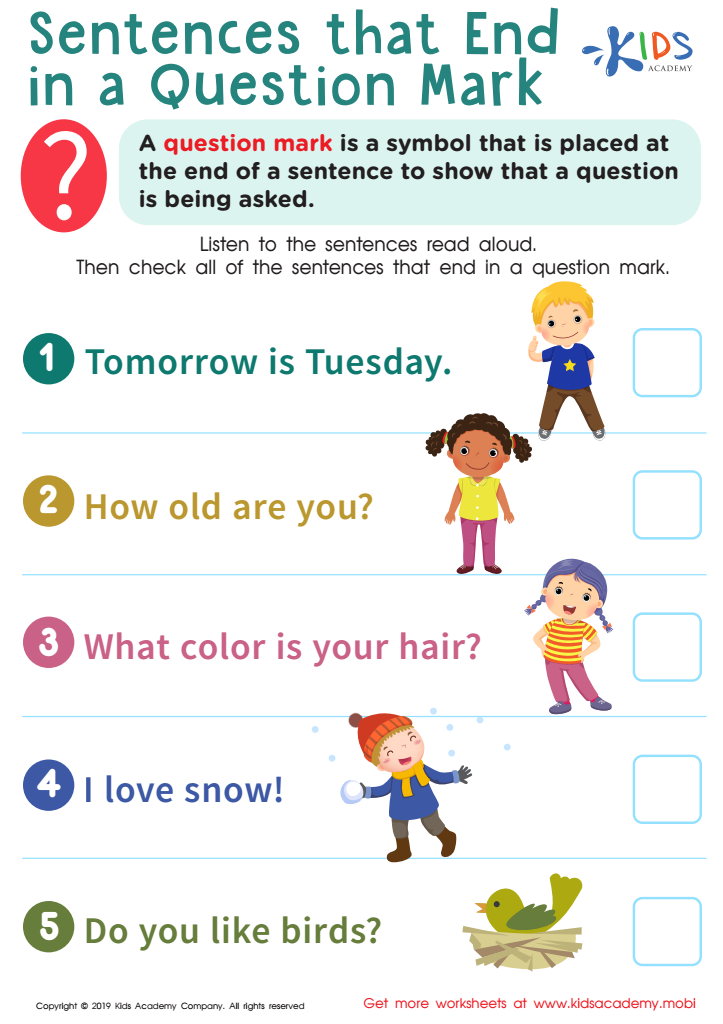
Sentences That End in an Question Mark Worksheet
Teach your students about the four most common punctuation marks - period, comma, question mark, and exclamation mark - with this worksheet. Show them how to use the question mark to indicate a sentence is a question. Then, have them check all sentences that end in a question mark.
 Assign to My Students
Sentences That End in an Question Mark Worksheet
Worksheet
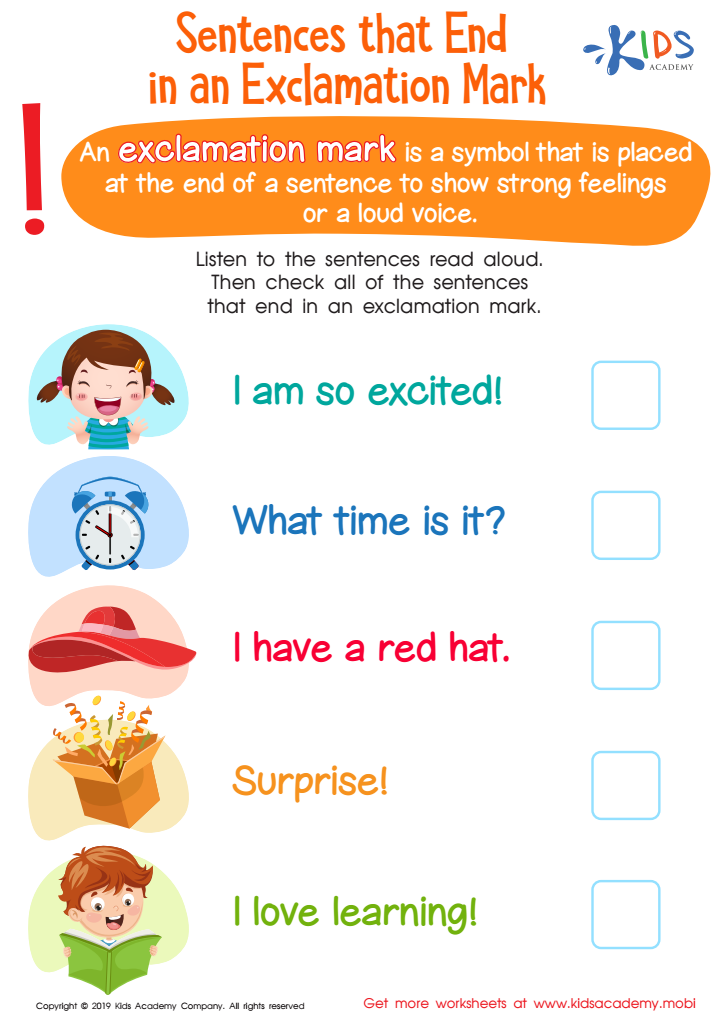
Sentences That End in an Exclamation Mark Worksheet
This worksheet is a great way to brush up kids' punctuation skills. Period, comma, question mark and exclamation mark are the first four punctuation marks they should learn. Exclamation marks show strong emotion or a noise. Use this printout to teach and test kids' understanding of exclamation marks.
Sentences That End in an Exclamation Mark Worksheet
Worksheet
Join Kids Academy for Free
Who is primarily going to use this learning content?






Understanding punctuation is crucial for young learners, as it forms the foundation of effective communication. For children aged 4-7, learning punctuation helps in several ways. First, punctuation marks are essential tools that teach kids how to read sentences fluently. For example, periods signal the end of a thought, while commas indicate a brief pause. This leads to better reading comprehension and a more enjoyable reading experience.
Secondly, early exposure to punctuation helps children write more clearly. Understanding where to place periods, question marks, and exclamation points lets them organize their thoughts and convey their ideas more accurately. This fundamental skill becomes increasingly important as they advance in school, where good writing is essential for succeeding in various subjects.
Moreover, learning punctuation from an early age instills attention to detail and patience in young learners, essential attributes for academic and personal growth. Recognizing and using punctuation correctly also enhances verbal communication skills, making children more effective speakers.
Lastly, mastering punctuation fosters self-confidence. When kids know how to read and write correctly, they’re proud of their abilities. Confidence in basic language skills sets a positive trajectory for lifelong learning, making it essential for both parents and teachers to prioritize punctuation education.








