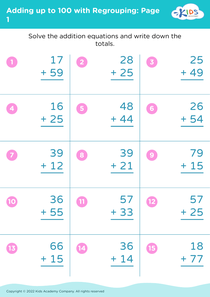
Improve counting skills Adding up to 100 Without Regrouping Worksheets for Ages 4-7
3 filtered results
-
From - To
Enhance your child's counting skills with our "Adding Up to 100 Without Regrouping" worksheets, designed specifically for ages 4-7. These engaging and interactive worksheets provide a fun way to master addition without the complexities of regrouping. Perfect for young learners, our activities promote confidence and proficiency in counting and basic math operations. By practicing regularly with these age-appropriate exercises, children will improve their number recognition, mental math capabilities, and problem-solving skills. Whether in the classroom or at home, our worksheets offer a valuable resource to support your child's mathematical journey. Start their learning adventure today!
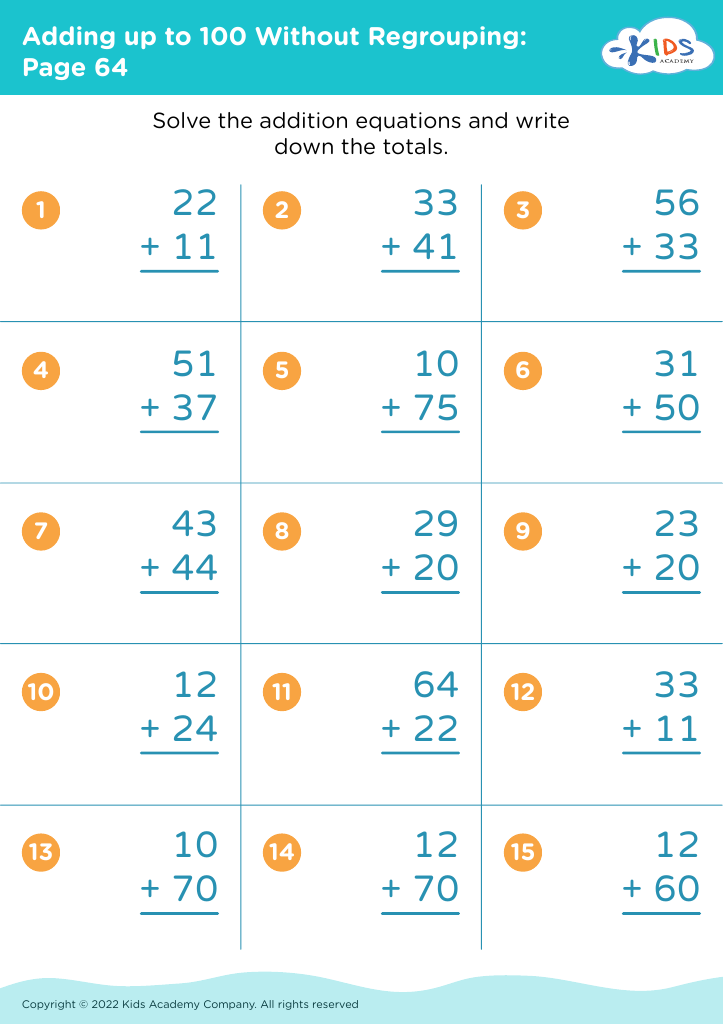
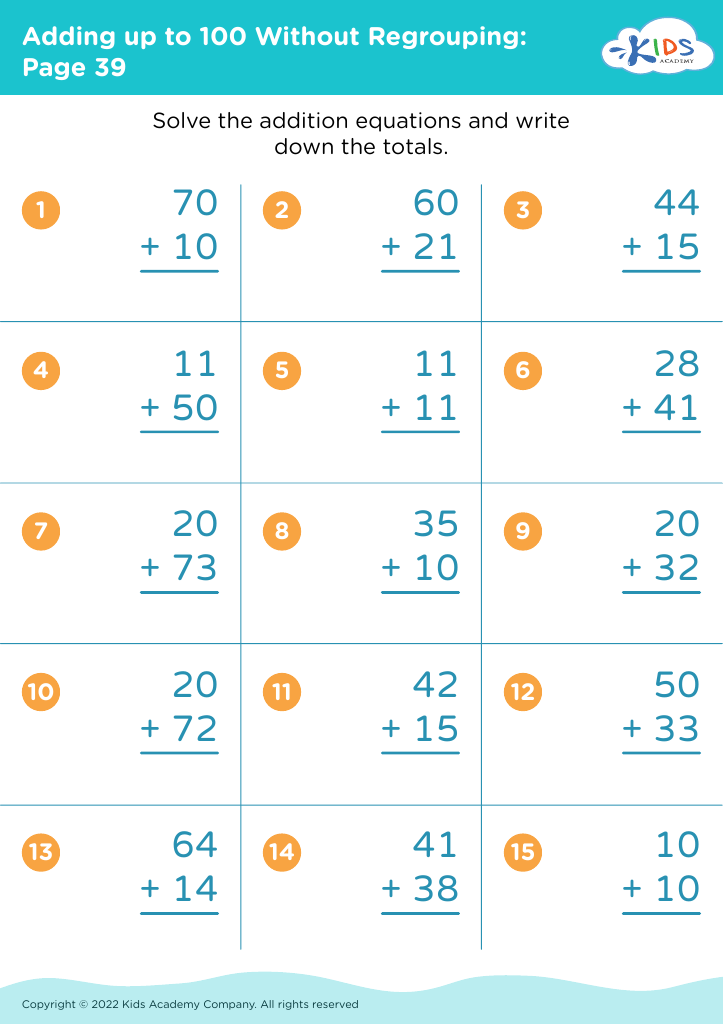
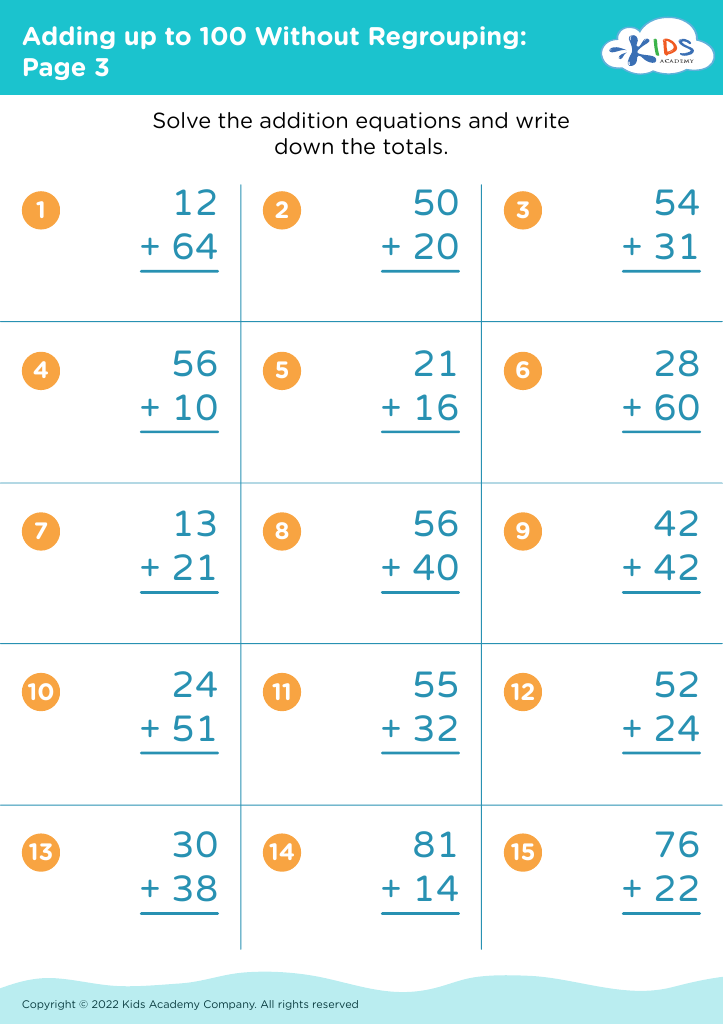




Counting skills, particularly adding up to 100 without regrouping, are foundational in a child’s early mathematical development. For children aged 4-7, these skills foster number sense and build confidence in mathematics. When parents and teachers prioritize these skills, they are equipping children with essential tools to understand basic arithmetic concepts, which are pivotal for future learning.
Mastering counting and addition without regrouping helps young learners develop mental math abilities. This not only simplifies more complex math problems in later grades but also lays the groundwork for critical thinking and problem-solving skills. By achieving proficiency in these early skills, children experience a sense of accomplishment, enhancing their motivation to engage with math.
Additionally, strong counting skills support various areas of learning, including pattern recognition and spatial awareness, and are linked to better performance in subjects like science and technology. Moreover, these skills encourage a positive association with math, reducing anxiety and fostering a love for learning.
Ultimately, by emphasizing counting skills in early education, parents and teachers help create a strong mathematical foundation that benefits children throughout their academic journey and beyond. Investing time in this area yields long-term benefits for students as they navigate increasingly complex concepts.