Fraction representation Addition & Subtraction Worksheets for Ages 4-7
3 filtered results
-
From - To
Introduce young learners to the world of fractions with our engaging Fraction Representation Addition & Subtraction Worksheets, specially designed for ages 4-7. These printable resources from Kids Academy feature vibrant visuals and fun exercises to simplify complex concepts. Through interactive problems and activities, children practice adding and subtracting fractions, enhancing their understanding and confidence in math. Ideal for both classroom and at-home learning, these worksheets support foundational skills that set the stage for future success. Foster a love for numbers and fractions, and watch your child's math abilities grow with each completed sheet!
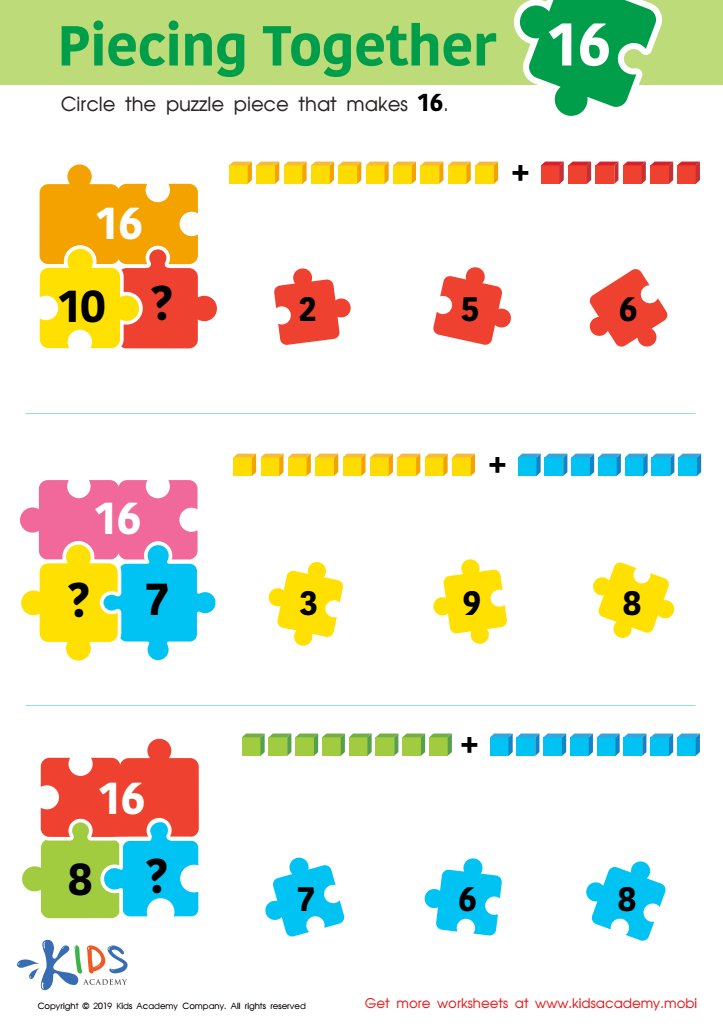
Piecing Together 16 Worksheet
 Assign to My Students
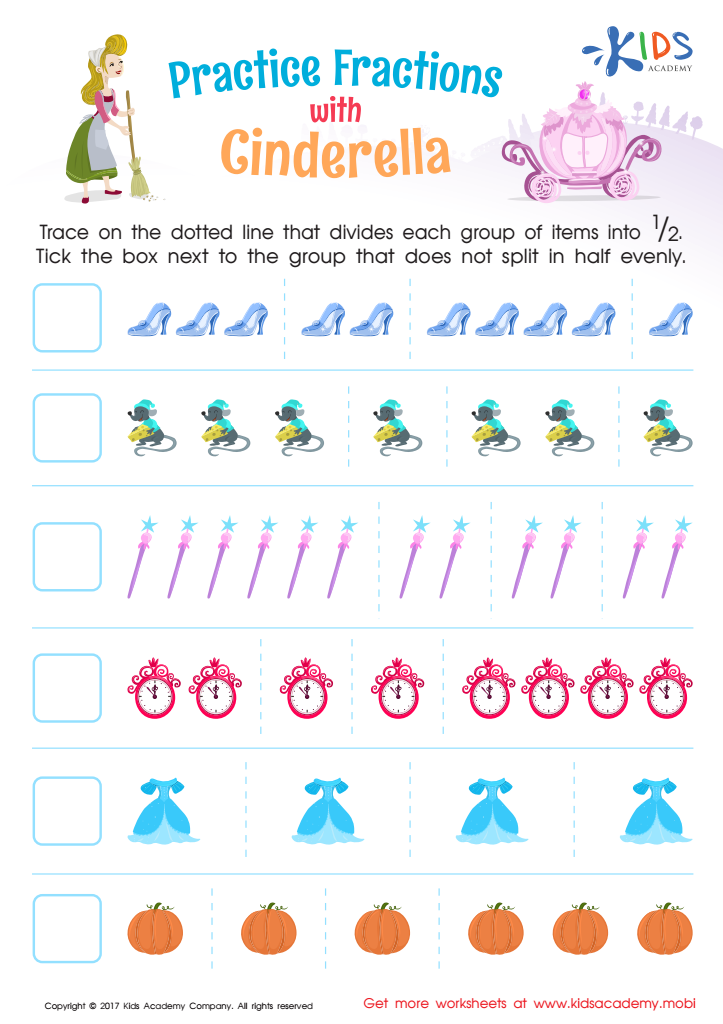
Fractions: Cinderella Printable








Engendering a strong foundation in fraction representation, addition, and subtraction at an early age, specifically between ages 4-7, is crucial for several substantial reasons. First, early introduction to fractions fosters better understanding of more complex mathematical concepts encountered later in education, such as algebra and geometry. By familiarizing young learners with these basic concepts, parents and teachers can mitigate the learning gaps that often appear in higher grades.
Additionally, grasping fraction representation and basic operations like addition and subtraction enhances a child’s overall number sense—a cognitive framework for understanding quantities and their relationships. This improvement in number sense can translate into heightened problem-solving skills, logical reasoning, and critical thinking.
Moreover, engaging with fractions at a young age helps develop visual-spatial skills and numerical fluency. Early exposure enables children to look at problems from different perspectives, an essential skill for both academic and real-world problem-solving scenarios.
Finally, incorporating these concepts into early education supports confidence in math. Math anxiety is a common issue that can hinder a child's performance in later years. By initially experiencing success with fractions, students build positive attitudes towards math, leading to a momentum of sustained learning and curiosity. Thus, parents and teachers leveraging this crucial developmental window can equip children with the tools necessary for lifelong mathematical success.








