
Mathematical thinking Addition Worksheets for Ages 4-7
4 filtered results
Difficulty Level
Grade
Age
-
From - To
Subject
Activity
Standards
Spark your child’s mathematical journey with our engaging Addition Worksheets designed for ages 4-7! These carefully crafted activities help build essential skills, fostering strong mathematical thinking and problem-solving abilities. Through colorful visuals and fun exercises, young learners grasp foundational concepts such as counting, number recognition, and basic addition. Perfect for home or classroom use, our worksheets make learning enjoyable, boosting confidence and academic performance. Encourage your child’s curiosity and love for math with resources tailored to their developmental needs. Visit Kids Academy today and watch your child excel with our premium educational materials!
Favorites
With answer key
Interactive
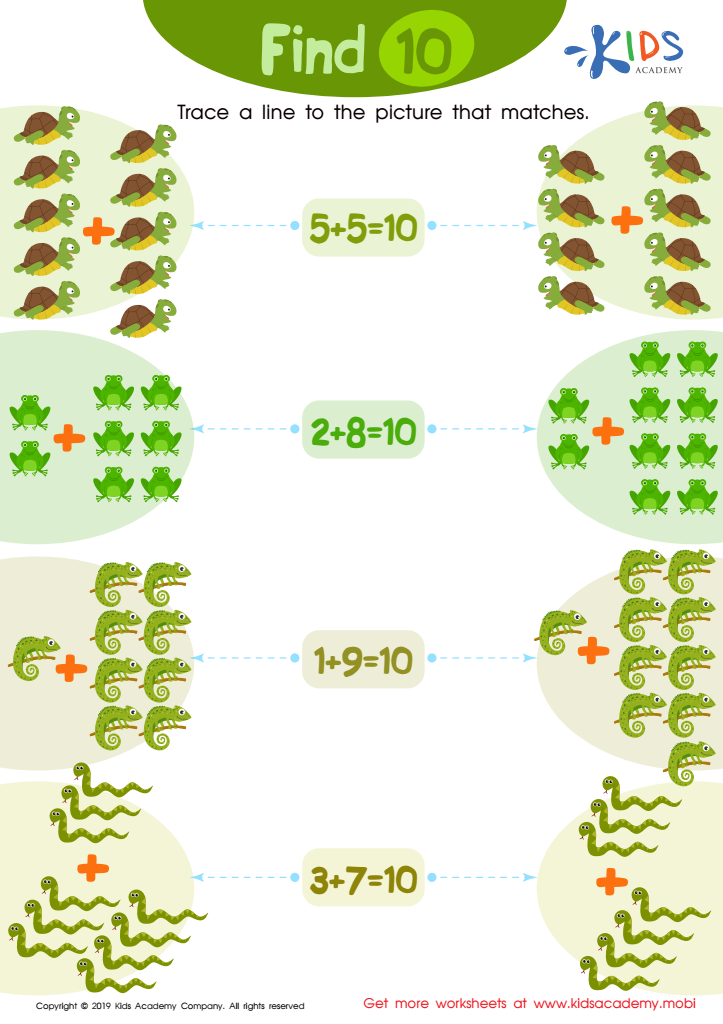
Find 10 Worksheet
Counting can be tricky, but your kids can master it with regular practice. Here's a fun activity to help: count the animals, then trace a line to the pictures that matches. With these tips, math will be an easy walk in the park.
 Assign to My Students
Find 10 Worksheet
Worksheet
Join Kids Academy for Free
Who is primarily going to use this learning content?







.jpg)
Introducing mathematical thinking, especially addition, to children ages 4-7 is crucial because it lays the foundation for future learning and cognitive development. At this age, children's brains are highly receptive and malleable, making it an optimal time to introduce key concepts that will scaffold more complex math in later years. Understanding addition helps develop logical thinking and problem-solving skills, which are applicable not only in math but across various life situations and academic subjects.
Additionally, early proficiency in math often boosts a child's confidence in their academic abilities. When children grasp addition, they begin to see patterns and relationships between numbers, fostering a positive attitude toward learning math overall.
On a social-emotional level, learning mathematics can enhance cooperative learning. Activities involving addition, such as group tasks or games, teach children how to work together, share, take turns, and communicate effectively.
Teachers and parents who prioritize early math education set the stage for lifelong numeracy. By integrating fun and engaging ways to learn addition, such as using physical objects, songs, or interactive apps, they help children become comfortable with numbers, which is essential for everyday tasks, from telling time to managing money. This early groundwork thus supports holistic educational development, making future academic challenges more approachable.








