
Pattern identification Addition Worksheets for Ages 4-7
3 filtered results
Difficulty Level
Grade
Age
-
From - To
Subject
Activity
Standards
Unlock the joy of learning with our Pattern Identification Addition Worksheets, designed specifically for children aged 4-7! These engaging worksheets make mastering basic addition skills fun and interactive, guiding young learners to recognize patterns while enhancing their mathematical understanding. Through colorful illustrations and age-appropriate exercises, kids will develop essential problem-solving skills as they identify, extend, and create patterns. Each worksheet encourages critical thinking and boosts confidence in math, providing a solid foundation for future learning. Perfect for both classroom settings and at-home practice, our resources are crafted to inspire a lifelong love for numbers! Check them out today!
Favorites
With answer key
Interactive
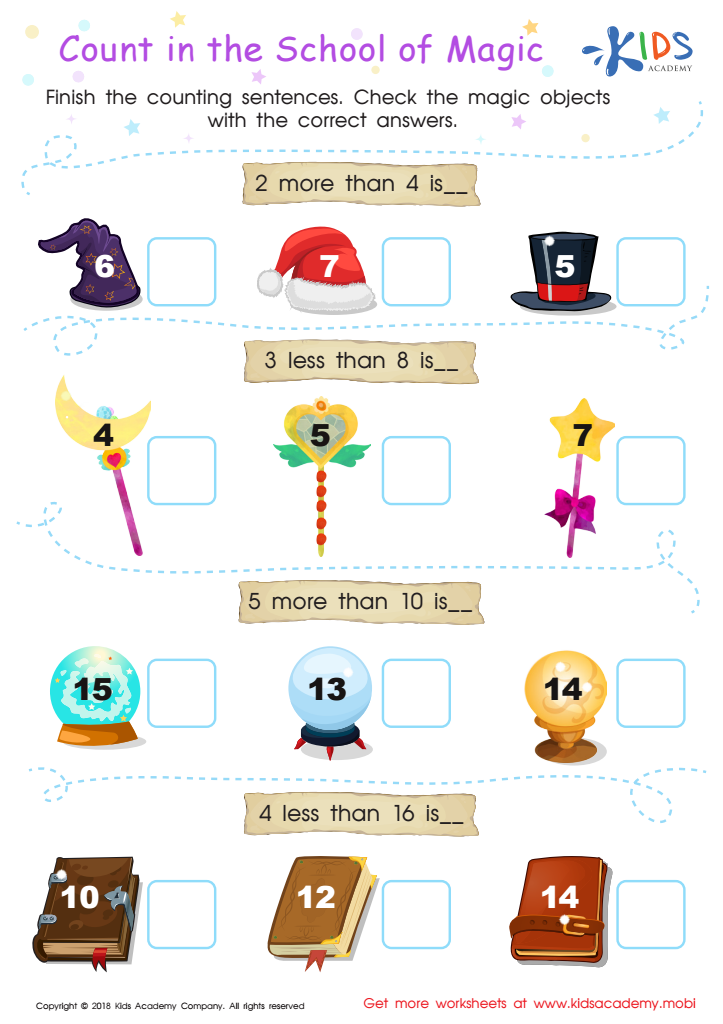
Count in the School of Magic Worksheet
Your math learners can explore the School of Magic with this worksheet. They'll read equations with addition and subtraction numbers under 20, count back and forth to find the answer, then complete the counting sentences. Fun pictures and easy accuracy make it an enjoyable and successful learning experience.
 Assign to My Students
Count in the School of Magic Worksheet
Worksheet
Join Kids Academy for Free
Who is primarily going to use this learning content?








Pattern identification and addition are fundamental skills that play a crucial role in a child’s cognitive development, especially for those aged 4-7. At this early stage, children are naturally curious and eager to explore concepts that will form the foundation of their mathematical understanding. Recognizing patterns enhances critical thinking and problem-solving abilities, as children learn to identify sequences in numbers, shapes, and everyday contexts.
Moreover, addition is one of the building blocks of mathematics. When children grasp the concept of addition through patterns, they develop a deeper understanding of numbers and their relationships. This understanding is not only vital for future math concepts but also promotes confidence and competence in their academic journey.
Parents and teachers should prioritize these skills because they foster a love for learning. Engaging young learners in activities that involve pattern recognition and basic addition can turn abstract concepts into tangible and enjoyable experiences. By promoting these skills early on, caregivers can set the stage for lifelong mathematical literacy and analytical skills, ensuring that children are not just passive recipients of information, but active, engaged participants in their learning. Ultimately, nurturing these foundations can positively impact a child's future academic success and problem-solving abilities.








