
Understanding fact families Addition Worksheets for Ages 4-7
4 filtered results
Difficulty Level
Grade
Age
-
From - To
Subject
Activity
Standards
Introduce your child to the exciting world of addition with our "Understanding Fact Families Addition Worksheets for Ages 4-7". These engaging worksheets help young learners grasp the concept of fact families, where related addition and subtraction facts are grouped together. Designed by educational experts, our worksheets use fun and interactive exercises to develop essential math skills in a stress-free manner. Perfect for early learners, these activities lay a solid foundation in arithmetic, promoting confidence and a love for math. Download today and watch your child’s understanding and enthusiasm for numbers grow!
Favorites
With answer key
Interactive
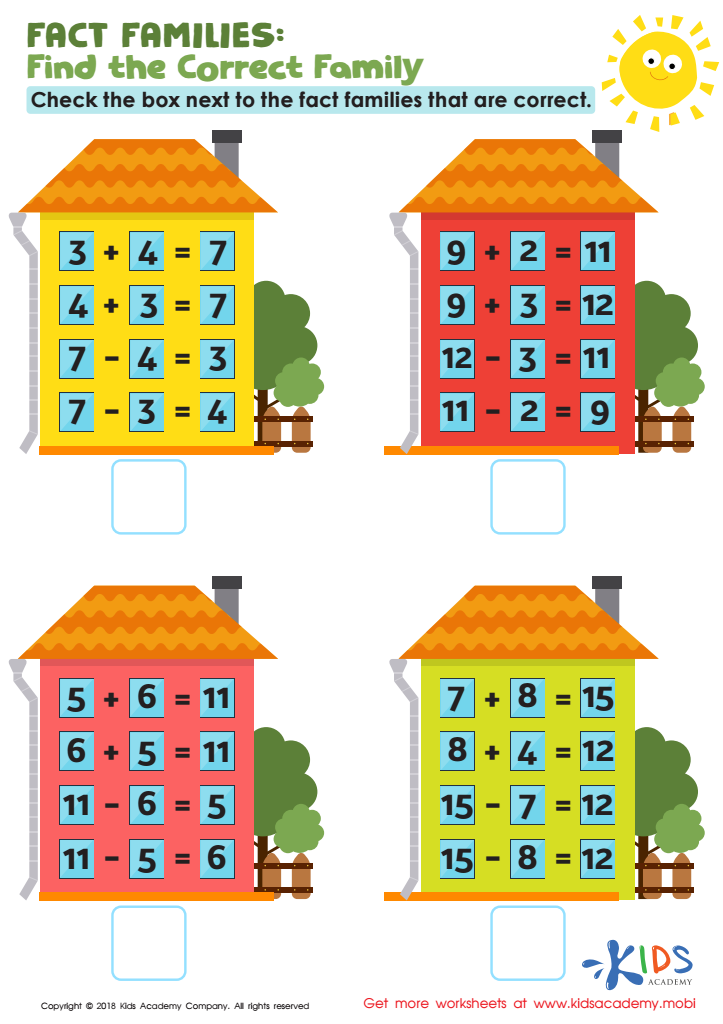
Fact Families: Find Correct Family Worksheet
Test your students' math and reasoning skills with this worksheet. It features 4 houses, each with a group of fact families on it. Some are correct, some are wrong - help students identify which are correct and circle the box next to them. This will help them progress in school.
 Assign to My Students
Fact Families: Find Correct Family Worksheet
Worksheet
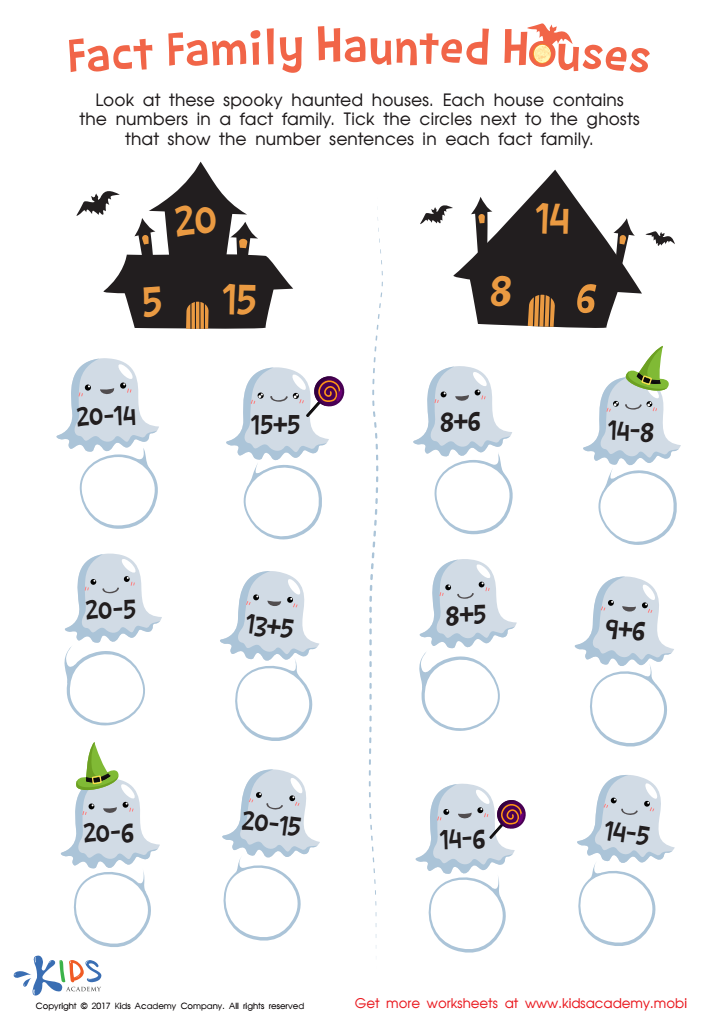
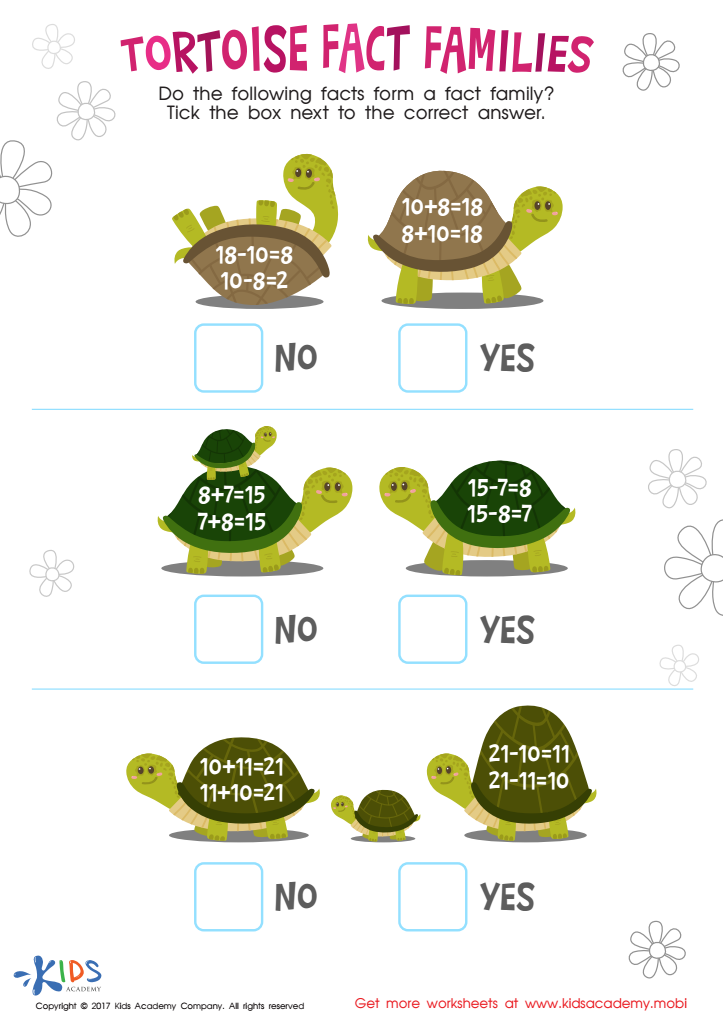
Tortoise Fact Families Printable
With 1st grade add & subtract tortoises, kids can improve their math understanding and skills. Enjoy fun, hands-on practice with fact families and strengthen logical reasoning and critical thinking!
Tortoise Fact Families Printable
Worksheet
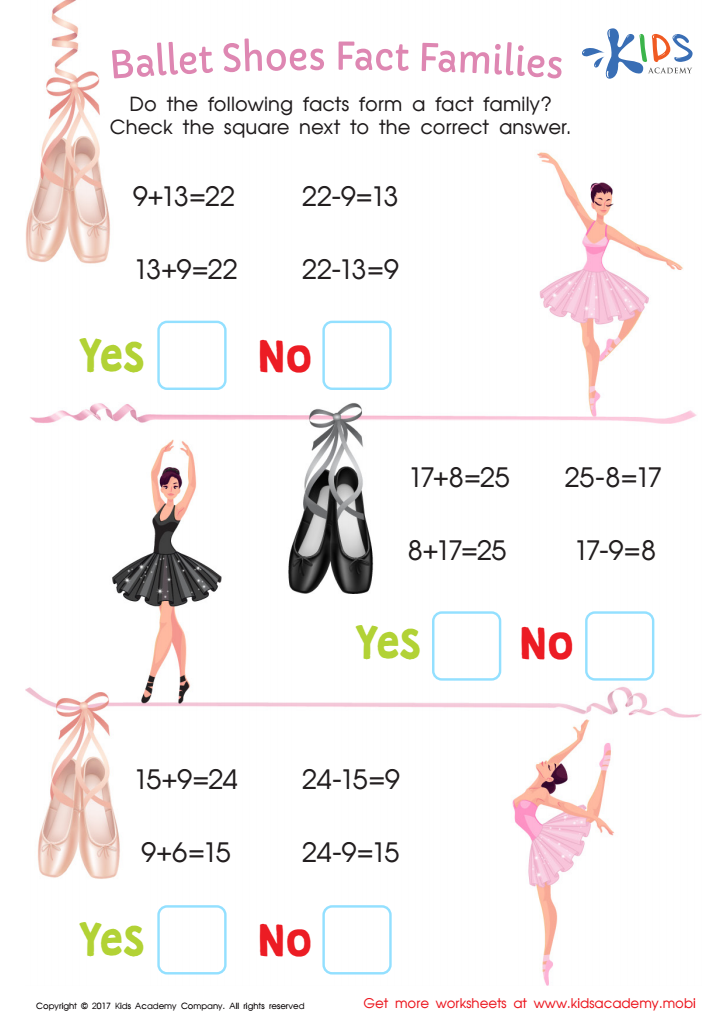
Ballet Shoes Fact Family Printable
Have them observe the equations and determine which groupings are fact families for a delightful learning experience. It encourages critical thinking, showing how addition and subtraction are related.
Ballet Shoes Fact Family Printable
Worksheet
Join Kids Academy for Free
Who is primarily going to use this learning content?








Understanding fact families in addition is fundamental for young children aged 4-7 for several reasons. Fact families help illustrate the relationship between numbers and cultivate a foundational understanding of arithmetic. At this critical developmental stage, grasping these concepts can foster mathematical confidence and competency.
First, recognizing fact families enables children to see how numbers relate to and interact with one another. For instance, understanding that if 2 + 3 = 5, then it follows that 3 + 2 = 5 shows the commutative property of addition. Furthermore, they learn that if these statements are true, then 5 - 2 = 3 and 5 - 3 = 2, highlighting the inverse relationship between addition and subtraction.
These relationships aid cognitive development by promoting logical thinking and problem-solving skills. Children who understand fact families can calculate sums and differences more quickly and accurately because they can see patterns and make connections more easily. This not only boosts their basic arithmetic skills but also sets the stage for more advanced mathematical concepts.
For parents and teachers, nurturing this understanding early on is crucial. It builds a strong mathematical foundation that will support future learning. Additionally, it can reduce math anxiety by providing children with dependable strategies and a clearer understanding of how numbers work. In turn, this fosters a positive attitude towards mathematics, encouraging lifelong learning and curiosity.








