
Practice problem-solving Math Worksheets for Ages 4-7
5 filtered results
Difficulty Level
Grade
Age
-
From - To
Subject
Activity
Standards
Boost your child’s problem-solving skills with our engaging Math Worksheets for ages 4-7. Specifically designed to enhance critical thinking, these printable resources cover fundamental concepts in a fun and interactive way. Children will explore counting, basic arithmetic, shapes, patterns, and more, all while enjoying vibrant illustrations that make learning captivating. Ideal for both classroom use and homeschool practice, these worksheets help young learners build confidence and develop essential math skills needed for future academic success. Equip your child with the tools they need to excel through clear, consistent practice that boosts retention and fosters a love for math. Explore today!
Favorites
With answer key
Interactive
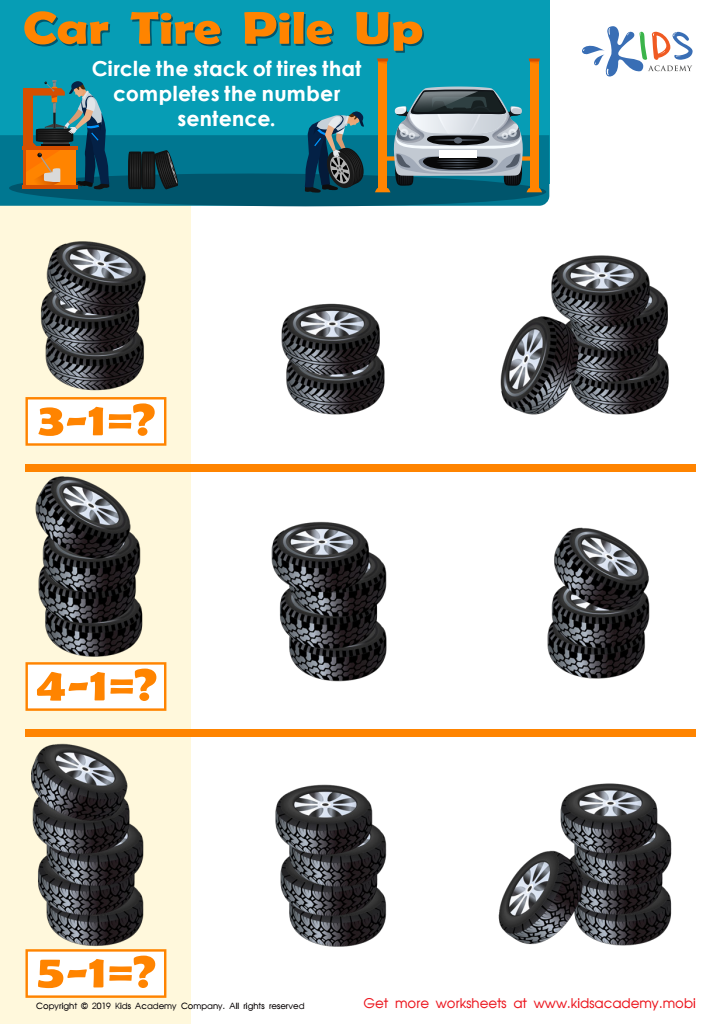
Car Tire Pile Up Worksheet
Examine the pic with your kids. Can they recognize the items piled up? The tires are organized in different quantities. Equations are on the left. Have your children work out the equations, counting the tire stacks to identify the correct answer.
 Assign to My Students
Car Tire Pile Up Worksheet
Worksheet
Join Kids Academy for Free
Who is primarily going to use this learning content?








Parents and teachers should prioritize problem-solving math practice for children aged 4-7 because it lays the foundation for critical thinking and lifelong learning. At this formative age, young minds are highly receptive and eager to explore new concepts. Problem-solving in math offers a structured way to develop cognitive abilities, enhancing reasoning skills, logical thinking, and the capacity to process information effectively. Engaging with math problems helps children understand patterns, relationships, and sequences, which are fundamental skills applicable beyond math.
Moreover, early math experiences are linked to future academic performance. Research indicates that strong early math skills often predict success in later schooling more accurately than early reading skills. When children tackle math problems, they also develop perseverance and resilience, learning to approach challenges with confidence and creativity. These are essential qualities for both academic success and personal growth.
For teachers, incorporating problem-solving in the curriculum provides an opportunity to assess students' understanding and tailor instructions to meet individual needs. For parents, supporting math problem-solving at home enhances parental involvement, creating a positive and encouraging learning environment. By valuing and fostering these math skills early on, both parents and teachers equip children with tools critical for academic achievement and real-life problem-solving situations.








