Recognizing equivalent fractions Math Worksheets for Ages 4-7
5 filtered results
-
From - To
Discover our engaging "Recognizing Equivalent Fractions" math worksheets, designed specifically for children aged 4-7. These interactive resources help young learners grasp the concept of equivalent fractions through fun activities and visuals. Each worksheet encourages kids to identify and match fractions, developing their understanding of numerical relationships in a playful way. Ideal for both classroom and home learning, our worksheets promote critical thinking and bolster early math skills. Give your child a solid foundation in mathematics while making learning enjoyable! Explore our collection and watch your child's confidence grow as they master equivalent fractions with ease.
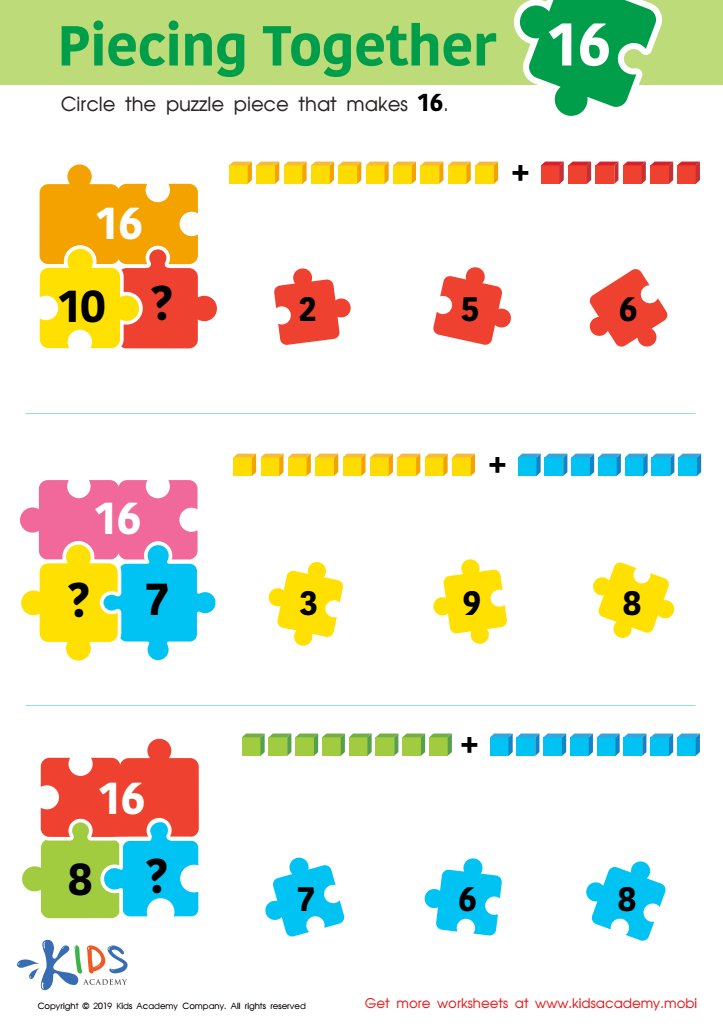
Piecing Together 16 Worksheet
 Assign to My Students






Recognizing equivalent fractions is a crucial skill for young learners aged 4-7, as it lays the foundation for their understanding of fractions and proportional reasoning in later mathematical concepts. For parents and teachers, emphasizing this skill is vital for several reasons.
First, recognizing equivalent fractions helps children develop a sense of number relationships and enhances their problem-solving abilities. It encourages them to think critically about how different fractions can represent the same part of a whole, fostering a deeper understanding of quantity and proportion.
Second, this skill builds a bridge between concrete and abstract mathematical concepts. By engaging with manipulatives and visual representations, children grasp the idea of equivalence more naturally, paving the way for more complex topics like addition or subtraction of fractions.
Third, mastering equivalent fractions boosts children’s confidence in their mathematical abilities, as they learn to manipulate numbers easily. This self-assurance can lead to a more positive attitude towards learning math overall.
Lastly, understanding equivalent fractions is essential for real-life applications, from cooking to problem-solving in everyday situations, ensuring that children are prepared for practical experiences outside the classroom. Thus, nurturing this skill benefits both their academic journey and daily life for years to come.








