
Understanding ordinal numbers Math Worksheets for Ages 4-7
3 filtered results
Difficulty Level
Grade
Age
-
From - To
Subject
Activity
Standards
Explore our engaging "Understanding Ordinal Numbers" math worksheets designed specifically for children aged 4-7. These carefully crafted activities introduce young learners to the concept of ordinal numbers, helping them master the sequence of first, second, third, and beyond in a fun and interactive way. Through vibrant illustrations and simple exercises, kids will gain essential number skills and early math confidence. Perfect for classrooms or home learning, our worksheets promote critical thinking and provide a solid foundation for future math learning. Download now and watch your child's understanding of ordinal numbers grow while enjoying the learning process!
Favorites
With answer key
Interactive
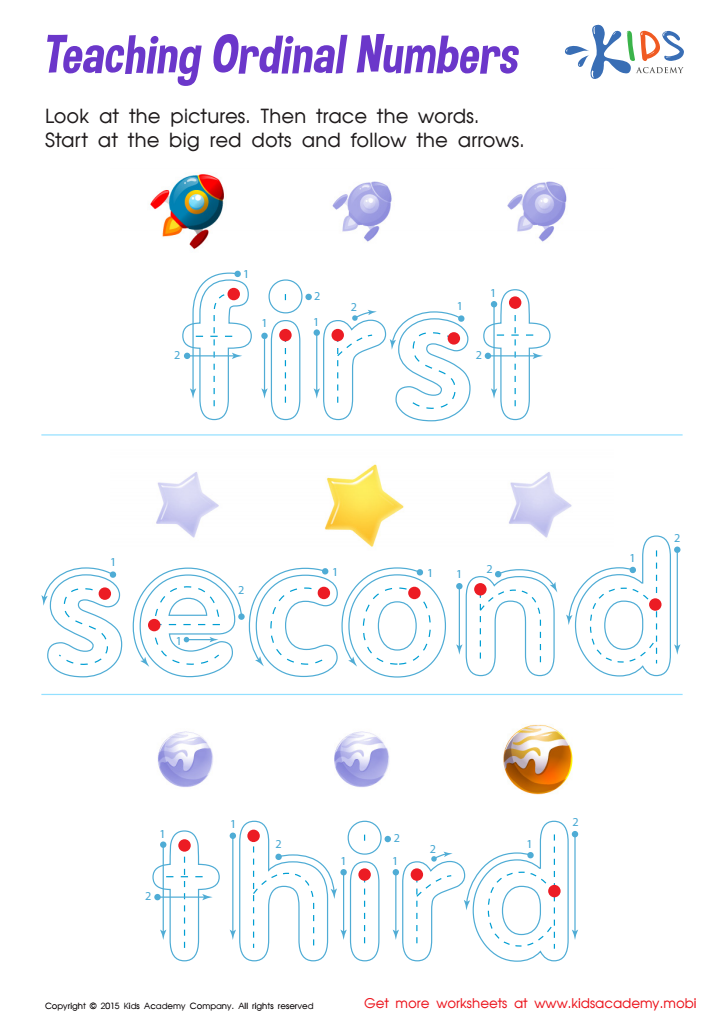
Ordinal Numbers: Teaching Ordinal Numbers Printable
Practice makes perfect!
Kids need to understand ordinal numbers - placement, recognition and spelling. Our worksheet helps kids make connections between the placement and spelling of ordinal numbers. Practice will help your little one perfect this vital number concept.
 Assign to My Students
Ordinal Numbers: Teaching Ordinal Numbers Printable
Worksheet
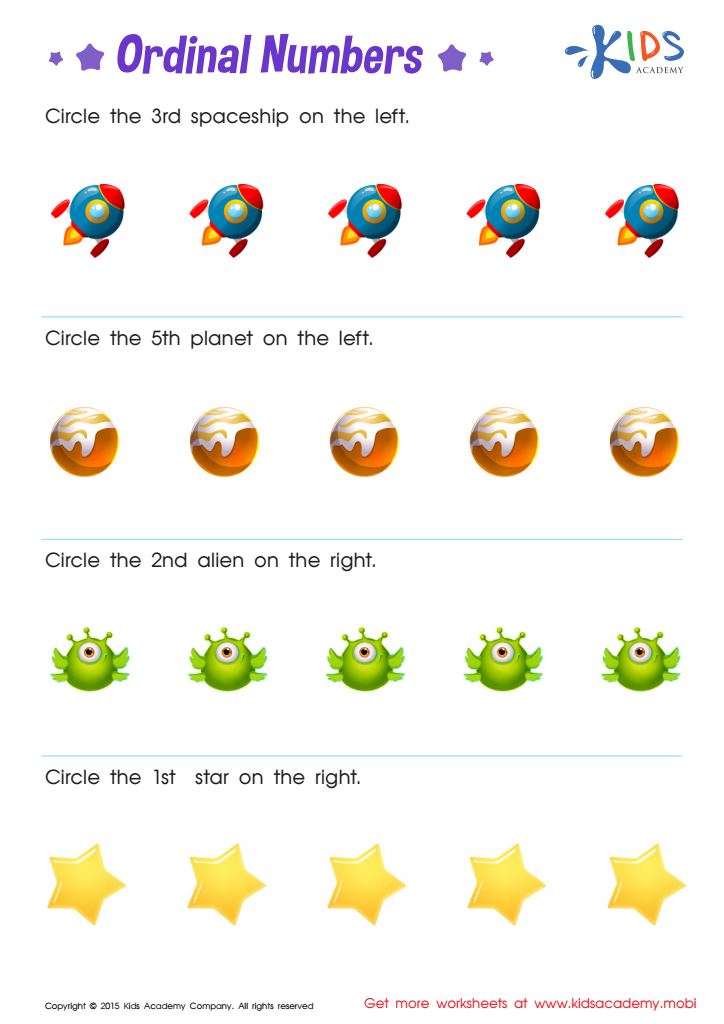
Ordinal Numbers: Space Ordinals Worksheet
Practicing with ordinal numbers worksheet PDFs helps kids master crucial concepts for higher-level math. Plus, when kids have fun learning, the knowledge sticks! So, have your child “blast off” with this space-themed worksheet to read directions, practice relative directions, and learn ordinal numbers.
Ordinal Numbers: Space Ordinals Worksheet
Worksheet
Join Kids Academy for Free
Who is primarily going to use this learning content?







Understanding ordinal numbers is crucial for young children's overall mathematical development, especially for ages 4-7. Ordinal numbers—like first, second, and third—help children grasp the concept of order and position, which is foundational for counting, sequencing, and problem-solving. Teaching these concepts early equips children with skills that extend beyond mathematics; they learn to follow instructions, understand routines, and make comparisons.
Parents and teachers should care because mastering ordinal numbers supports critical cognitive skills. Knowledge of ordinal sequences aids in language development, enhances memory, and boosts comprehension of more complex mathematical concepts later on. For instance, when children understand that “third” comes after “second,” they foster logical thinking vital for their educational journey. Moreover, integrating ordinal numbers into everyday situations, such as lining up for activities or organizing toys, can make learning relevant and fun.
Incorporating ordinal number lessons can also enrich children’s social interactions by enabling them to discuss turn-taking in games or narrate personal experiences. For these reasons, a focused approach to understanding ordinal numbers paves the way for success in elementary education and beyond, highlighting its importance for both parents and educators.








