
Time recognition Measurement Worksheets for Ages 4-7
3 filtered results
Difficulty Level
Grade
Age
-
From - To
Subject
Activity
Standards
Discover our engaging Time Recognition Measurement Worksheets crafted specifically for children aged 4-7. These worksheets are designed to help young learners master the concepts of time, building crucial skills in reading analog and digital clocks, and understanding daily routines. With fun and colorful activities, kids can effortlessly grasp hours and minutes, aiding their ability to tell time accurately. Perfect for preschool and early elementary students, our time worksheets foster confidence in an enjoyable and interactive way. Give your child a head start in learning with our expertly-designed educational resources – ideal for both classroom use and home practice.
Favorites
With answer key
Interactive
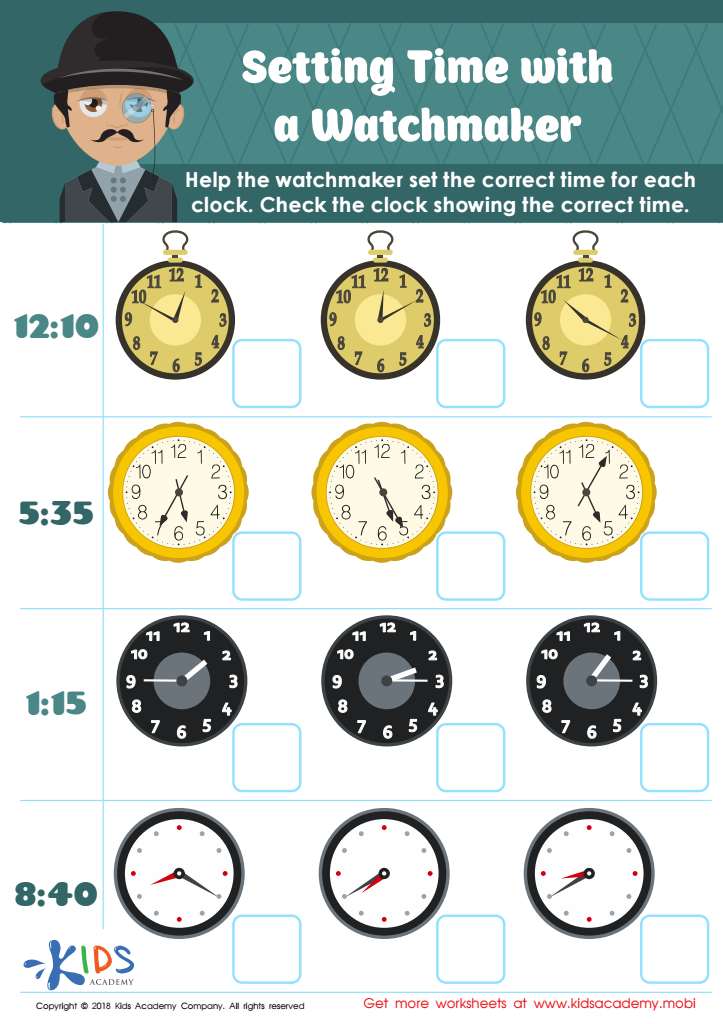
Setting Time with Watchmaker Worksheet
Can your kids tell the time? If so, this worksheet should be easy. Help them set the time for each clock: look at the time written on the left side and find the clock on the right side that matches.
 Assign to My Students
Setting Time with Watchmaker Worksheet
Worksheet
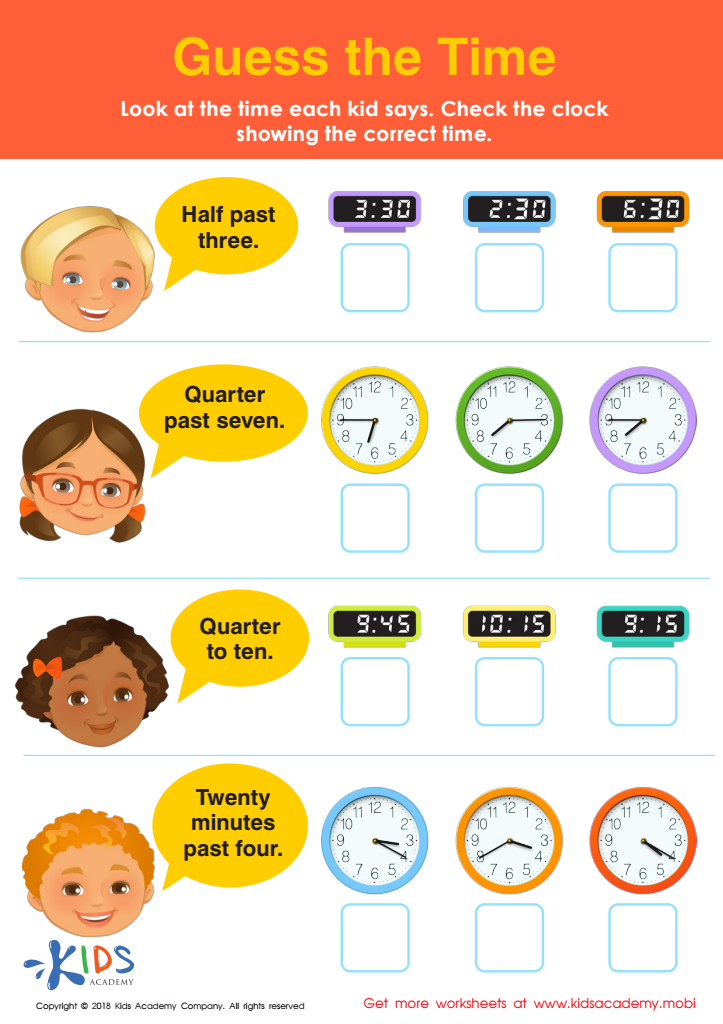
Guess the Time Worksheet
Help students tell the time accurately with this fun exercise. Read the time each person says and find the corresponding clock. Check the options on the left and have students guess the right time. This worksheet is sure to sharpen their time-telling skills.
Guess the Time Worksheet
Worksheet
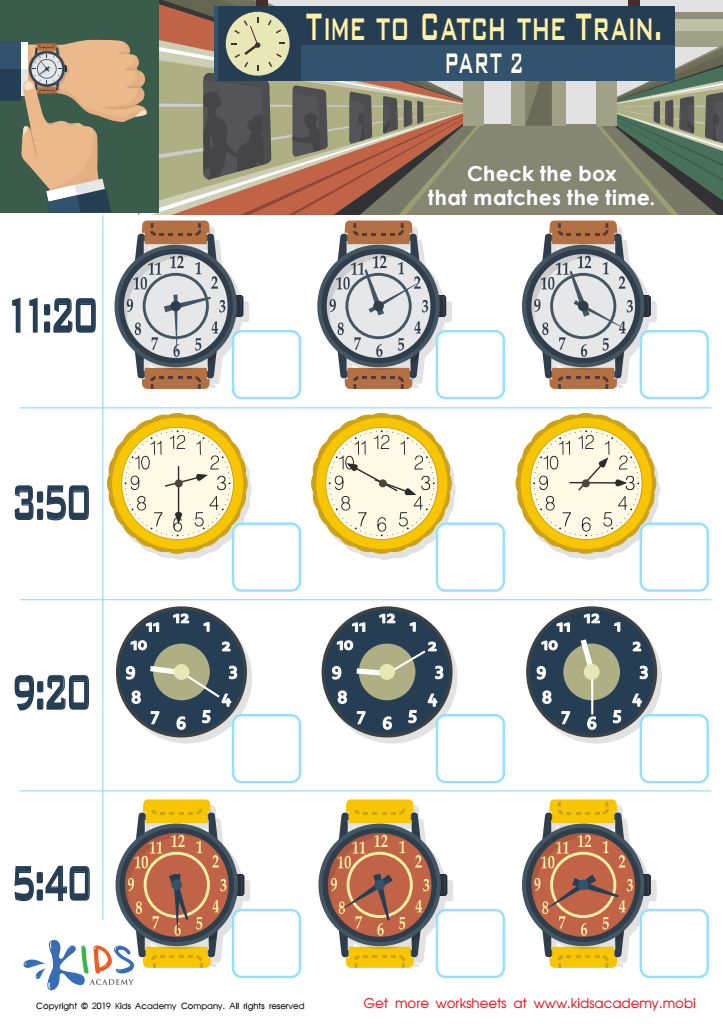
Time to Catch the Train Part 2 Worksheet
Teach your kids the importance of telling time and how to do it. Explain that there are multiple ways to show the time, such as written on the left side or watches in the picture. Guide them to check the box that matches the time. Knowing the time is essential to get things done and create order. Ensure your kids understand this and they will reap the benefits.
Time to Catch the Train Part 2 Worksheet
Worksheet
Join Kids Academy for Free
Who is primarily going to use this learning content?








Time recognition and measurement skills are critical for children between the ages of 4-7 for several reasons. At this early stage, young learners are developing foundational skills that will support their academic growth, daily routines, and overall time management. Understanding time helps children grasp concepts like sequence, duration, and the passage of time, which are essential for both learning and life activities.
Firstly, recognizing time fosters independence. Children who can tell time are better able to manage their daily schedules, such as knowing when it's time to eat, play, or prepare for bed. This promotes self-regulation and reduces reliance on adults to dictate their routines, enhancing their sense of responsibility and autonomy.
Secondly, time measurement is closely linked to math skills. Learning to read clocks and understand units of time enhances children's numeracy by introducing concepts like counting, arithmetic (addition and subtraction of hours and minutes), and even fractions. These math concepts are pivotal for higher learning in STEM fields.
Lastly, teaching time recognition at an early age sets children up for success in school. Punctuality and the ability to estimate how long tasks take are essential skills for classroom management and organization. Familiarity with how time works leads to better concentration and reduces anxiety associated with transitioning between activities.
In summary, nurturing time recognition and measurement in early childhood prepares children for greater independence, supports mathematical learning, and equips them with essential life skills that contribute to their overall development.








