
Enhancing mathematical logic Worksheets for Ages 4-8
3 filtered results
Difficulty Level
Grade
Age
-
From - To
Subject
Activity
Standards
Unlock your child's potential with our "Enhancing Mathematical Logic Worksheets for Ages 4-8" at Kids Academy. Designed to foster critical thinking and problem-solving skills, these engaging worksheets lay a solid foundation in mathematical understanding. Fun activities and puzzles encourage young learners to explore patterns, relations, and sequences, enhancing their logic and reasoning abilities. Perfect for both classroom and home use, our worksheets feature age-appropriate content that progressively builds upon each concept. Boost your child's confidence and interest in math through interactive exercises that make learning exciting and effective! Join us and watch your child's mathematical abilities soar.
Favorites
With answer key
Interactive
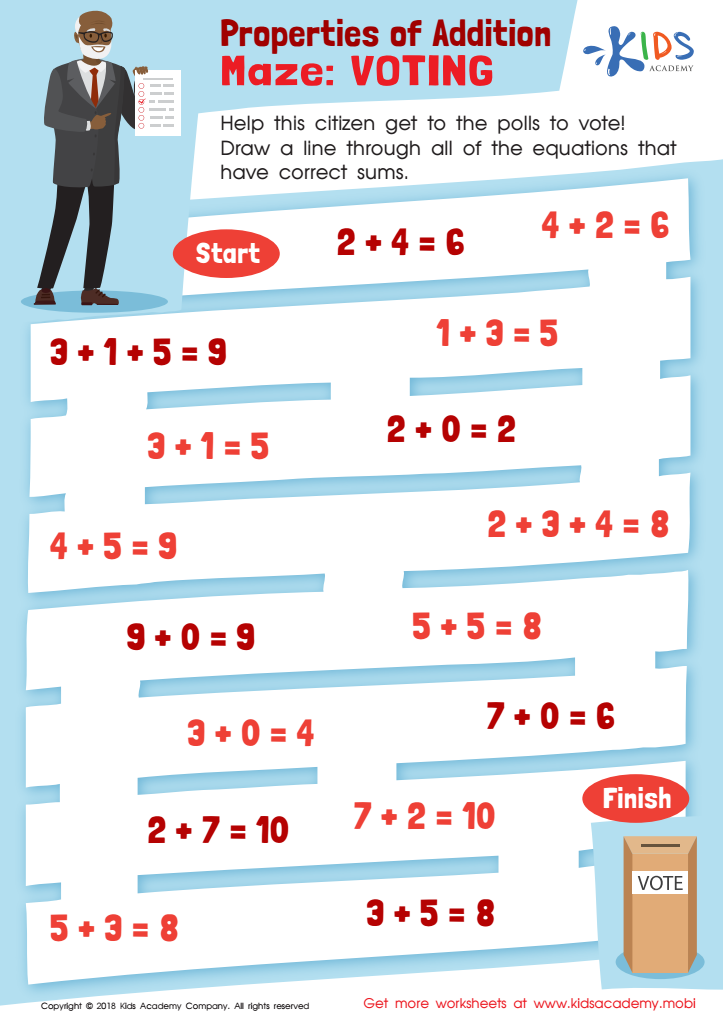
Properties of Addition Maze: Voting Worksheet
The good citizen in the worksheet needs your child's help to vote. Ask them to draw a line through all equations with correct sums to get the citizen to the polls. Voting is the right and obligation of all good citizens. It helps elect the right candidates and exercise legal rights.
 Assign to My Students
Properties of Addition Maze: Voting Worksheet
Worksheet
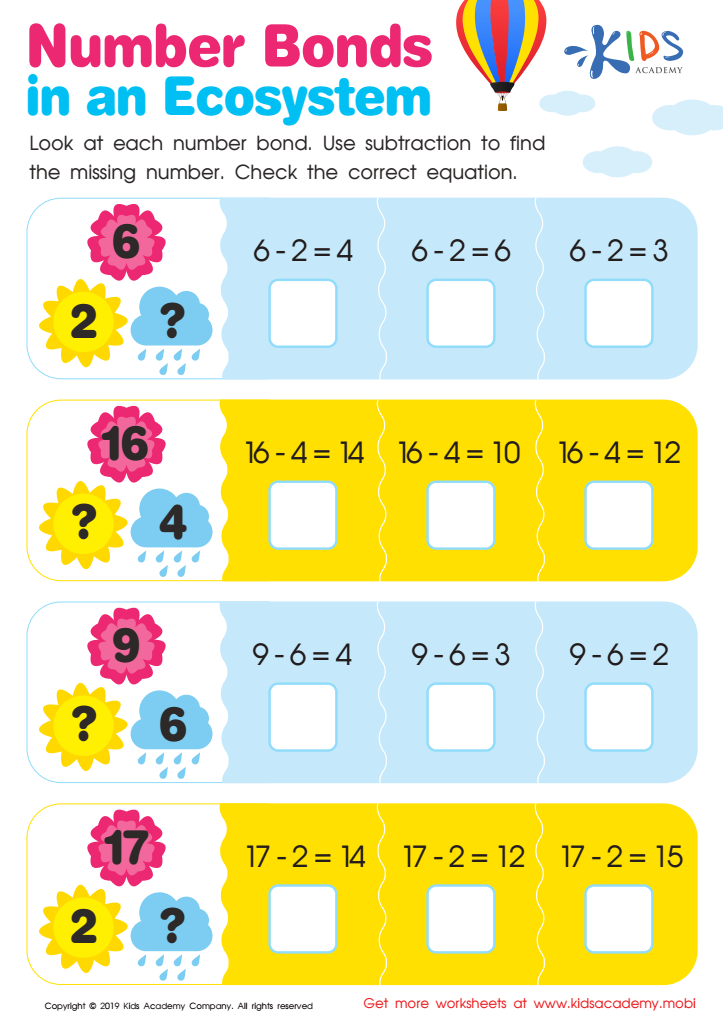
Number Bonds in an Ecosystem Worksheet
This worksheet is a great tool to help your kids sharpen their maths skills. Use the colourful images to teach them how to subtract the missing numbers and check the equation. Show them the four different images and let them try solving each number bond. With your guidance, they'll be able to hone their maths skills in no time!
Number Bonds in an Ecosystem Worksheet
Worksheet
Join Kids Academy for Free
Who is primarily going to use this learning content?








Enhancing mathematical logic in children ages 4-8 is crucial for their cognitive development and long-term academic success. At this developmental stage, children are naturally curious and adept at absorbing new concepts. Introducing mathematical logic helps them build foundational skills essential for problem-solving and critical thinking.
Developing mathematical logic early fosters a positive attitude towards math, reducing the likelihood of math anxiety and encouraging a growth mindset. As children explore patterns, sequences, and basic arithmetic, they learn to approach problems methodically and think analytically. These skills extend beyond mathematics, influencing abilities in science, reading comprehension, and everyday decision-making.
Moreover, early exposure to mathematical logic stimulates brain development, enhancing memory, concentration, and reasoning abilities. It supports the development of executive function skills, such as planning and organizational abilities, which are vital for academic and personal success.
Teachers and parents play a pivotal role in nurturing this growth. Engaging activities such as puzzles, games, and hands-on experiences can make learning enjoyable and effective. By prioritizing mathematical logic, they help create a strong educational foundation, ensuring children are well-equipped to navigate more complex concepts in later grades and in life.








