
Understanding equivalence Worksheets for Ages 4-8
3 filtered results
Difficulty Level
Grade
Age
-
From - To
Subject
Activity
Standards
Discover our engaging "Understanding Equivalence" worksheets tailored for children aged 4-8. These printable resources are perfect for young learners to grasp the concept of equivalence, enhancing their math skills through fun, interactive activities. From basic number matching to comparing groups of objects, our worksheets promote critical thinking and problem-solving abilities. Designed by educational experts, our materials cater to various learning styles, ensuring a solid foundation in math. Parents and educators can easily incorporate these worksheets into daily routines, fostering a love for learning and ensuring a smooth transition to more advanced math concepts. Download and start learning today!
Favorites
With answer key
Interactive
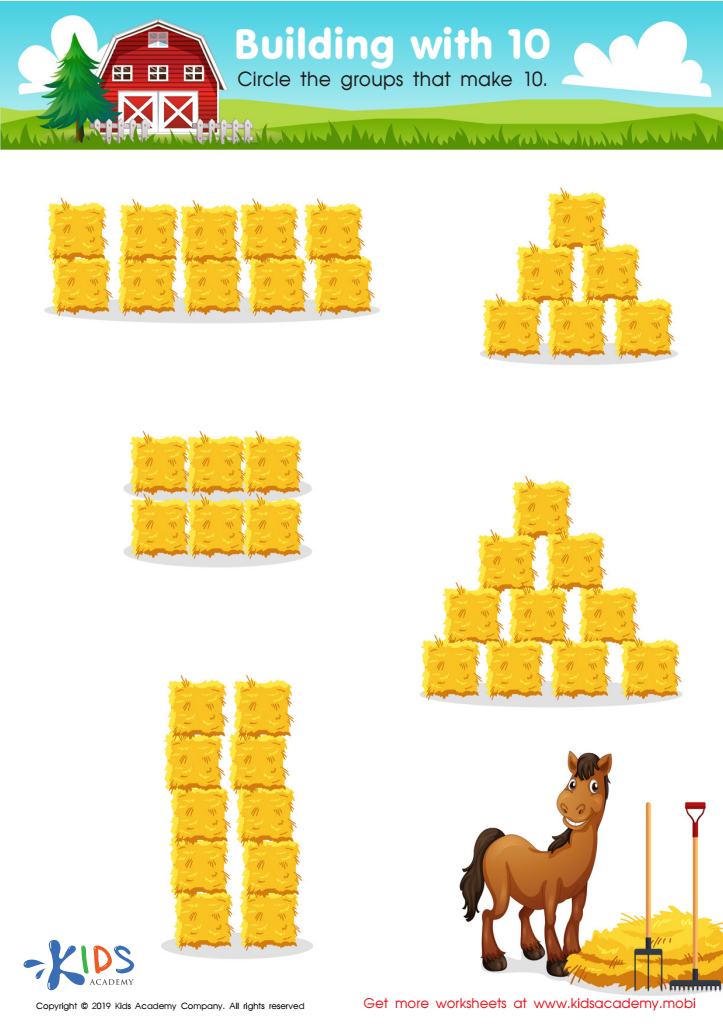
Building with 10 Worksheet
Counting numbers can be simple with this worksheet: Ask your kids to count the stacks of objects, ensure accuracy with your help, then circle the ones of ten. With practice and guidance, your children will soon become counting pros!
 Assign to My Students
Building with 10 Worksheet
Worksheet
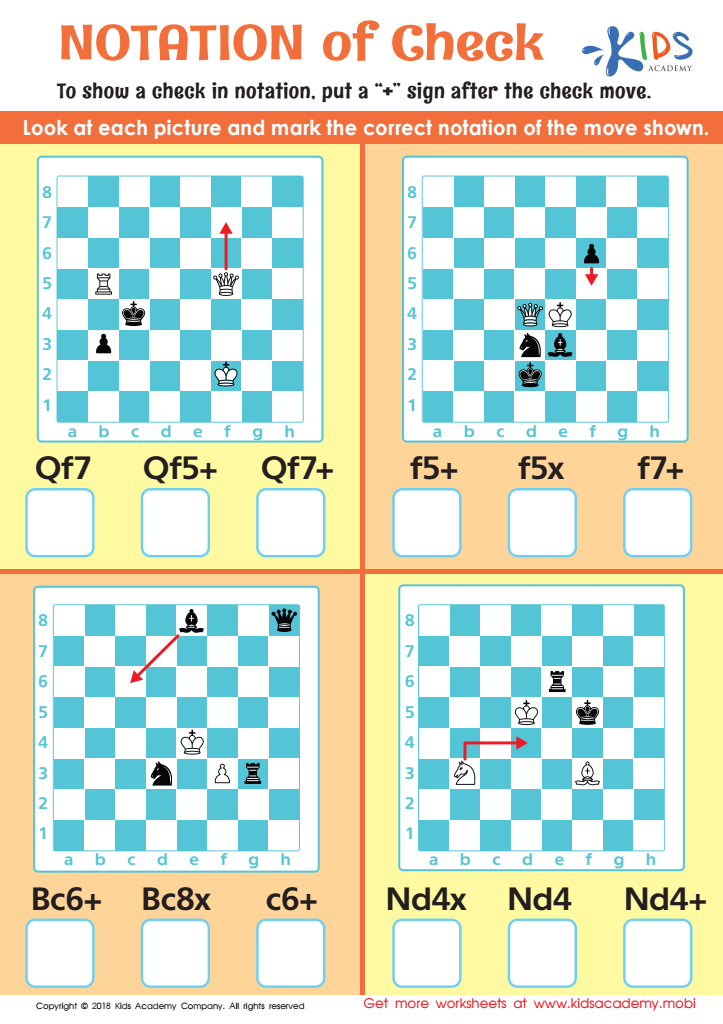
Notation of Check Worksheet
Chess is an addictive game! Once you know the basics of check and checkmate, you'll be hooked! Teach your little one to make check notation with this free PDF worksheet. They can use downloadable practice to look at each picture and mark the correct notation, strengthening their problem-solving skills while they learn to play - and win - this fun game!
Notation of Check Worksheet
Worksheet
Join Kids Academy for Free
Who is primarily going to use this learning content?








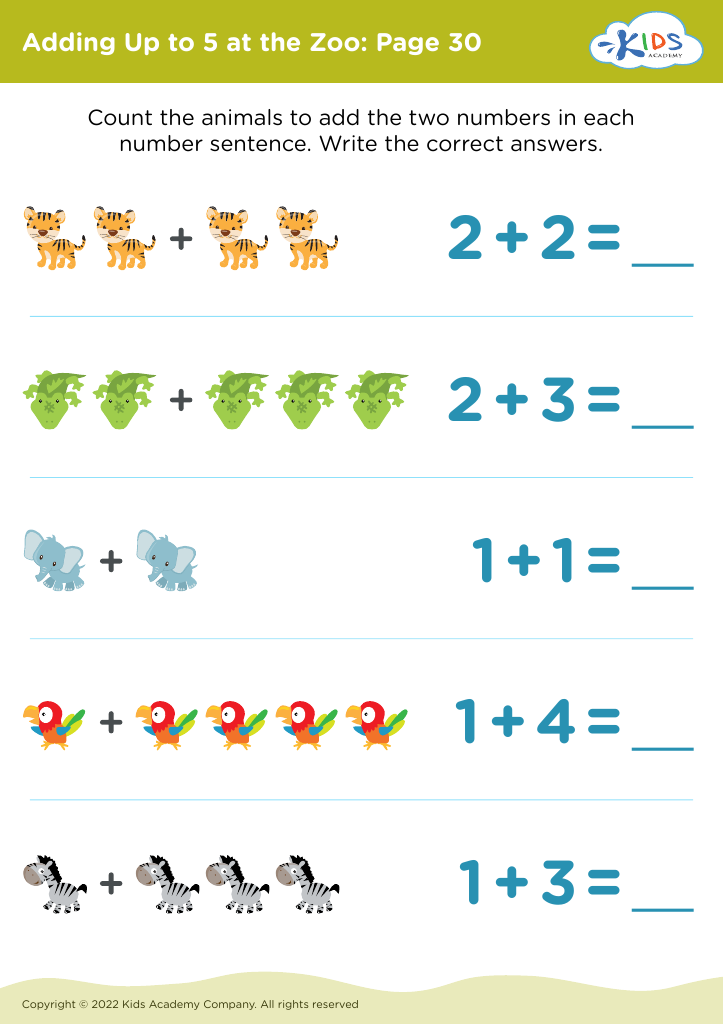
Understanding equivalence is the foundation for mathematical comprehension in children aged 4-8. At this critical stage, grasping the concept of equivalence extends far beyond simple arithmetic. It enables children to recognize that despite different forms, quantities, or expressions, certain sets of items are equal or balanced.
For instance, when a child understands that 5 = 2 + 3, they're recognizing that the same quantity can be represented in multiple ways. This knowledge is crucial for advancing in mathematics as it lays the groundwork for algebra, fractions, geometry, and even problem-solving. It enhances cognitive skills like reasoning, logical thinking, and the ability to see relationships among numbers and shapes.
For parents and teachers, nurturing an understanding of equivalence supports children's confidence and willingness to engage with more complex mathematical ideas in the future. A stable grasp of these concepts at an early age reduces math anxiety, builds mathematical fluency, and encourages a positive attitude towards learning. Activities like balancing scales, matching games, and interactive play can turn abstract concepts into tangible learning experiences, making math fun and accessible. Therefore, emphasizing equivalence enhances a child’s holistic educational development, preparing them for continued academic success.








