
Logical Reasoning 2D Shapes Worksheets for Ages 4-8
4 filtered results
Difficulty Level
Grade
Age
-
From - To
Subject
Activity
Standards
Nurture your child's mathematical skills with our "Logical Reasoning 2D Shapes Worksheets for Ages 4-8". These engaging and educational worksheets are designed to develop critical thinking and logic through fun activities involving 2D shapes. Perfect for young learners, our worksheets enhance spatial awareness and geometry concepts, enabling kids to recognize, differentiate, and reason with basic shapes. Each worksheet provides age-appropriate challenges to stimulate curiosity and build foundational math skills. Boost your child's confidence and intelligence with these interactive learning exercises and watch them excel in math. Download now to transform learning into an exciting adventure!
Favorites
With answer key
Interactive
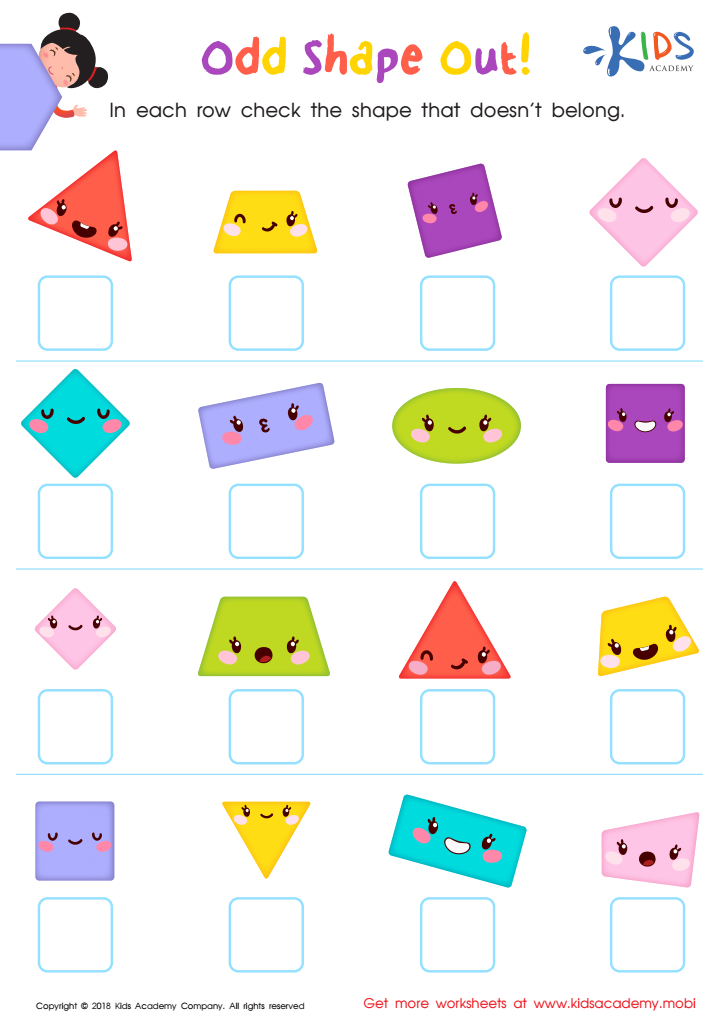
Odd Shape Out Worksheet for Grade 3
Time to test your child's shape knowledge! With this worksheet, help them find the odd shape out in each row and check the box under it. Print out the pdf and look through it with them – each row has four brightly colored shapes. See if they can spot any differences among them and then check the box below the shape that does not belong.
 Assign to My Students
Odd Shape Out Worksheet for Grade 3
Worksheet











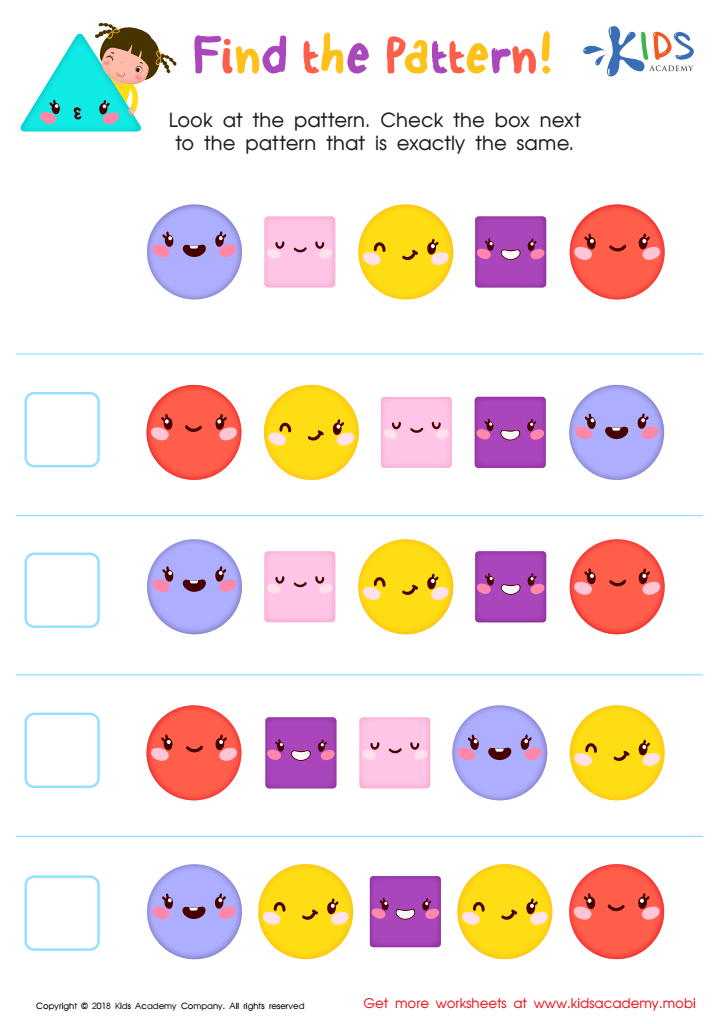
Find the Pattern Worksheet
This colorful pattern worksheet is perfect for testing your kids' pattern recognition. The bright colors will keep them engaged, while they check the box next to the pattern that is the same. Ask your kids to identify the colors used and see how well they can spot similarities!
Find the Pattern Worksheet
Worksheet
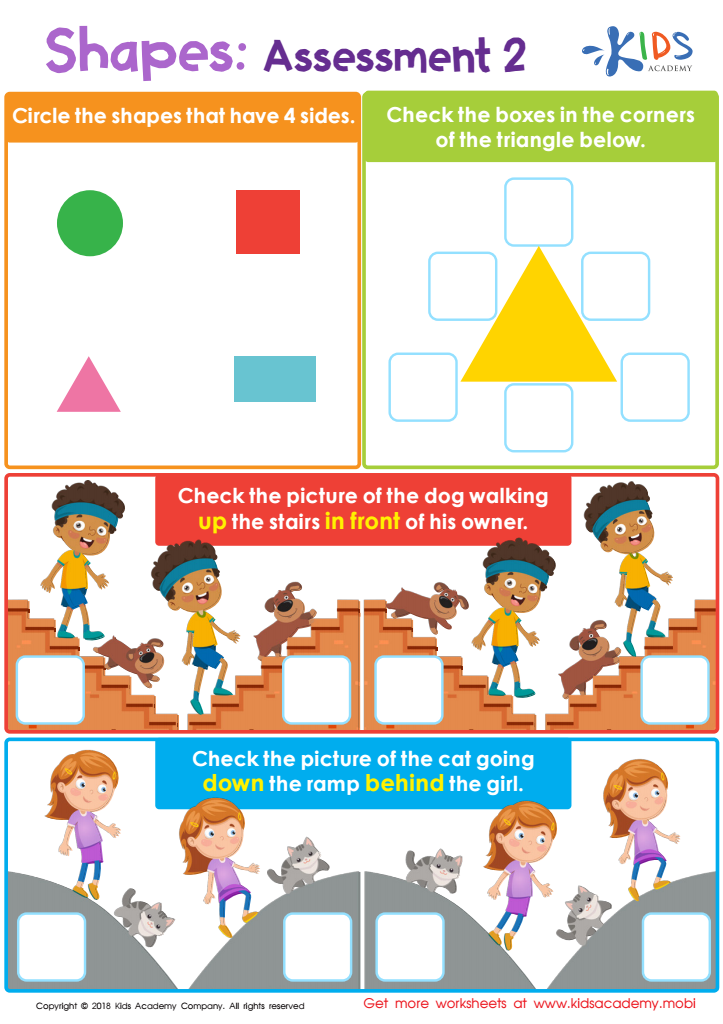
Shapes: Assessment 2 Worksheet
This geometry worksheet assesses a student's knowledge of shapes and positional words. They must identify shapes with 4 sides and corners on a triangle. The worksheet also tests understanding of words like "up", "front", "down" and "behind". Easily determine what your student knows about these concepts with this downloadable worksheet!
Shapes: Assessment 2 Worksheet
Worksheet
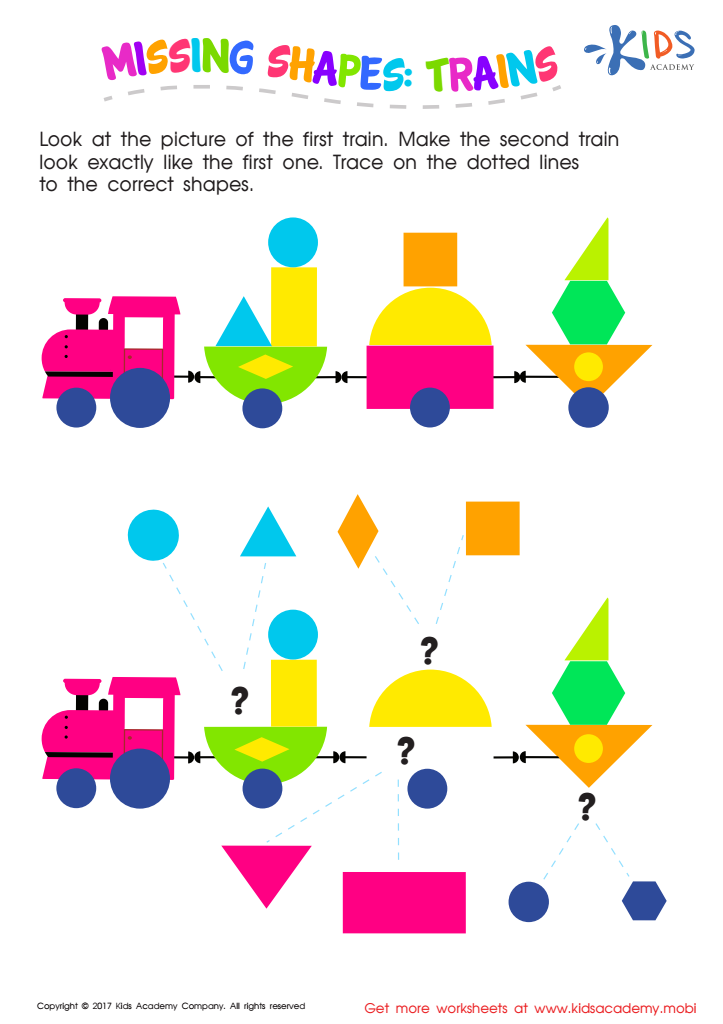
Missing Shapes: Trains Worksheet
Before beginning, ask your child what the object in the picture is, the sound it makes and where it can be found. If they know, confidently move on. Help them make the second train look like the first by tracing dotted lines. Hold their hand for guidance.
Missing Shapes: Trains Worksheet
Worksheet
Join Kids Academy for Free
Who is primarily going to use this learning content?








Logical reasoning and understanding 2D shapes are fundamental skills that lay the groundwork for a child’s overall cognitive development and future academic success. At ages 4-8, children are in a crucial developmental phase where their brains are highly receptive to learning new concepts and building critical thinking skills.
Firstly, learning about 2D shapes (such as circles, squares, triangles, and rectangles) helps to enhance their spatial awareness. This is crucial not only in understanding geometry but also translates to better comprehension in areas such as reading and writing, where spatial orientation (like recognizing letters and word formation) is pivotal.
Secondly, logical reasoning skills, developed through analyzing and categorizing these shapes, promote problem-solving abilities. Children learn to identify patterns, make predictions, and recognize relationships, which forms the bedrock for mathematical thinking. These skills extend beyond math, aiding in logic-based tasks across different subjects.
Interactive activities involving 2D shapes, such as puzzles and games, promote these cognitive skills while also keeping the learning experience fun and engaging. Encouraging curiosity and the ability to think critically from a young age not only boosts confidence but also sets a solid foundation for lifelong learning. Thus, parents and teachers nurturing these skills are significantly contributing to the child’s academic and personal development.








