Identifying shapes Adding up to 100 Without Regrouping Worksheets for Ages 4-8
4 filtered results
-
From - To
Introducing our "Identifying Shapes Adding up to 100 Without Regrouping Worksheets" designed for ages 4-8! These engaging worksheets focus on helping children identify basic geometric shapes while mastering addition up to 100 without regrouping. Kids will enjoy colorful, interactive activities that bolster both their math and geometry skills. Perfect for early learners, the worksheets are crafted to enhance cognitive development, improve problem-solving abilities, and foster a love for learning. Bring math to life and watch your child's confidence soar with our expertly designed, fun, and educational resources. Discover a world where learning shapes and numbers is a joyful adventure!
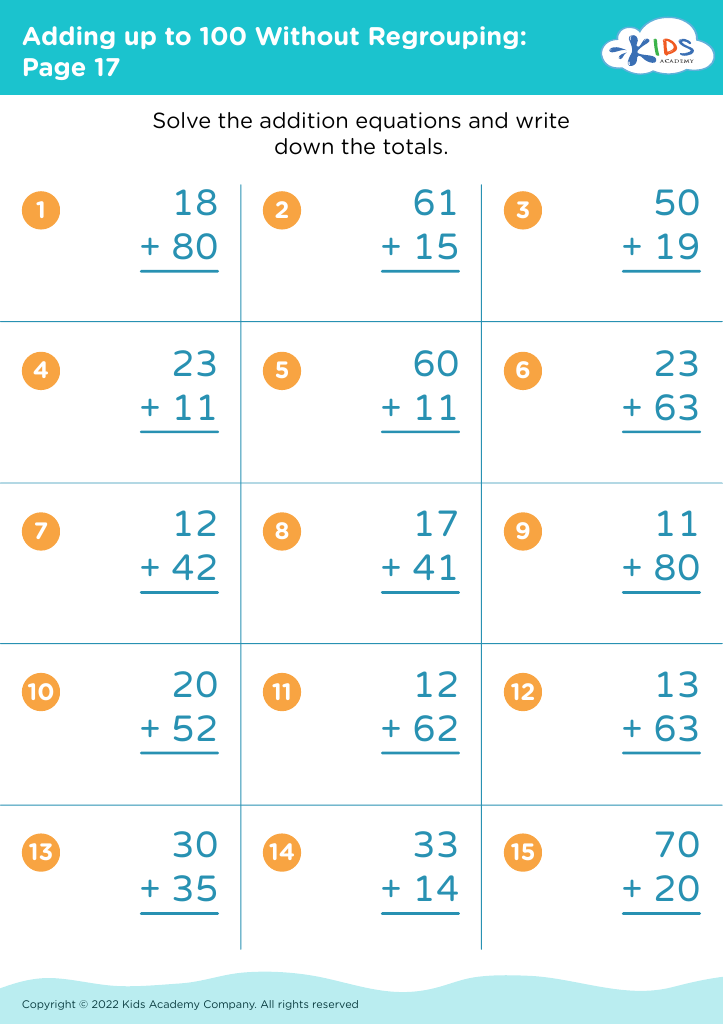
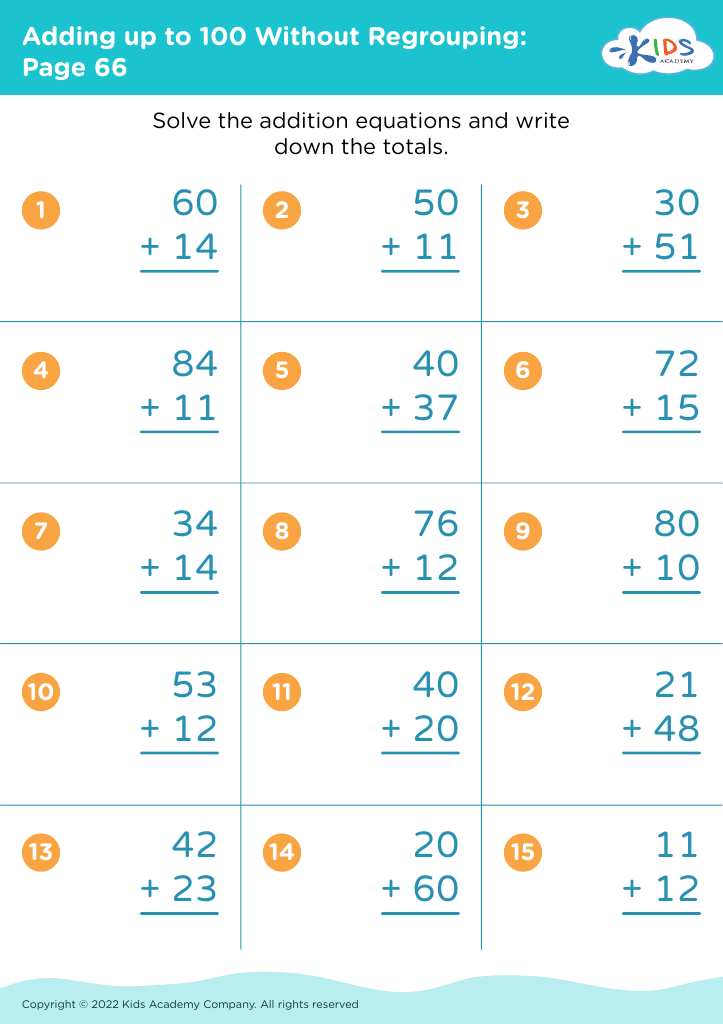
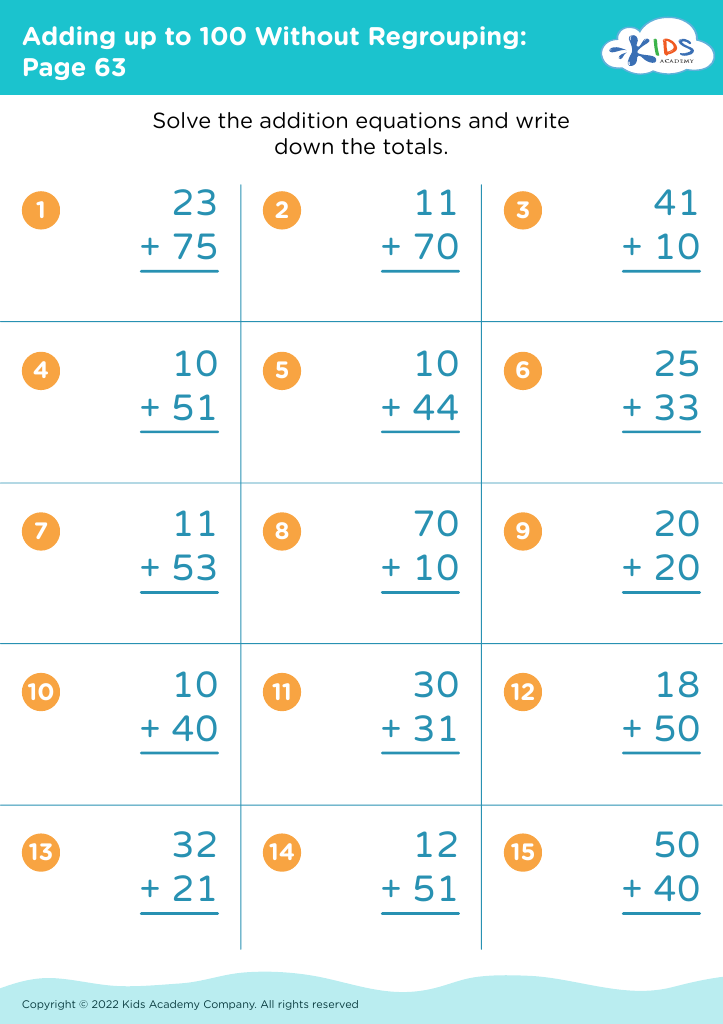
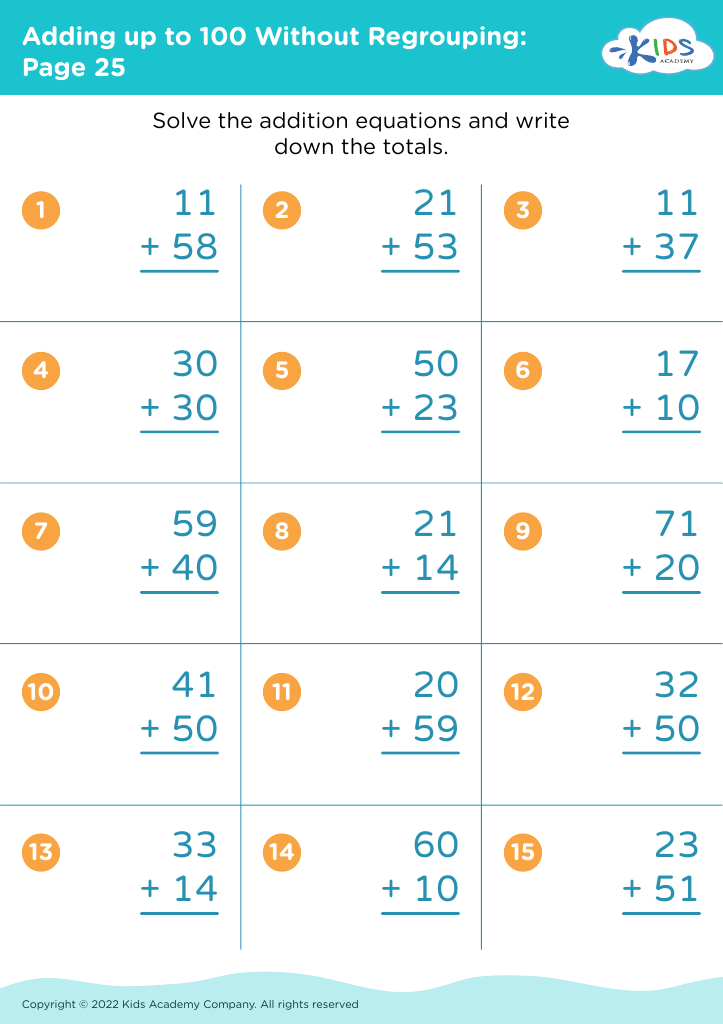




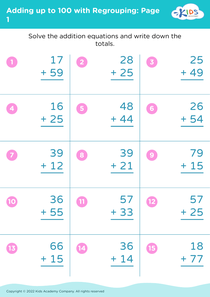
Identifying shapes and adding up numbers to 100 without regrouping are foundational skills critical for young children, ages 4-8, and parents and teachers should prioritize these for several important reasons. Firstly, learning to identify basic geometric shapes such as circles, squares, and triangles enhances a child's spatial awareness and visual perception. These skills are crucial for understanding more complex mathematical concepts and for real-life tasks such as reading maps, arranging objects, and even art.
Adding up numbers to 100 without regrouping builds computational fluency, an essential aspect of early numeracy. It helps children understand the base-ten number system, recognize patterns, and develop mental math strategies. Mastery in simple addition also ensures students have a solid foundation to tackle more complicated mathematical problems in the future, including operations involving regrouping, subtraction, multiplication, and division.
Furthermore, engaging in these activities develops a child's problem-solving abilities and critical thinking skills. It encourages logical reasoning and can improve concentration and attention to detail.
In sum, investing in these basic mathematical and geometric skills during the early years sets a strong foundation for future academic achievement and practical everyday tasks. Thus, parents and teachers should actively support and encourage these learning activities to foster a well-rounded development in young children.