Improve counting skills Adding up to 1000 Without Regrouping Worksheets for Ages 4-8
4 filtered results
-
From - To
Boost your child's counting skills with our "Adding Up to 1000 Without Regrouping" worksheets, designed specifically for ages 4-8. These engaging resources help young learners practice addition in a fun and interactive way, building their confidence as they work through various problems. With a focus on counting and addition without regrouping, children will strengthen their understanding of numbers and enhance their problem-solving abilities. Perfect for classroom use or homeschooling, these worksheets provide the essential practice needed to master early math skills. Download our printable worksheets today and watch your child excite as they improve their counting and addition skills!
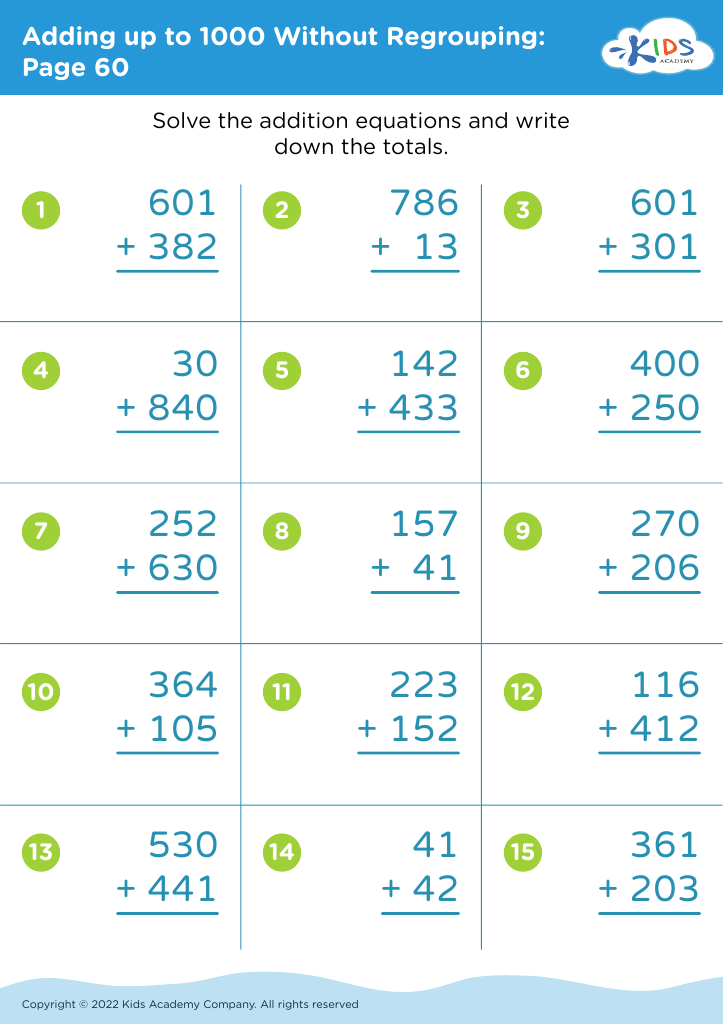


Improving counting skills and mastering addition up to 1000 without regrouping is vital for children aged 4 to 8 for several reasons. First, foundational math skills at this age set the stage for future academic success; as children develop comfort with numbers, they build confidence in their abilities. Strengthening these skills helps young learners grasp more complex concepts in higher grades, leading to greater proficiency in math overall.
In addition, solid counting skills enhance cognitive development, fostering critical thinking and problem-solving abilities. Skills like counting and adding also support other subject areas, including science and engineering, where numerical understanding plays a crucial role.
Moreover, as children progress in their education, they will encounter real-world scenarios that require basic math skills, such as budgeting, shopping, or cooking. By ensuring that children can add numbers up to 1000 without regrouping, adults are equipping them with essential life skills. Furthermore, encouraging a positive attitude towards math can help alleviate any potential math anxiety, promoting a lifelong love for learning. Ensuring that children can confidently count and add formations lays the groundwork for sound decision-making and empowers them to tackle everyday challenges confidently.