Simplifying Fractions Adding up to 1000 Without Regrouping Worksheets for Ages 4-8
3 filtered results
-
From - To
Our "Simplifying Fractions Adding up to 1000 Without Regrouping Worksheets" are perfect for children aged 4-8, fostering a strong math foundation. These engaging worksheets are designed to make learning easy and fun, helping kids grasp essential skills in fraction simplification and addition in a stress-free way. The carefully crafted exercises focus on fractions that add up to 1000 without regrouping, building confidence and proficiency. Perfect for both classroom and home use, these worksheets are an excellent resource for practice and mastering basic math concepts crucial for future academic success. Fun illustrations and clear instructions ensure kids stay motivated and enjoy learning.
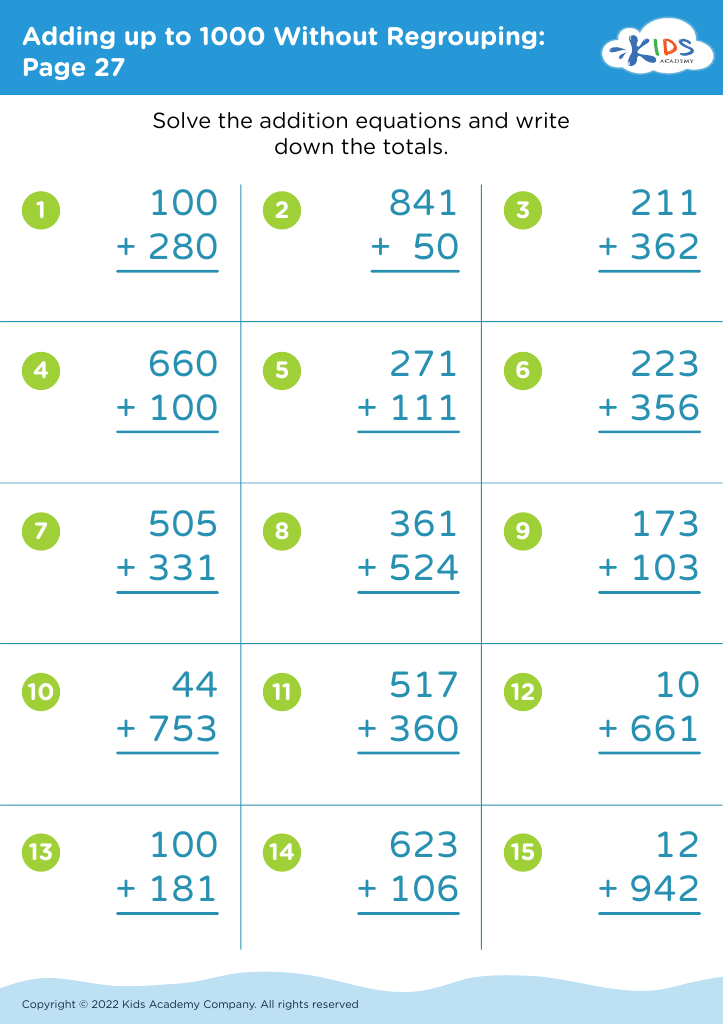
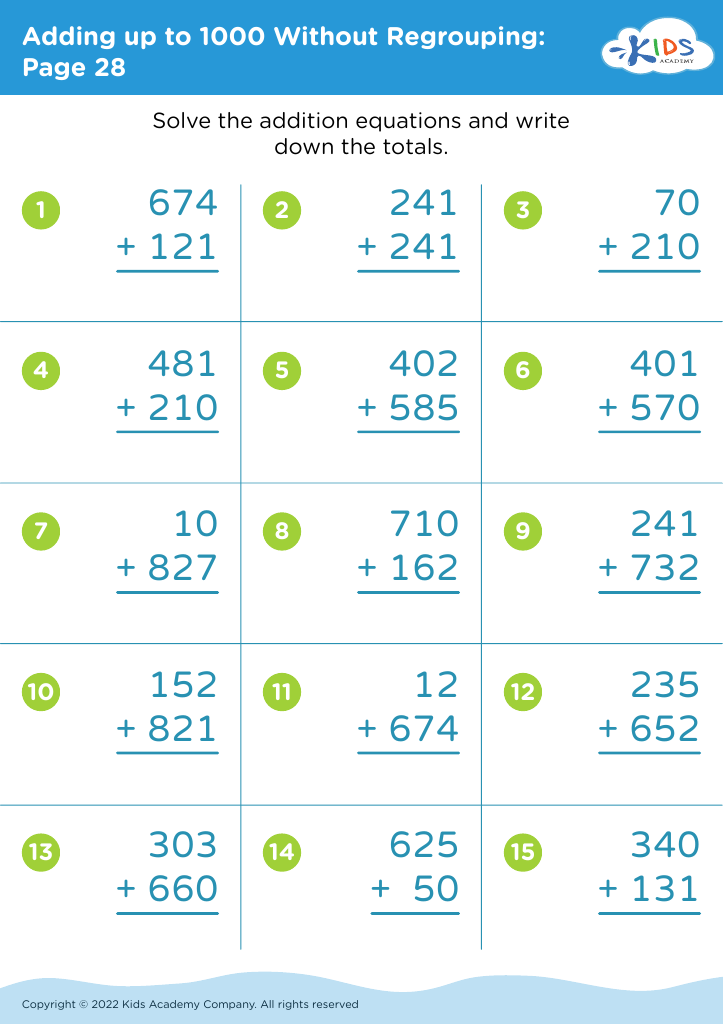
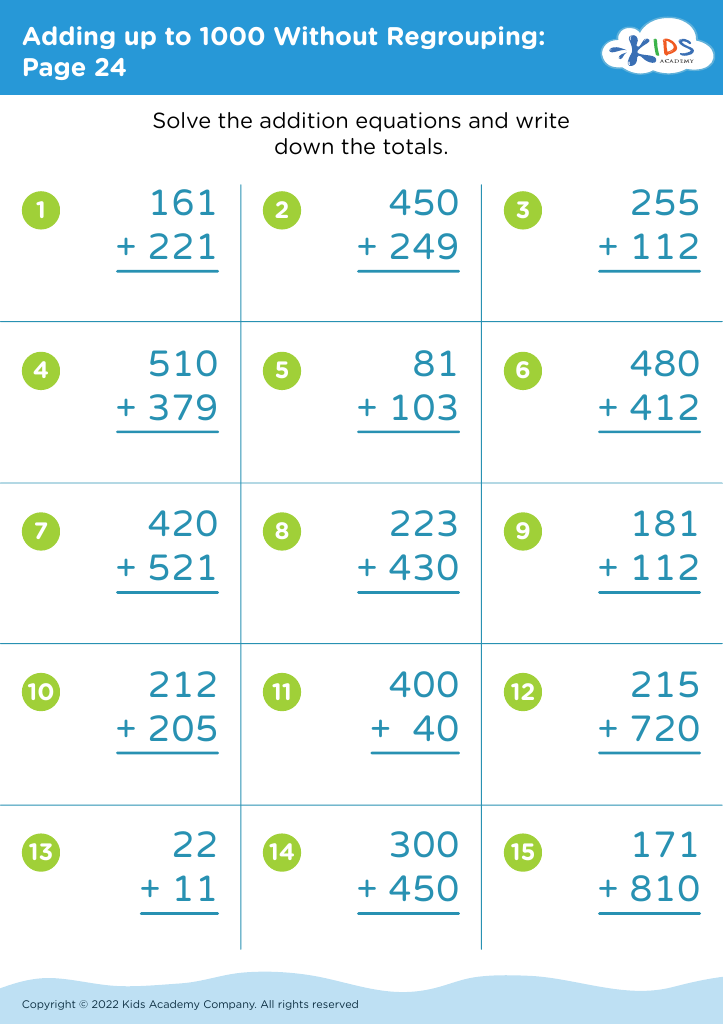


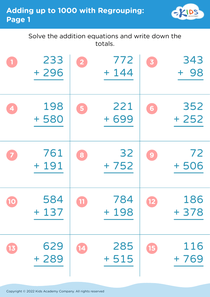
Simplifying fractions and adding numbers up to 1,000 without regrouping are foundational math skills essential for young learners aged 4 to 8. At this developmental stage, nurturing these abilities can significantly shape a child's overall numerical competency and confidence.
Firstly, simplifying fractions helps children understand part-whole relationships, which is crucial for their comprehension of more complex mathematical concepts later on. By learning to recognize simpler fractions within more complex ones, children develop a stronger grasp of equivalence and proportionality, improving their problem-solving abilities.
Secondly, adding up to 1,000 without regrouping enhances basic arithmetic skills. It reinforces place value understanding—an integral concept that underpins all higher-order math operations. Successfully adding large numbers without regrouping aids in building a solid arithmetic foundation, eventually making regrouping less intimidating and more intuitive as they advance.
Moreover, these skills foster critical thinking and persistence. As kids work through these mathematical operations, they encounter opportunities to develop logical reasoning and practical problem-solving strategies, reinforcing a growth mindset around tackling challenging tasks.
In summary, ensuring young children grasp these foundational concepts equips them with essential skills, boosts confidence, and establishes a solid groundwork for future math success, making them crucial areas of focus for both parents and teachers.