Comparing quantities Adding up to 50 Worksheets for Ages 4-8
3 filtered results
-
From - To
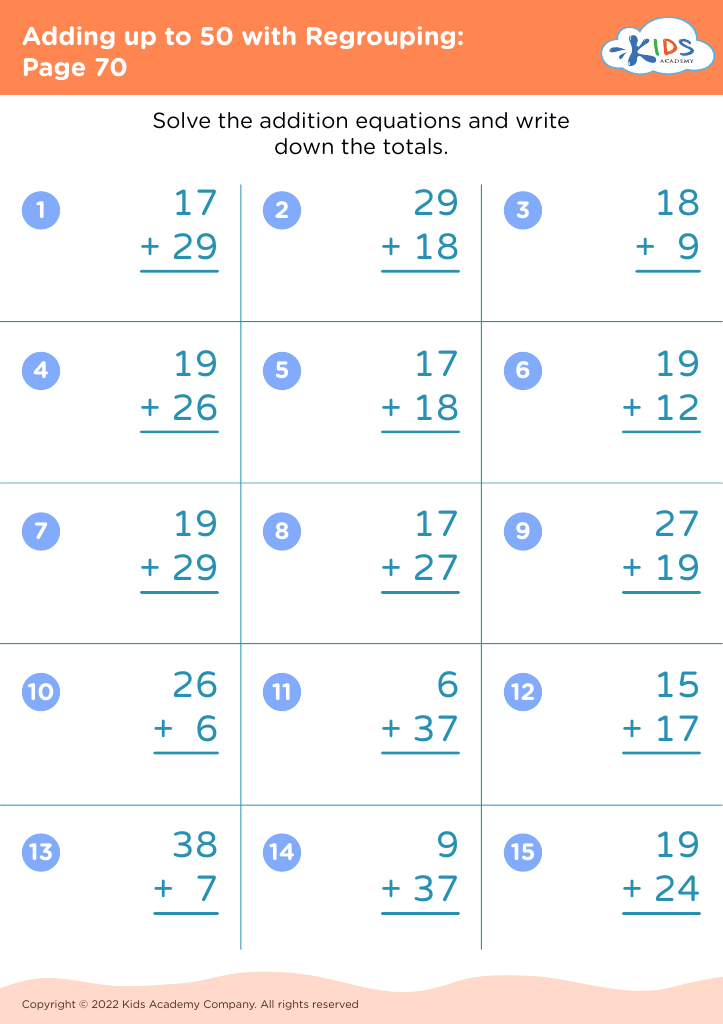
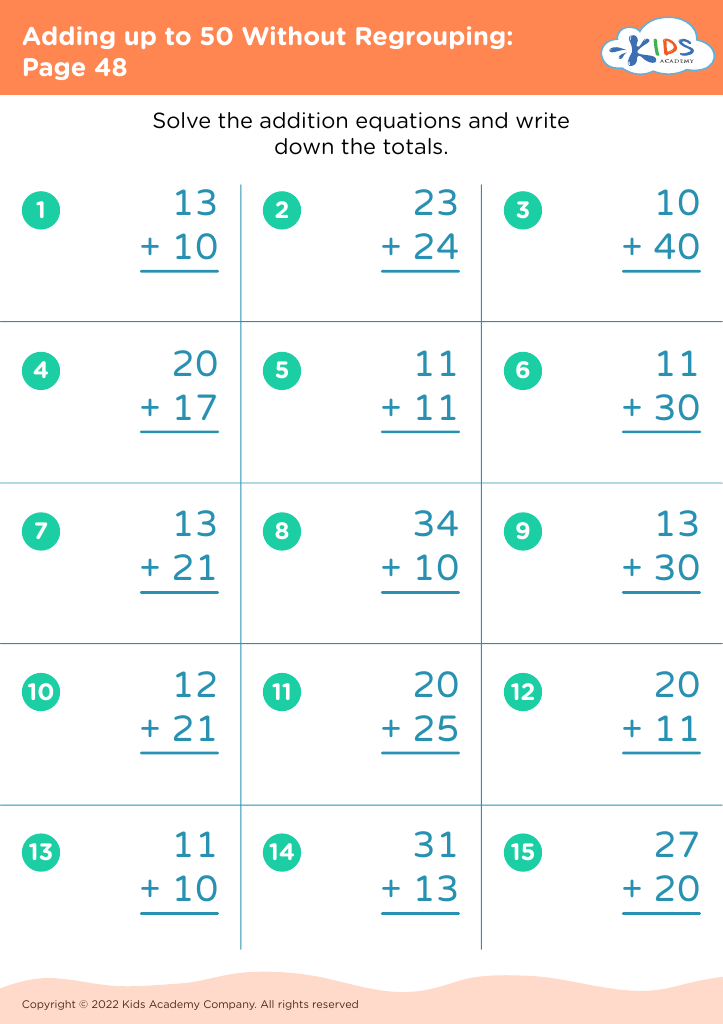
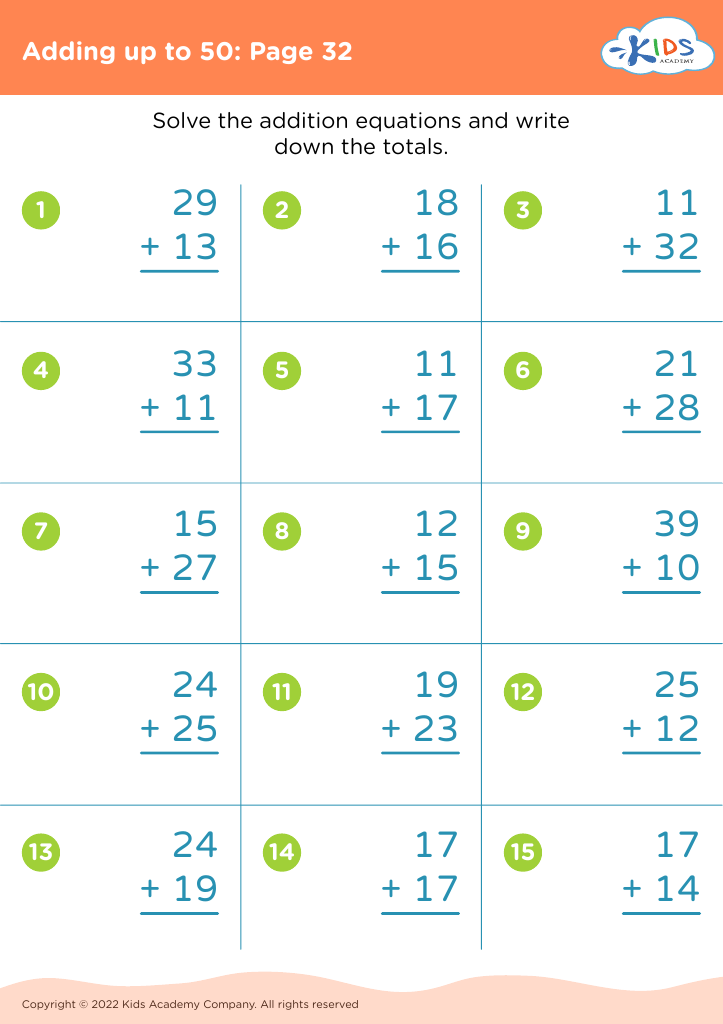
Explore our engaging "Comparing Quantities Adding Up to 50 Worksheets" designed for children ages 4-8! These specially crafted worksheets help young learners practice their counting and comparison skills while teaching them how to add numbers up to 50. Through interactive exercises, children will strengthen their understanding of quantities, develop essential math skills, and boost their confidence in number recognition. Perfect for classroom use or at-home learning, these worksheets provide a fun and effective way to promote early math proficiency. Join us today and give your child the tools they need to excel in their mathematical journey!




Understanding how to compare quantities and perform addition up to 50 is a crucial mathematical skill for children ages 4-8. At this developmental stage, children are building foundational numeracy skills that will influence their future learning. Learning to compare quantities helps children understand the concepts of more, less, and equality, which are essential for critical thinking and problem-solving. It promotes cognitive skills such as logical reasoning and decision-making.
Adding numbers up to 50 fosters an understanding of arithmetic and equips children with the tools to handle basic math independently. It supports the development of number sense—allowing children to understand the relationships between numbers and how they interact, which is fundamental for more advanced math concepts later on.
Parents and teachers should care about these skills because they not only enhance academic performance but also boost confidence in young learners. Mastery of comparing quantities and addition lays the groundwork for future success in math and associated subjects. Moreover, these skills are relevant in everyday situations; children learn to deal with money, time, and resources more effectively as they grow. Ultimately, fostering strong early math skills sets children on a path to lifelong learning and problem-solving abilities.








