Problem Solving Adding up to 50 Worksheets for Ages 4-8
3 filtered results
-
From - To
Discover our engaging "Problem Solving Adding up to 50 Worksheets," designed specifically for children ages 4-8! These interactive worksheets promote foundational math skills by challenging young learners to solve problems using addition up to 50. Each activity not only enhances mathematical understanding but also fosters critical thinking and reasoning abilities. Ideal for both classroom and home learning, our worksheets offer a fun and effective way to reinforce problem-solving strategies. With colorful visuals and age-appropriate exercises, your child will enjoy developing their math skills while gaining confidence in their abilities. Start nurturing a love for learning today with our expertly crafted worksheets!
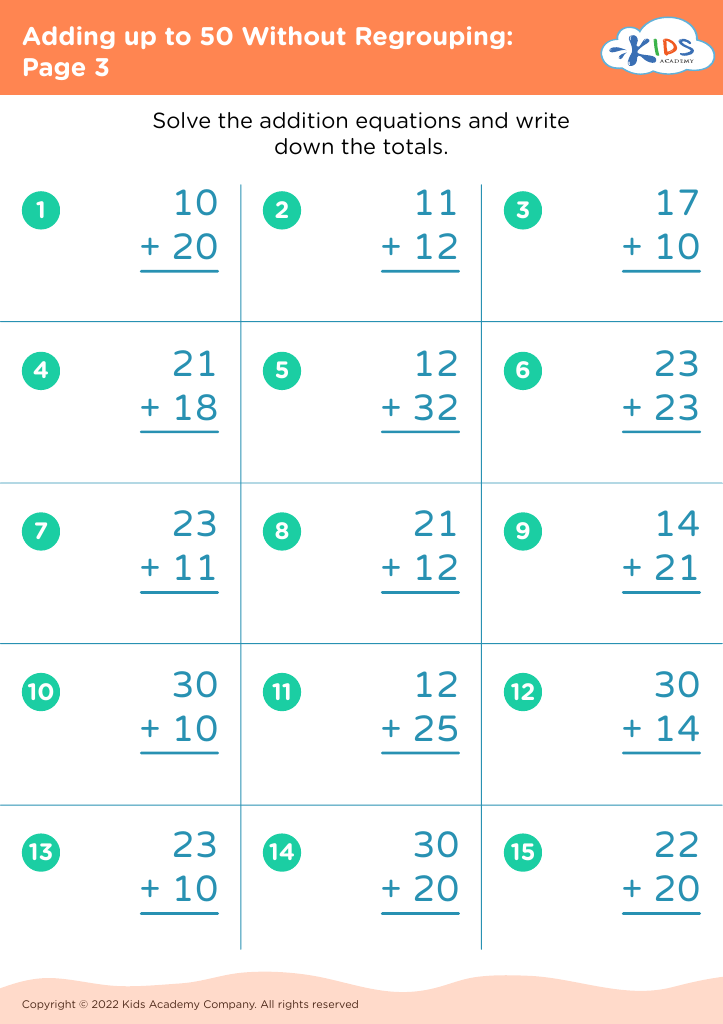

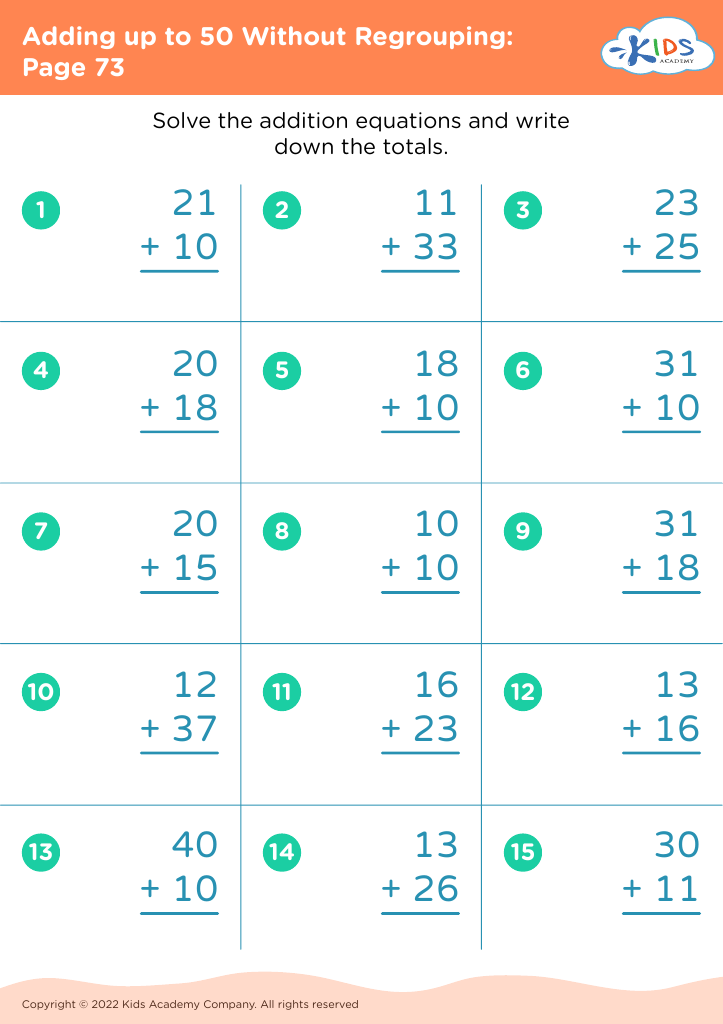




Problem Solving Adding up to 50 is essential for children ages 4-8 as it lays the foundation for crucial mathematical skills and cognitive development. At this stage, children are developing their number sense, which is vital for understanding basic arithmetic operations. Engaging in problem-solving activities helps to cultivate analytical thinking, as children learn to break down problems into manageable parts and explore various strategies to find solutions.
For parents and teachers, fostering an environment where problem-solving is celebrated helps children gain confidence in their abilities. This age group is naturally curious, making it an ideal time to introduce exciting, interactive challenges that encourage exploration and creativity. Moreover, these skills extend beyond math; problem-solving equips children to tackle everyday challenges and enhances their resilience.
Additionally, success in early mathematics can predict later academic achievement. By prioritizing problem-solving activities that involve adding up to 50, educators and parents can spur a sense of accomplishment and motivation in young learners. Engaging with numbers not only supports mathematical mastery but also promotes social skills through collaborative learning experiences and discussions on strategies. Thus, emphasizing problem-solving is vital for the holistic developmental journey of children in this age group.








