
Geography knowledge Addition & Subtraction Worksheets for Ages 4-8
4 filtered results
Difficulty Level
Grade
Age
-
From - To
Subject
Activity
Standards
Discover our engaging Geography Knowledge Addition & Subtraction Worksheets designed specifically for children aged 4-8! These worksheets combine essential math skills with geographical concepts, making learning fun and interactive. Students will explore various geographical themes while practicing addition and subtraction through colorful illustrations and relatable scenarios. Ideal for both classroom use and home-based learning, these resources encourage young learners to develop critical thinking while enhancing their mathematical abilities. Strengthen your child's knowledge of geography and arithmetic with our easy-to-use worksheets that promote a love for learning and exploration. Start the journey to mathematical proficiency and geographical awareness today!
Favorites
With answer key
Interactive
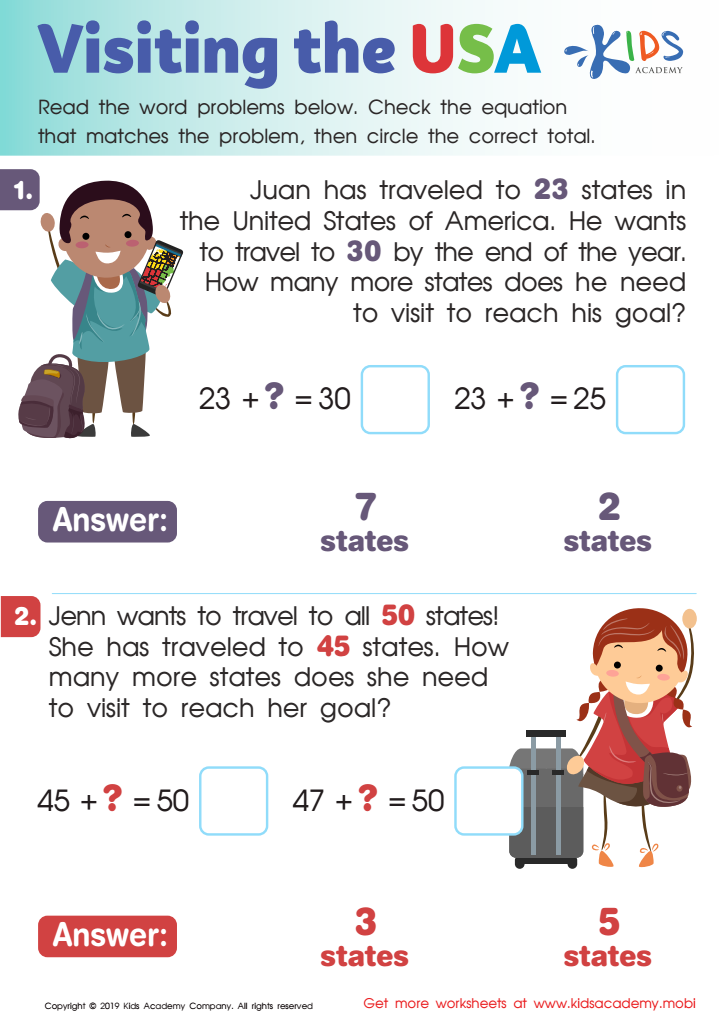
Visiting the USA Worksheet
Do your kids love travelling? Ask them why and find out what they look forward to the most. People travel for a variety of reasons, such as adventure, holiday, or business. Juan and Jenn in the picture travel for adventure and have a goal they want to achieve. Read the word problems to your kids and help them pick the right equation and match the total.
 Assign to My Students
Visiting the USA Worksheet
Worksheet
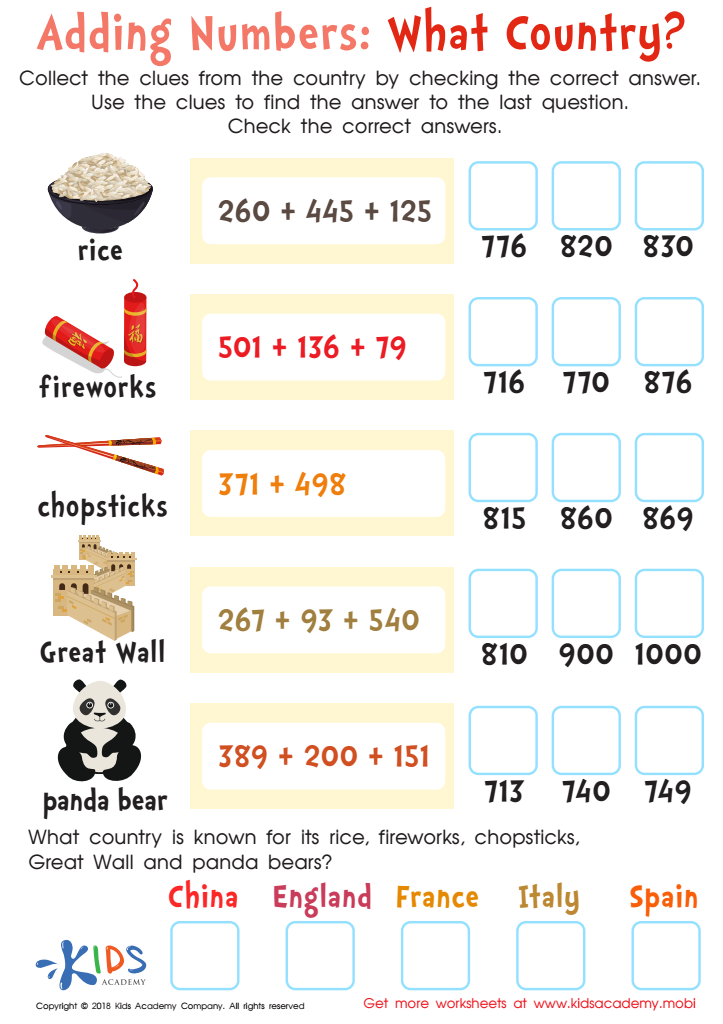
Adding Numbers: What Country Worksheet
Students can use this worksheet to learn more about different countries. Have them collect clues from the worksheet to answer the last question. Help them check the correct answer, and they'll gain knowledge about each country's food, animals, celebrations, and landmarks.
Adding Numbers: What Country Worksheet
Worksheet
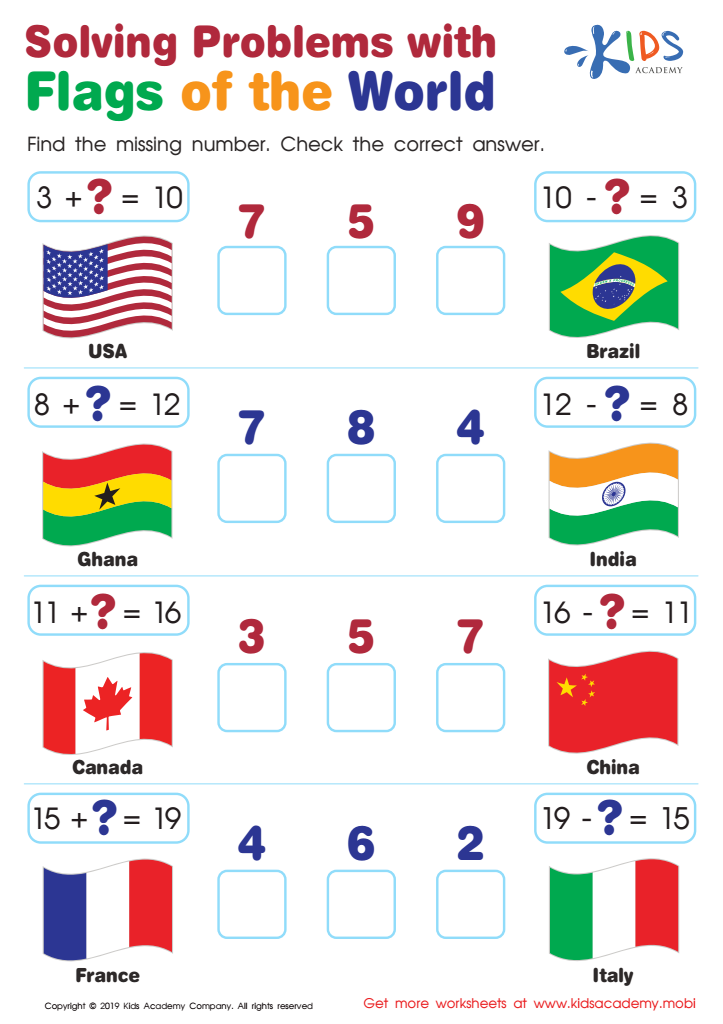
Solving Problems with Flags of the World Worksheet
Name some countries you know with your kids, then introduce their flags with this worksheet. Help them find the missing number in each addition problem, and then check the answer. It's a fun way to learn about different countries near and far.
Solving Problems with Flags of the World Worksheet
Worksheet
Join Kids Academy for Free
Who is primarily going to use this learning content?








Geography knowledge, intertwined with basic addition and subtraction, plays a crucial role in the cognitive development of children aged 4-8. For parents and teachers, fostering this interdisciplinary understanding enriches a child's education and intellectual curiosity.
Firstly, geography enhances a child's awareness of the world around them, including different cultures, landscapes, and environmental features. Understanding geographic concepts encourages curiosity about global connections, making learning more relatable when combined with math. For example, when children learn about maps, they can practice addition by calculating distances between locations, enhancing both their math skills and spatial awareness.
Additionally, integrating geography with math helps develop critical thinking and problem-solving skills. For instance, simple addition and subtraction can be applied to real-world scenarios, such as estimating the population of different countries or calculating the number of plants in various habitats—all foundational skills that are important throughout life.
By encouraging this blend, educators and parents provide children with a well-rounded education. Merging geography with math not only makes learning fun and interactive but also prepares young learners to become informed, engaged, and globally aware citizens capable of making sense of the world around them. This holistic approach ultimately fosters a love for learning that lasts a lifetime.








