
Mathematical thinking Addition Worksheets for Ages 4-8
4 filtered results
Difficulty Level
Grade
Age
-
From - To
Subject
Activity
Standards
Nurture your child's mathematical thinking with our engaging Addition Worksheets, designed specifically for ages 4-8. These easy-to-understand exercises help young learners develop foundational skills in a fun and interactive way. Each worksheet is crafted to enhance logical reasoning and problem-solving abilities while introducing key addition concepts. Perfect for both classroom and at-home learning, these resources offer a variety of challenges that cater to different learning styles. Watch your child's confidence and competence grow as they tackle and master addition through our thoughtfully designed printable worksheets. Make math enjoyable and accessible with Kids Academy!
Favorites
With answer key
Interactive
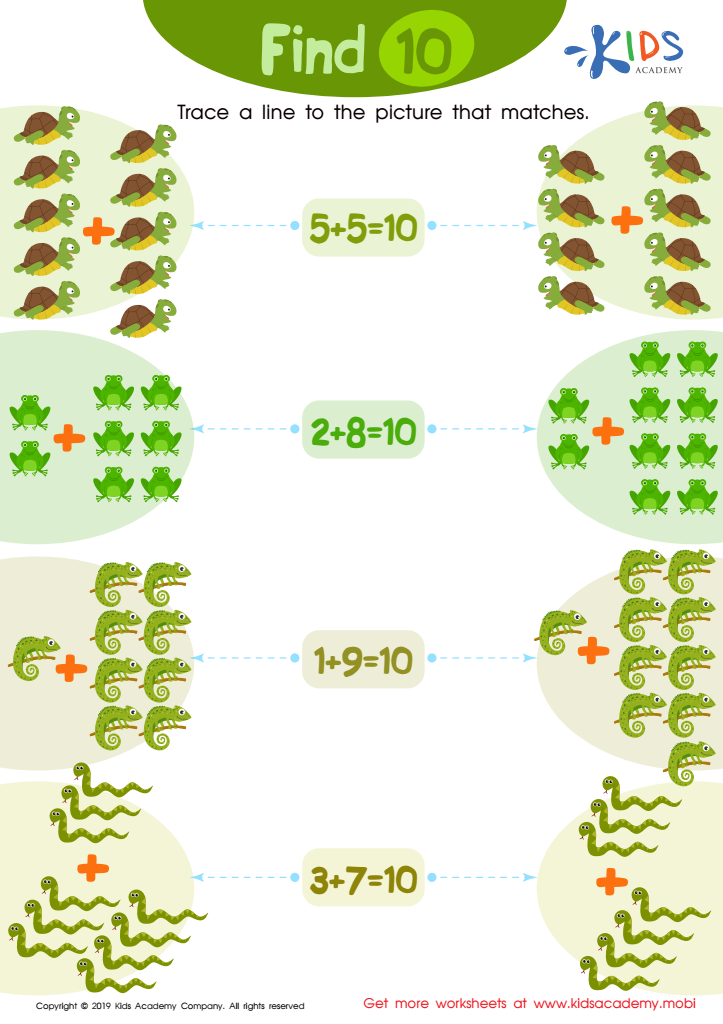
Find 10 Worksheet
Counting can be tricky, but your kids can master it with regular practice. Here's a fun activity to help: count the animals, then trace a line to the pictures that matches. With these tips, math will be an easy walk in the park.
 Assign to My Students
Find 10 Worksheet
Worksheet
Join Kids Academy for Free
Who is primarily going to use this learning content?








Mathematical thinking, specifically addition, is crucial for children aged 4-8 as it forms the foundation of their future mathematical learning and problem-solving skills. During these early years, children's brains are highly receptive to new information, making it an ideal period to introduce and solidify basic math concepts.
Understanding addition helps children to develop number sense, allowing them to recognize relationships between numbers and how they interact. This basic arithmetic skill sets the stage for more complex mathematical concepts like subtraction, multiplication, and division that they will encounter later in their education.
Moreover, grasping addition at an early age helps enhance children's cognitive abilities, including their logical reasoning and critical thinking. It encourages them to think systematically and approach problems methodically, skills that are transferable to other areas of learning and everyday decision-making.
Furthermore, early proficiency in addition boosts children's confidence in their mathematical abilities, leading to a positive attitude toward the subject. This is vital, as a positive early experience with math can significantly influence their performance and interest in the subject throughout their schooling.
Lastly, early mathematical thinking supports the development of social skills. Collaborative activities involving addition foster teamwork, communication, and the ability to work through challenges together. Therefore, parents and teachers should prioritize mathematical thinking to ensure a well-rounded, confident, and prepared young learner.








