
Observation skills Addition Worksheets for Ages 4-8
3 filtered results
Difficulty Level
Grade
Age
-
From - To
Subject
Activity
Standards
Enhance your child's math and observation skills with our engaging Addition Worksheets for Ages 4-8. Developed by education experts, these printables blend fun and learning seamlessly, helping young learners master both basic addition and keen attention to detail. Each worksheet is carefully crafted to encourage critical thinking and precision, featuring vibrant illustrations and varied exercises that captivate kids' imagination while sharpening their mathematical abilities. Perfect for at-home practice or classroom use, our worksheets are designed to support and complement early education curricula, ensuring your child builds a strong foundation in math and observational expertise. Download now and watch their confidence soar!
Favorites
With answer key
Interactive
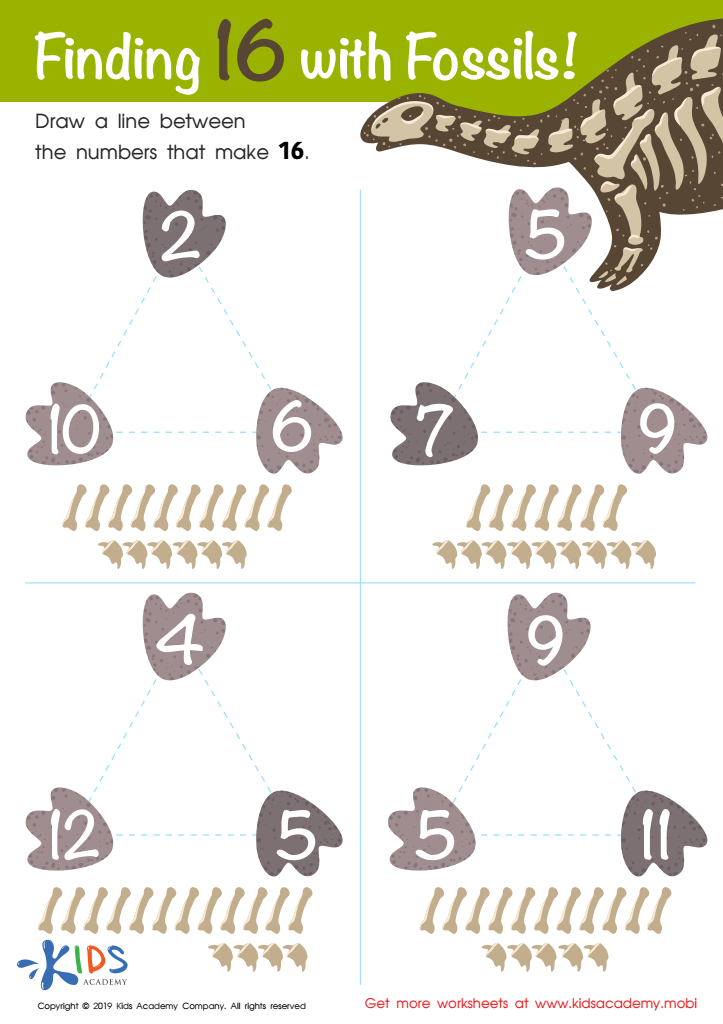
Finding 16 With Fossils Worksheet
Experts hunt for fossils, dig them up, and study them to learn more about past life forms - how they lived, what they looked like, and when they lived. Show kids the picture in this worksheet and point out the fossils. Help them count the bones and draw a line between the numbers that add up to 16 in each triangle.
 Assign to My Students
Finding 16 With Fossils Worksheet
Worksheet
Join Kids Academy for Free
Who is primarily going to use this learning content?




.jpg)



Observation skills are crucial for children aged 4-8 as they lay the groundwork for future learning and development. For parents and teachers, fostering these skills should be a priority because they significantly influence a child's cognitive, emotional, and social growth.
Firstly, observation skills enhance intellectual capability. When children attentively observe their surroundings, they absorb new information, learn to make connections, and develop critical thinking skills. This ability helps them understand concepts better and solve problems effectively.
Socially, keen observation helps children understand social cues, emotions, and behaviors, which are fundamental for building strong relationships. They learn empathy and cooperation by noticing how others feel and react.
Emotionally, being good observers enables children to become more self-aware. By paying attention to their own behaviors and the responses they provoke in others, children can better manage their emotions and actions.
Additionally, observation skills boost academic performance. Children who observe attentively are more engaged in classroom activities and more likely to pick up on details during lessons, leading to better retention and comprehension.
Therefore, incorporating activities that promote keen observation—such as nature walks, science experiments, and storytelling—can be incredibly beneficial. Parents and teachers hold the key to unlocking these critical observation skills, shaping well-rounded, perceptive, and adaptable children.








